
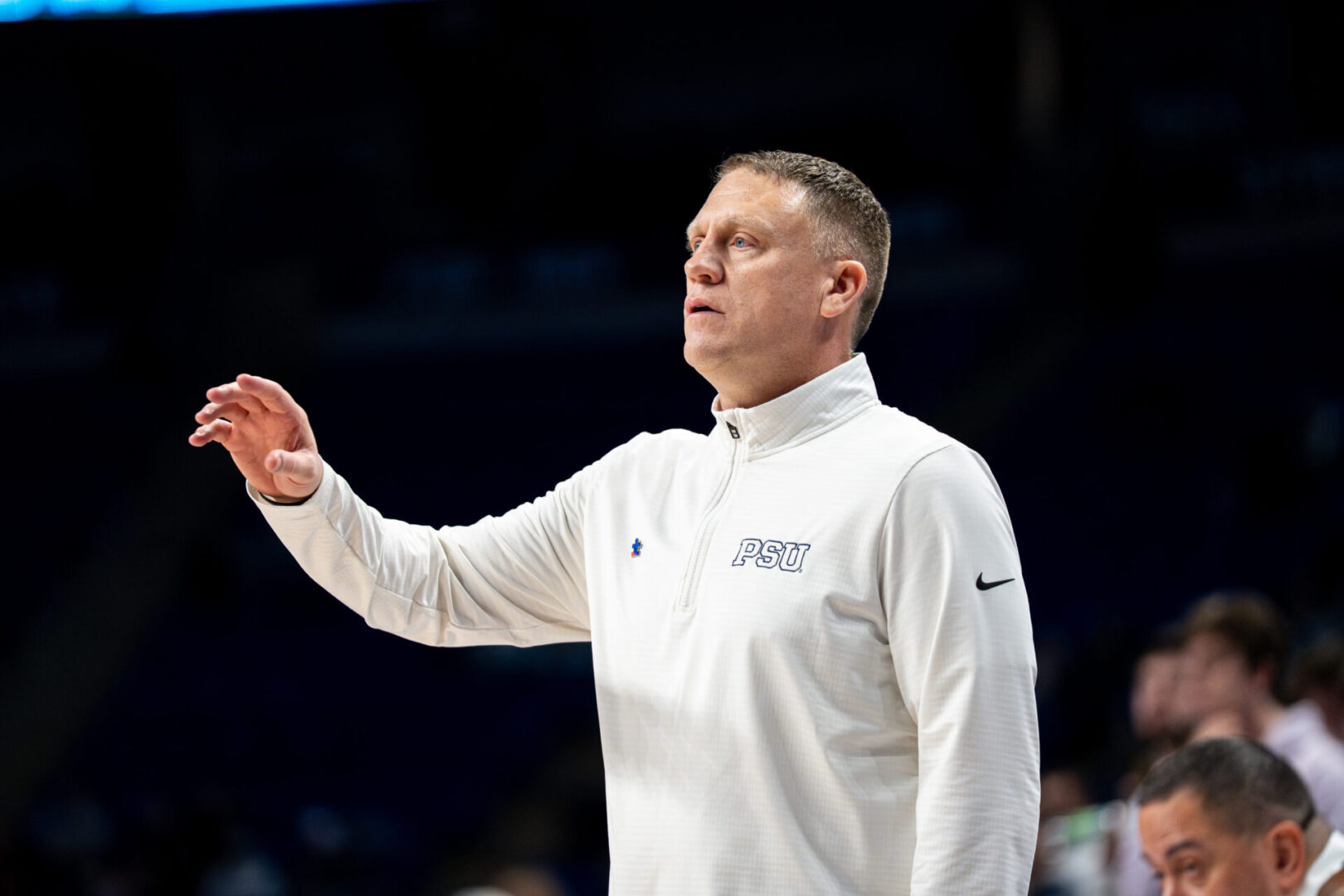
Penn State has never been considered a basketball school by any means, but even so, the last five months have been brutal for fans of the program.
As the losses piled up for the Nittany Lions throughout Big Ten play, so did the calls for head coach Mike Rhoades’ dismissal from the program. I get it. As someone who watched nearly every minute of the season, there were moments where it seemed like Penn State would be better off disbanding the basketball program and funneling the money into football instead.
Here are a handful of excerpts from stories I wrote throughout the year:
Jan. 22: “The Badgers dominated from start to finish in a 98-71 rout, including scoring streaks of 14 and 13 points in the first half alone, in an ugly outing for head coach Mike Rhoades’ squad.”
“After a particularly embarrassing stretch which included seven missed shots in a row, Rhoades called a timeout with his squad trailing 35-17 — it didn’t help, as the team missed four more shots out of the break and fell into a deeper deficit.”
Feb. 18: “The opening three minutes featured a comical string of mishaps by the Nittany Lions, who fell into a 9-0 hole before Rhoades burned his first timeout of the game. Out of the break, Penn State dropped to 0-for-6 from the field with four turnovers before Kayden Mingo scored a mid-range jumper to avoid the shutout.”
March 4: “Penn State went on a drought out of the break, finding every possible way not to score, including turnovers, missed shots, stepping out of bounds and an offensive foul as the Buckeyes extended their lead to 23-9.”
In other words, this season wasn’t just bad — it was frequently ugly, and there’s no way to defend that. And when losses pile up, it’s natural for the conversation to turn toward the future of the head coach.
Athletic director Pat Kraft has shown a short fuse when it comes to head coaching changes. In this athletic year alone, Penn State has parted ways with James Franklin (football), Lisa Bervinchak Love (field hockey) and Carolyn Kieger (women’s basketball) for underperformance.
But Rhoades shouldn’t join that list, at least not now.
In the modern landscape of college athletics, it’s easy to call for change after a losing season. Fans understandably feel frustration when results don’t meet expectations. But a disappointing year shouldn’t erase the broader context of where the program is and what Rhoades is trying to build.
- The bigger picture
Rhoades has made it clear he intends on building Penn State into a more competitive basketball program, which hasn’t been an easy task for any coach. But it’s important to separate this year’s team from the overall program.
Let’s call it like it is: Nittany Lion basketball has no history, no culture, no identity and no recruiting infrastructure.
Whether it was Randolph-Macon, Rice or VCU, Rhoades has been a program-builder at every previous stop, a large part of why he was hired in the first place. That’s something that requires time, and he’s been adamant about wanting to build something in Happy Valley.
His first year was a solid starting point: 16-17 with a 9-11 conference record in a transition year, including wins over No. 11 Wisconsin and No. 12 Illinois. Last year, there was a slight improvement to 16-15, including wins over No. 8 Purdue and No. 12 Wisconsin. Plus, the team went 3-11 in games decided by single digits, showing it was closer to a better finish than its record suggested.
This year was undoubtedly a step backward, but coaches who succeed at Penn State typically do so by building foundations — player development, continuity, and a recognizable style. Pulling the plug now would only reset the cycle yet again.
While nothing is confirmed, Mingo hinted at a return to the program next season after the Big Ten tournament loss, and other key players like Ivan Jurić and Freddie Dilione V will likely stay. Whether it was Yanic Konan Niederhauser, Ace Baldwin Jr., Nah’Shon Highland, Vince Williams Jr. or Justin Tillman, Rhoades has shown an ability to develop talent. With a majority of this year’s team expected to return and three-star forward commit Jamison White arriving, a couple additional transfers could lead a quick turnaround next season.
- Bump in the road
This may seem like a lot of excuse-making, but there are several explanations for why the 2025-26 season went off the rails, which makes this year feel more like a one-off than a consistent pattern.
For one thing, Rhoades and others expected Konan Niederhauser to return this season, which would’ve completely changed the complexion of a team that desperately needed help at forward. Instead, he became the first first-round pick in program history (that seems like pretty good development for an unranked recruit out of high school).
The Nittany Lions were also the youngest team in the Big Ten this season, and one of the youngest in the power conferences, which creates an uphill battle in a sport increasingly dominated by veteran-laden rosters.
Add to that the injury struggles the team faced, losing Kayden Mingo, Ivan Jurić, Freddie Dilione V and others at different times throughout the year, and personnel quickly became a glaring issue.
On top of that, the Nittany Lions lost to No. 9 Michigan State by four points, No. 20 Illinois by eight points, No. 2 Michigan by two points and No. 5 Purdue by eight points — a win from this group of games wouldn’t have changed the overall trajectory, but it would’ve made the year feel far more respectable.
- Adaptability
Between NIL deals and the transfer portal, rosters can flip dramatically in a single offseason. That volatility means a bad season doesn’t necessarily signal a broken program.
Rhoades made it clear after the team was eliminated in the Big Ten tournament to end its season that he would be making adjustments this offseason.
“I’ve always reevaluated everything I do and what we do in the program, and I’ll do that again,” Rhoades said. “I know that works. And you know, it’s been a tough stretch. This is a hard, hard job, but it’s pretty awesome too, to be in a Big Ten and trying to figure it out at the place we’re at.”
- Fit
Coaching hires aren’t just about wins and losses; they’re about alignment. Rhoades understands the region, recruits the Mid-Atlantic well and embodies the workmanlike mentality Penn State prides itself on.
He’s known for player relationships, defensive intensity and building locker-room culture. Those are exactly the qualities a program like Penn State should prioritize if it wants sustainable success rather than fleeting tournament runs.
One of his biggest accomplishments was landing a commitment from Kayden Mingo, the highest-rated recruit in program history. The Nittany Lions were also a finalist for his younger brother Dylan Mingo, who landed at North Carolina instead.
Recruiting stars don’t necessarily equate to wins, but acquiring talent is one of the most important parts of the job, and Rhoades has shown some ability to do so, even with an NIL budget that presumably pales in comparison to Big Ten peers.
- He’s not James Franklin
Perhaps the best argument I have for why Rhoades deserves more time at Penn State is the glaring difference between him and James Franklin, who both had similar losing streaks once conference play began. As someone who also covered the football team this fall, one difference stands out: the willingness to confront the problem head-on.
When asked if he still wanted to be the head coach at Penn State, Franklin went on a nearly two-minute rant about how he “understands” the frustration but was committed to his players — completely failing to actually answer the question.
The lack of a definitive answer was on par with other statements he made throughout the losses to Oregon, UCLA and Northwestern. There was a certain lack of accountability, and almost a hostility toward fans or reporters who questioned the state of the program, rather than introspection or any signifier of changes to be made.
For all of Rhoades’ shortcomings this season, he’s made it very clear that he wants to be at Penn State and is willing to put in the effort to succeed. Here are some of his statements after losses this season.
“Yeah, I’m gonna coach my butt off. Go as hard as I can. Wake up tomorrow, work hard, work harder than I ever have. Just keep going, keep coaching.”
“This right now sucks. My staff and I will give every piece of every fiber we have to try to right this ship and do this right. I know what I’m doing, but we’re behind the eight ball. We’re not good enough. I get it.”
“I wanna win, I didn’t come here to do this bulls—, I wanna win. I don’t care if it’s a one-point game or 30-point game … I hate to lose, and I don’t want being close to be OK. Screw that. We didn’t come here to be close.”
“Since I’ve been here, we’ve had some really good wins. We just don’t have enough, and that’s got to be the goal.”
“Cause I care. I’m going to fight. There’s some things we got to deal with. We’ll deal with them. Try to keep building the program. It’s a different landscape than it’s ever been before, so you just got to continue to respond in different ways to it and fight for your program and keep pushing.”
“You just fight like crazy. This sucks. I’ll be up all night trying to figure it out, and we’ll go right back at it. We got to change some things. We got to fix some things.”
“Building a program is really, really hard. Building a program at a place that doesn’t have much basketball tradition is even harder, but I signed up for it man, and I believe in myself. I believe in how we do things. Some of you guys may not. I don’t really care. I never cared before, but I’ll figure it out. It might kill me, but I’ll figure it out.”
Rhoades has already done some notable things at Penn State: landing the highest-rated recruit in program history, producing the first first-round draft pick in program history, producing the highest-scoring team in program history (79.1 points per game in 2024-25) and beating four conference opponents ranked in the top 15.
There’s still a lot of work to be done, and this season was largely unacceptable — even by Penn State standards. But Rhoades has made it clear he’s committed to doing that work, and his track record shows he’s capable of it. More support, whether its an increased NIL budget or higher attendance at home games, wouldn’t hurt either. One down year — especially when the team was picked to finish last in the conference in the preseason — shouldn’t erase that.



