
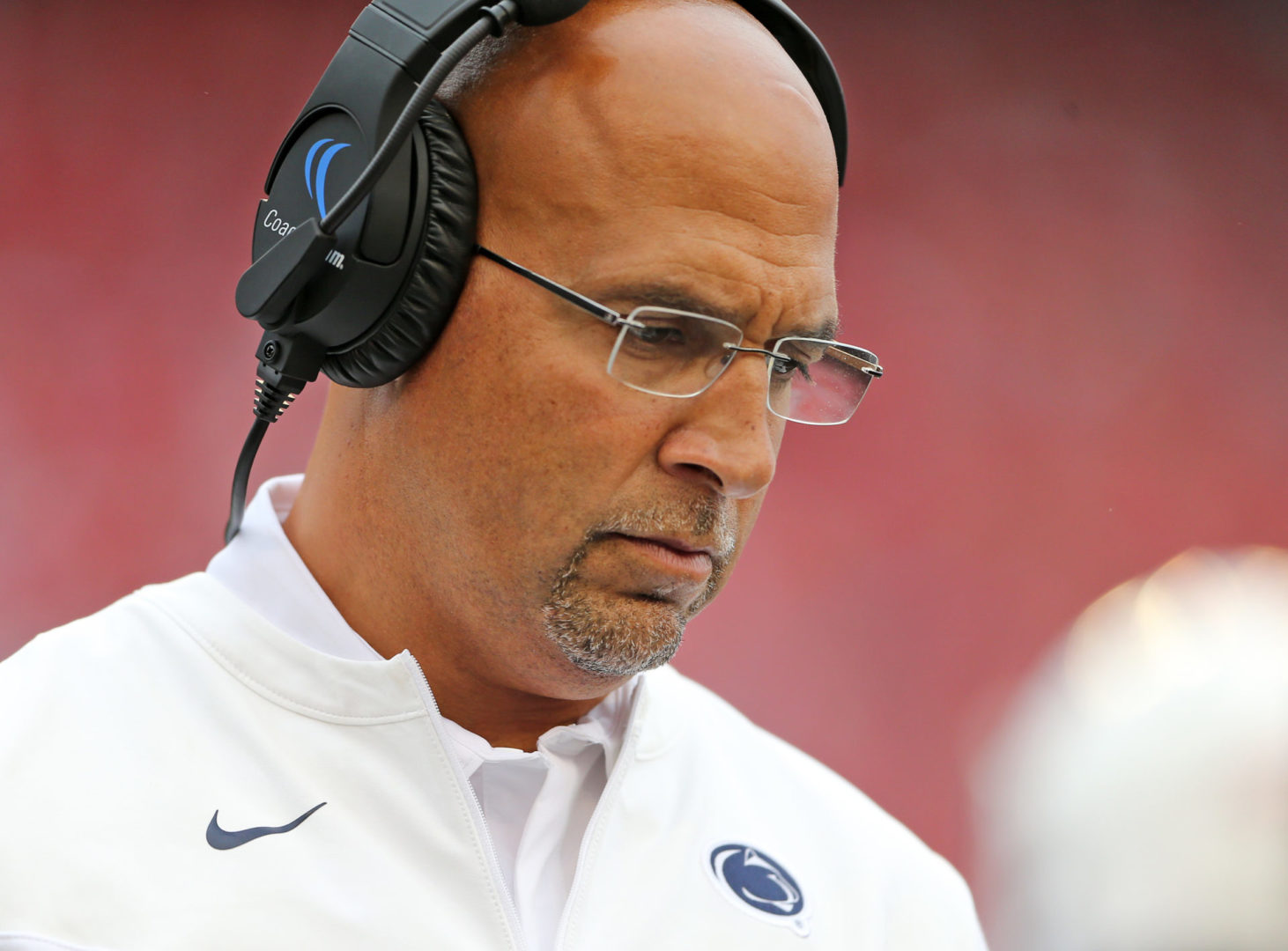
Let’s start with the mistake right off the bat.
When talking about spending millions of dollars on facility upgrades and the various bells and whistles on James Franklin’s wish list, people view those things as a transactional reward given to Franklin. If he does this, then he earns that.
In lieu of certain kinds of success, many seem to see the things Franklin wants as compensating for his own shortcomings. If he can’t solve the problem on his own, he can simply blame something antiquated inside the Lasch Building rather than himself.
The truth isn’t that simple.
Yes, Franklin has to be better. It’s his job to find a way to win in a world where things are never perfect. When the obstacles are minimal, Franklin has turned the Nittany Lions into one of the foremost non-playoff powers in the country (and in fairness Penn State should have made the playoffs in 2016).
When things don’t quite go Penn State’s way, Franklin hasn’t steered the Nittany Lions through those choppy waters with nearly as much ease. Maybe that’s just how it works because that’s what makes obstacles hard, but a coach of Franklin’s stature is supposed to be the equalizer in moments of peril. Even if that expectation is perhaps a few notches too high on the occasions when fate has other plans.
That said, it doesn’t mean Franklin is wrong to want what he wants.
There is a perception in some corners of the Penn State universe that the Nittany Lions are the one program in America that can win a national title despite being behind on various aspects of the arms race or the overarching student-athlete experience. Forget the fact Alabama, Clemson, Ohio State, Oklahoma and others have set trends for the better part of the last decade, and forget the fact they’ve had more success than everyone else. Forget the fact they recruit better than everyone else and subsequently have the better players in nearly each and every game.
Forget reality – Penn State doesn’t need to invest; it doesn’t need to change. Penn State is Penn State. That’s what people say, and these are the results they get. Great but not quite elite, living off a dwindling cache of success that survives by virtue of its own massive existence in a recruiting footprint that is dwarfed by that of its biggest existential rivals.
Thinking like that is how Texas turned into Texas and how USC turned into USC. Moving on for greener grass that didn’t exist is what turned Nebraska into Nebraska. Its why resting on your laurels is never enough. Thinking like that is what has left Penn State’s last national title decades in the past and its only Heisman winner even farther behind.
That brings us to the question at hand: what is Penn State football?
It’s the question that Franklin has alluded to for the better part of the past few years. Penn State can be the program it is at the current moment — it responds to trends, it competes with its rivals and it manages to cycle through a playoff chance and a Big Ten title run from time to time. That is still better than most. But its current claim to fame is “almost.” Penn State is “almost” what it wants to be, “almost” what it can be. But it has yet to truly change.
Penn State can continue to be all of this. There are worse things than being “almost” because that leaves options like “never” and “maybe one day.” There is no rule that says Penn State has to be elite. Most everyone isn’t and it’s just football after all. Penn State deciding to be what it is isn’t a morality question, it’s simply accepting that the price tag is too high.
Or Penn State can decide to pony up and put its money where its mouth is both in how it approaches the program and the physical structures that support it.
And that’s why this isn’t really about James Franklin. Sure, maybe some coach out there is going to be slightly smarter with what Franklin already has or might be slightly more crafty on fourth-and-5, but it won’t change the fact Penn State was still facing a fourth-and-5 against a team with better players and more talent. It won’t change the fact that Penn State has to play perfect when it faces Ohio State instead of simply playing well. The Buckeyes rarely dominate games in the series anymore, but they rarely face the same margin of error as the Nittany Lions. Ohio State has to play well, Penn State has to play great.
This isn’t a mistake in a game dictated by players. Joe Moorhead was/is great, but his players in 2016 and 2017 made that team what it was.
This leaves Penn State at a crossroads. Franklin will have to earn his paycheck, but Franklin has also done better than most would have imagined when he was hired nearly a decade ago. Some tend to forget the Nittany Lions were nuked into the stone age by the NCAA and then nearly made the playoffs, won the Big Ten and had a No. 2 overall NFL Draft pick just a few years later.
There isn’t a white knight over the hill right now, and even if there was he would ride into town and tell everyone the same things Franklin has been saying for years. “Things here are great, but if you want to win they’ll have to be better.”
That’s why these investments and fundamental changes aren’t about Franklin, because Penn State will eventually realize that these things make a difference in a game dictated by players and the variable in this equation – players – won’t change with a different coach. College football is a personnel game and it’s not a mistake the nicest places have the best players. Penn State isn’t the program to buck the trend because that’s not how the game is played.
As for Franklin’s own future, continuity is the name of the game and the fact of the matter is Franklin would be a leading candidate for the Penn State job if he didn’t already have it.
That brings us to the biggest question of all: if James Franklin wasn’t Penn State’s head coach, would he want the job right now? And if he did, would he want it for what Penn State is, or for what it could become?
And if the answer to that question is no – or the answer is for what Penn State could become – perhaps the overarching problem isn’t the coach. Even if that coach isn’t perfect.
More Local & Penn State Sports
View all Local & Penn State Sports
It’s Time for a Major Overhaul of College Football
After the Kiffin saga at Ole Miss, college football broke through another barrier. But it was an unforced error because of the current structure and calendar supposedly governing the sport. […]
State College Spikes Announce 2025 Promotions and Theme Nights
The State College Spikes announced their 2025 lineup of theme nights, giveaways, promotions and events ahead of the upcoming season. From Elgses Night to Star Wars Night to Yellowstone Night, […]

Penn State Wrestling Downs Illinois to Claim Big Ten Regular Season Title, 70th Consecutive Dual Meet Victory
No. 1 Penn State wrestling (13-0, 7-0 Big Ten) powered through No. 13 Illinois (9-3, 4-3 Big Ten) 29-9 on Sunday in Champaign, Illinois, to secure its fifth consecutive Big […]


