

Colombia is the world’s third largest producer of coffee, after Brazil and Vietnam. The rich volcanic soil in the arid mountains of the country produces ideal conditions for growing high-quality coffee. Colombian coffee is known to be among the best in the world, with a rich, full-bodied, and perfectly balanced taste.
No one knows exactly when coffee arrived in Colombia, but some think the bean came with Jesuit priests in the seventeenth century. The first shipment of coffee overseas was in 1835, when 2,500 pounds of coffee headed from Colombia to the United States. By 1875, Colombia was exporting 170,000 bags to the US and Europe. In 1992, exports of coffee topped at 17 million bags and are currently around 11 million bags per year.
Since March, locals and visitors in State College have enjoyed a cup of Colombian coffee at Barranquero Café, located at 324 East Calder Way. Owners and State College natives Susan Jermusyk and her uncle, Gerry Kistler, were inspired to open the coffee shop after visiting Café Jesús Martín in Colombia in 2010.
Named after a colorful Colombian bird, Barranquero Café’s rustic, industrial décor is inspired by the small coffee shop in Colombia. Colombian artwork on the walls welcomes families and coffee enthusiasts alike. The mezzanine, tucked away on the second floor, invites customers to play board games and learn about Colombia and its coffee.
Barranquero Café offers 10 different brews of Colombian coffee as well as teas made with the coffee shells.
“Each of the different coffees, from the Diamante, Bourbon, Peaberry to the Honey and Natural, have their own distinct flavor profile, which we have listed at the front for people to look at when they are deciding on what to order,” says Jermusyk. “The Honey and the Natural are not traditionally processed coffees. For the Honey, harvesters take the fruit off but leave the sweet nectar on, and then it is laid out to dry. For the Natural, the whole fruit is laid out to dry in a greenhouse for 45 days, and then it is kept in a sack for eight months before it is roasted.”
Jesús Bedoya, owner of the Café Jesús Martín, grew up in the Santa Ana Valley — known as the Coffee Triangle of Colombia — on a coffee farm owned by his father and grandfather.
“The farm has been in the family for five generations, over 100 years old, but Jesús was the first in the family to roast the beans,” explains Jermusyk.
Café Jesús Martín is the sole coffee supplier of Barranquero Café. Its coffee beans are subject to high-quality controls during the whole process, starting with paying its harvesters a fair wage. The coffee beans are handpicked, so each fruit is picked at the correct ripeness. At other farms, when machines are used, all the fruit is stripped from the plant, so under-ripped fruit is picked in the process. The beans from Café Jesús Martín also are roasted in small batches, so it’s a more even roast.
“I never thought growing up I would be a coffee drinker, but this coffee has a natural sweetness because it’s a medium roast. What people don’t realize is that the longer you roast the beans, the more flavor you burn, so darker roasts have more bitter flavors,” explains Jermusyk.
Barranquero Café serves hot-brewed and cold-brewed coffees. Most people are familiar with hot-brewed coffee, but the cold brew is a unique process in which water is dripped through coffee grounds at room temperature over the course of many hours, usually overnight. The coffee grounds aren’t subjected to the intense heat of boiling water, making the chemical profile of the final brew different than that of conventionally brewed coffee, and the lower acidity creates a smoother cup.
“We want people to have a coffee experience, so we encourage people to ask us about the coffee and smell the grounds,” says Jermusyk.
At Barranquero Café, in addition to an Americano, macchiato, cappuccino, and latte, there are a few unique specialty espresso drinks on the menu. A campesino is a single shot of espresso with warmed agua de panela, an infusion made from dissolved sugarcane. A tinto is a single shot of espresso and water, a very popular drink in Colombia. Angela’s Vietnamese is a drink created by Bedoya’s wife and is a layered beverage that consists of condensed milk and a single shot of espresso.
Jermusyk says, “We just added the affogato, a scoop of Penn State Creamery vanilla ice cream, and a single shot of espresso.”
The food menu includes a variety of meat and black bean empanadas, pan de queso, coffee brownie, and muffins.
“We had no idea that there was such a large Latin American community here until we opened, so we are working on adding arepas and other Colombian foods to the menu,” says Jermusyk. “We are lucky to have found Milena Zamora, who is originally from Bogotá, Colombia, who came up with a lot of the recipes.”
For more information, visit barranquerocafe.com.
More Spot 4
View all Spot 4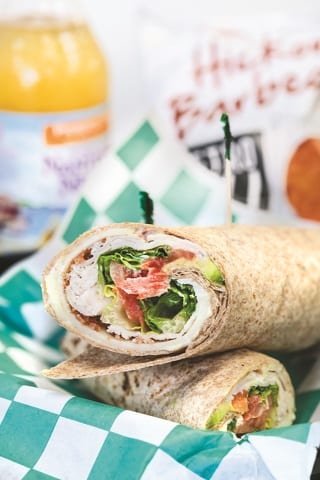
Taste of the Month: Featuring freshly-made wraps and melts – and a variety of ice cream flavors – Happy Wraps has found a home in Bellefonte
There’s usually a reason why people pass through a small town and never leave. For some, it’s the charm of walking down the street and knowing everyone who passes by, […]

Neighbor to Neighbor: Adapting, and Adopting
Life during COVID-19 takes some adjustment. When the pandemic began, we were all staying home as much as possible, no longer going to the movies or restaurants, even ordering groceries […]
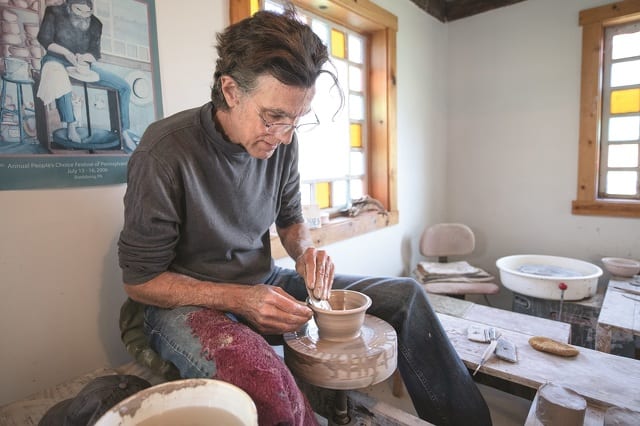
Creativity at the Wheel: For Scot Paterson of Aaronsburg Pottery, art begins with a pile of clay and an appreciation for his customer
You can find Scot Paterson on any given mid-morning strolling out to his self-renovated backyard workshop, finished off with reclaimed barn siding. The reflective bright blue hues of glazed mugs […]


