

Last Friday I delivered my “Take Charge of Your Life” presentation in Brother Matthew Hershey’s freshman theology classes at the Benedictine Military School in Savannah, Georgia. Matt is a State College native who graduated from St. Vincent Seminary in Latrobe. His father, Bob, and my wife, Heidi, worked together for 25 years at Meiser and Earl, Inc. a consulting firm in State College that specializes in hydrogeology. Bob and his wife, Mary, a former State High Chemistry teacher, sat in on the first class along with Heidi.
I asked the freshman cadets, “Who knows exactly what they want to be?” This one very self-confident young man immediately threw up his hand and said with complete self-assurance, “I am going to be a welder.” Now that was a refreshing response I was not expecting to hear. The rest of the students gave the typical answers you’d expect from a ninth grader, including playing in the NFL, Major League Baseball or the NBA, and one young man said he was going to be a professional video gamer. Ah, the passion of youth. Most of the students called out more traditional vocations such as dentist, civil engineer, real estate broker, software developer and accountant.
So, for this young man to not only admit he wanted to be a skilled laborer, but to volunteer it in such a convincing manner, took some real courage. Keep in mind this is a private, Catholic, military, all-boys school that prides itself on placing its graduating seniors in top colleges academically and athletically. In fact, their starting quarterback on this past season’s state championship football team was recruited by Auburn and graduated early to enroll for the Tigers’ January semester. Welder doesn’t quite fit the stereotype of such a prestigious academy.
Why is it that more high school students are missing out on the enormous job market that exists in skilled labor such as welding, plumbing, carpentry and electrical work? Because of the stigma we have wrongly created that somehow it is beneath us to not attend college and to have a vocation that “gets dirty.”

Mike Rowe, host of “Dirty Jobs,”wrote in a column for the Daily Caller that he attributes the lack of skilled labor to what Americans value. “The skills gap is not a mystery – it’s a reflection of what we value. Unfortunately, many Americans don’t value skilled labor … If you’re not grateful to the people who bring you affordable energy, plentiful food, smooth roads, heating, air-conditioning, steel production, or indoor plumbing, you probably won’t encourage your kids to explore careers in those fields.”
In a Nov. 15, 2021 article for the Home Builders Institute (HBI) titled “Lack of Skilled Construction Labor is a Real Threat to Housing Supply and Affordability” author Becky Schultz points out that research estimates the need for approximately 740,000 new construction workers per year for the next three years to be able to keep up with demand. That’s over 2.2 million jobs!
“Unfortunately, a recent report by the Home Builders Institute (HBI), based on research by the National Association of Home Builders (NAHB) Economics Group, shows the lack of skilled construction labor has become a key limiting factor for improving both housing inventory and affordability. The shortage of skilled labor is one that has been reverberating through the industry. The HBI Fall 2021 Construction Labor Market Report shows the required number of construction workers to keep up with demand to be estimated at approximately 740,000 new hires per year for the next three years.”
I have witnessed this dilemma firsthand recently as we attempt to prepare our current home for a possible sale and deal with the delayed construction of our new home in Bluffton, South Carolina. I called in a lot of favors to get our roof replaced and house painted in a timely manner. As for our home down south, we were originally told late May for a completion date. It has now moved to a late July date. We fully expected some delays due to the supply chain, but our builder, Pulte Homes, owns its own lumber company and it orders in such bulk around the country that it has solved most of its supplier needs. Our good friends are building their new home near Sarasota, Florida and their home completion date is delayed 4-6 months.
So, what’s the big hold up? Skilled labor shortages.
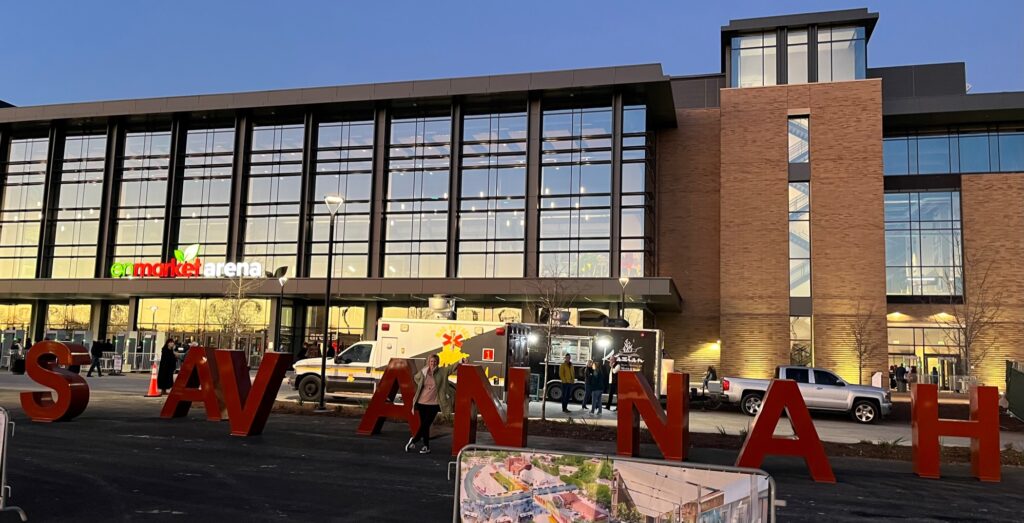
On Wednesday, we attended the grand opening celebration for Savannah’s new EnMarket Arena, featuring Earth, Wind and Fire (who can still rock with the best of them!). The grand opening was supposed to take place on Jan. 13 but had to be postponed due to, you guessed it, worker shortages. It’s a beautiful mid-size city arena holding 9,000 for concerts and 7,500 for minor pro hockey (the ECHL’s Ghost Pirates begin play next fall). Even with the opening events complete, the parking lots surrounding the building are not yet completed and some finishes both inside and outside the arena still need work.
The delays due to worker shortages are happening all over the country. Plumbers, electricians, carpenters, roofers, you name it and there are simply not enough people in these vocations to fill the demand. We met with the owner of 278 Liquid Floors concrete coating company and found out he moved to South Carolina two years ago from Minneapolis. When he couldn’t find enough help locally, he enticed two workers who he knew from Fargo, North Dakota, to move to Beaufort County since the area located between Hilton Head Island, South Carolina, and Savannah, Georgia, is booming.
Several police officers in South Carolina recently quit the force to take jobs in construction (better pay and a lot safer). Good for the construction companies, unfortunate for local law enforcement as it creates another labor challenge. Try hiring trained emergency medical technicians in your town. It will become more of a priority when you or a loved one needs one and they aren’t there.
If you are reading this, and you are sitting at home with your college degree still searching for a white-collar job and find your student loans coming due, then perhaps it’s time to consider a switch of careers. The idea that the only way to be successful is to get a college degree has been proven time and time again to be a fallacy. For some of you, instead of going back to college and possibly going even further into debt to get a masters or a second undergraduate degree, perhaps you should consider trying your hand at a skilled trade. Locally, you might want to consider enrolling in classes at the Central Pennsylvania Institute of Science and Technology (CPI) in Bellefonte or Penn State-affiliated Pennsylvania College of Technology in Williamsport.
It doesn’t matter if you are a high school student who isn’t sure you want to go to college (or perhaps you don’t want to go deeply into debt at 18), or a displaced employee who lost their job due to the pandemic, don’t be too prideful and stubborn to contemplate a career change. I keep hearing these heartbreaking stories of people in their 30s and 40s raiding their 401k’s either taking the penalty or borrowing money from themselves to make ends meet. This should be an absolute last resort.
Don’t get me wrong, the facts still are clear that a college degree, especially in STEM majors, make significantly more money over the course of their careers. However, the cost of attending colleges has become so far out of reach for some that it is time for many to rethink the value of a trade school vs. a college degree, at least to start out. For example, you can become a certified HVAC technician in one year spending $10,000 – $20,000 at a trade school and make $40,000 – 50,000 right away. Compare that to some college degree programs that take 4 years and cost $30,000 to $50,000 a year and might only net you a job making $35,000 to $40,000. It’s not just the added expense but the three years of lost wages that you must factor into your decision.
There are way too many overeducated and underemployed college graduates these days with enormous debt while we have a real shortage of skilled workers. Let’s start looking at the skilled trades as we should: important, vibrant and well paying. Oh, and nothing says you can’t go on to get a four-year degree in the future. You may even be able to get your skilled labor employer to help pay for it!



