
Relax. This isn’t about the apocalypse. It’s about a place, specifically the southwest corner of Portugal, whence I have just returned.
There are several Ends of the World/ Land’s Ends/ Fim do Mundos/ Fin del Mundos/ Finisterres around the globe. Each is on a coast that juts into the sea. The ones in Europe reveal the limits of human knowledge at the time of their naming: If you gazed out from these land fingers before the navigators stumbled on the Americas, you might have imagined the ocean swallowing the sun and sea monsters swallowing caravels like they were canapes.
The Iberian peninsula has three such places: Fisterra, in northwest Spain, Cabo da Roca, just north of Lisbon, and Cabo São Vicente, which is where I was.
As you might expect, these lonely, windswept places put visitors in touch with that questing human spirit that wants to know what lies over the horizon. One finds oneself hungering for adventure, for discovery, for glory, for lunch!
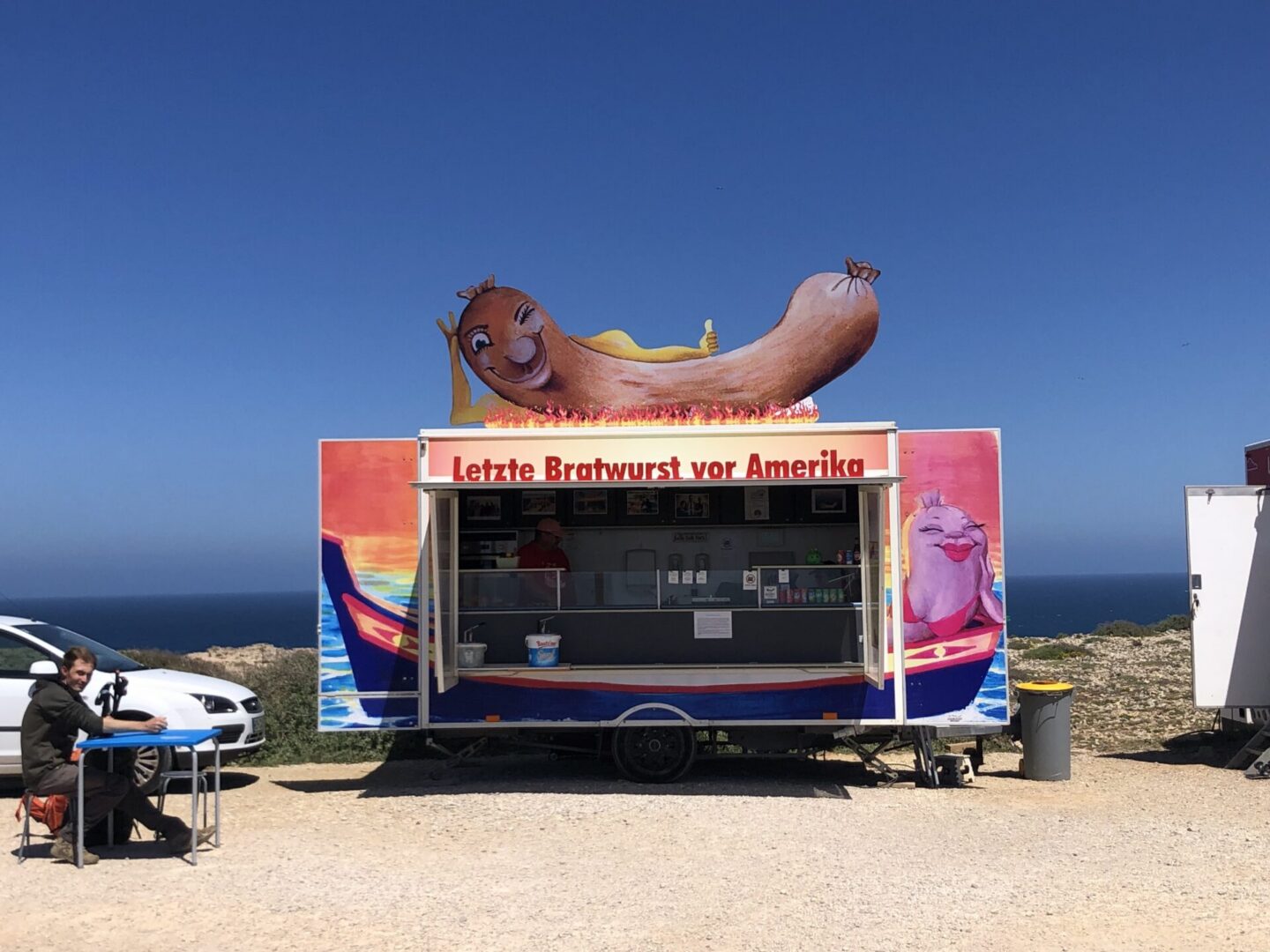
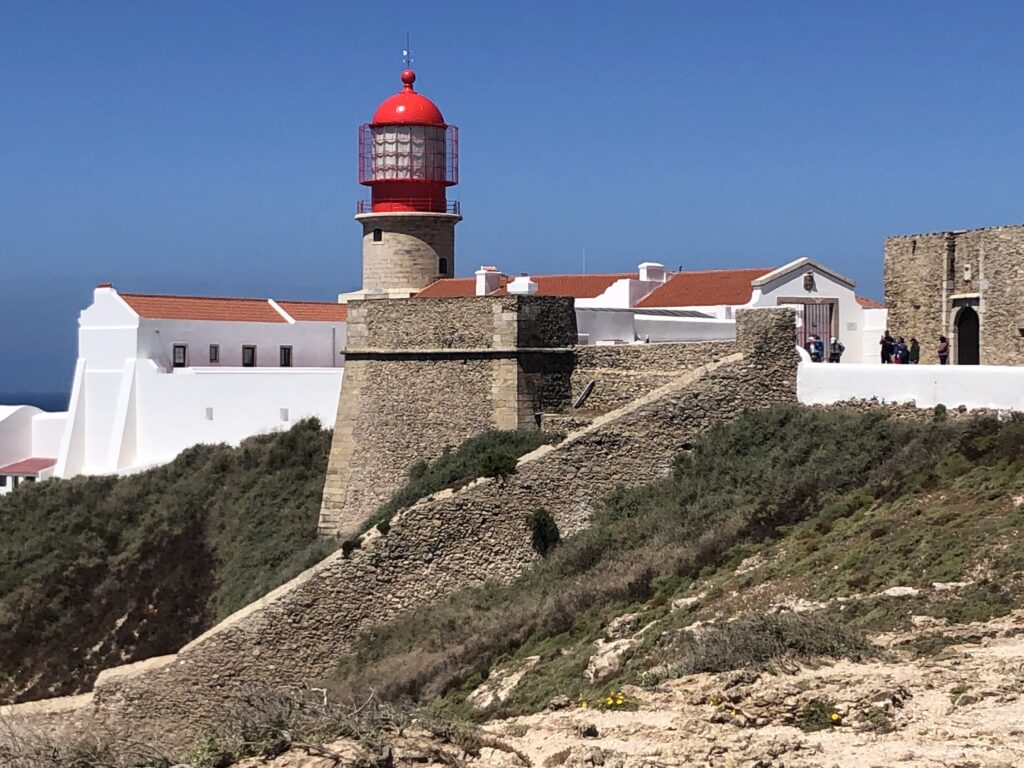
At Cabo São Vicente, fortunately, there are, in addition to the red-capped lighthouse, food trucks. One displayed a saucily winking sausage on its roof above the words Letzte Bratwurst vor Amerika – Last Bratwurst before America.
Naturally, we had to have one. It came with a “Certificado,” in German and English:
We herein declare that the above named person has visited the most southwestern point of continental Europe on this day.
That’s travel for you. One minute you’re communing with the ghost of Henry the Navigator, the next you’re pumping mustard onto a bratwurst and wondering why there aren’t any porta-potties.
**
A day later, I received a message from the airline encouraging me to arrive at the Lisbon airport three-and-a-half hours early to clear the new Entry/Exit System. I hadn’t heard about the EES, so I looked it up. I learned that it’s an “automated IT system for registering non-EU nationals” traveling in Europe.” Among the benefits:
- Making Border Checks More Modern and Efficient: The EES will gradually replace passport stamps with a digital system that records when travellers enter and exit, making border checks faster and helping staff to work more efficiently.
- Making Travel Across Borders Easier and Faster: With EES, travellers will spend less time at the border thanks to faster checks, self-service options, and the possibility to give their information in advance.
The operative word here is “faster.” But then why the need to show up so early? I soon found out why. As with so many recent techno innovations, faster actually means slower. Way slower.
The line to get through passport control was the longest I have ever had the dubious pleasure of cooling my heels in. Once I joined it, I studied the faces of those who were lining up behind me. Mouths were agape.
Soon, my holiday in Portugal succumbed to the Etch-a-Sketch effect, whereby the glorious sights and sounds of the preceding 10 days were shaken into oblivion by the less glamorous aspects of journeying: the schlepping, the waiting, the crowding.
At such moments I marvel at the mystique of travel. It’s what everyone says they want to do more of when they retire. In airports and in my cramped economy class seats, I wonder why.
Likewise when I’m visiting a must-see attraction. There comes a moment when I’m among the hordes at the Eiffel Tower, the Coliseum or the Leaning Tower when I feel embarrassed by my touristic idleness amid the industry of the locals. Haven’t we anything better to do than gawk at stuff and take pictures of ourselves?
The answer is, of course we do – it’s whatever most of us do the other 50 or so weeks of the year when we aren’t traveling.
Several days prior to our longest-line-ever experience, my wife and I escaped one of Lisbon’s touristic hells — and this wasn’t even high season — in a tuk-tuk. Tiago the tuk-tuk driver was deferential at first, but soon he and we had dropped enough hints about our politics to allow for a more open conversation about our generally troubled times and the devil’s bargain of a tourism-based economy.
Yes, the tourists, the ex-pat retirees and the digital nomads spend money, but they also drive up housing costs, while most of the jobs the tourism economy generates are of the low-wage service variety. Tiago’s real job is artist.
I’m back in State College now, catching up on all the grim news I tried to ignore while I was away. Is it crazy to take a holiday at a time like this – to munch on a bratwurst while standing on a windswept cliff at the edge of the world?
Maybe this column is about the apocalypse after all. But the people in that endless line, Americans mostly, who could have been fretting about missing their flights and fuming about being treated as if their time was not valuable, endured what could not be cured and thereby showed surprising, faith-in-humanity-restoring grace.
More Columns
View all Columns
Penn State After Michigan: A Top 20 Bye (Week) and Sell
ANN ARBOR, Mich. — Penn State left the Big House here on Saturday night as the not-so-proud owner of a four-game losing streak. With an upcoming bye week, Matt Campbell’s […]

Penn State QB Rocco Becht’s Big Mistakes in The Big House: In His Own Words
ANN ARBOR, Mich. — Penn State quarterback Rocco Becht’s three second-half turnovers in The Big House were the biggest kind of mistakes. Interception, interception, lost fumble. And in a span […]

Penn State’s Matt Campbell on AD Pat Kraft: ‘My Focus Has Been Completely on This Building’
Penn State coach Matt Campbell, whose 3-3 Nittany Lions last won nearly a month ago, is focused on his team, his staff and the preparations for their game on Saturday […]


