
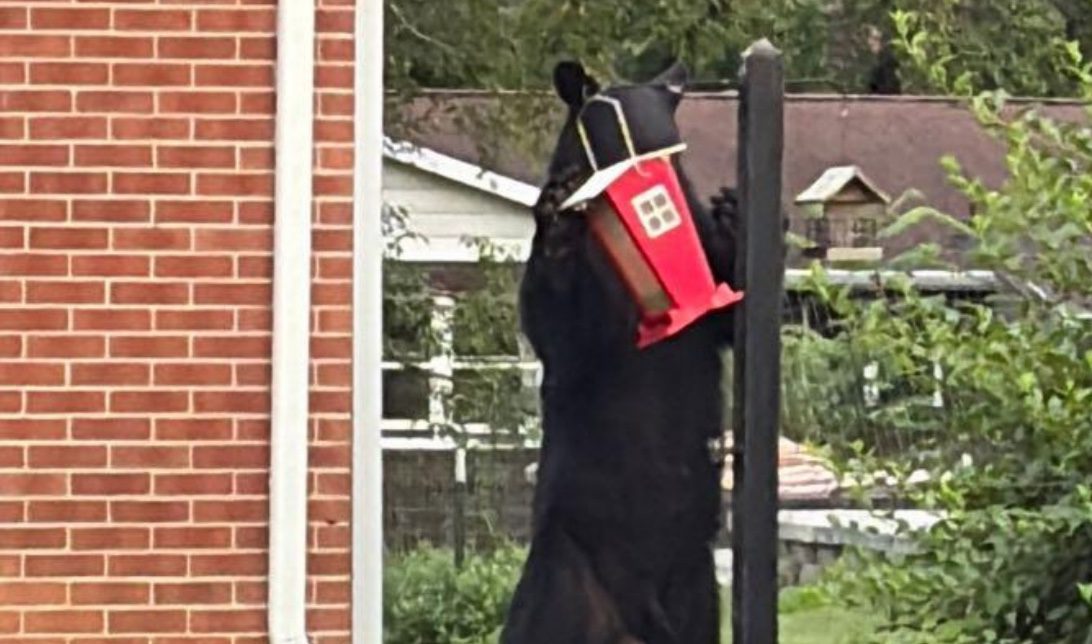
The reports have been pouring in from all over:
Bear sighted in the Highlands. Bear in Holmes-Foster. In Park Hills and Park Forest. West College Heights. Boalsburg. Autumnwood. Pine Grove Mills.
On front porches! Destroying bird feeders! Going through garbage! Spooking ducks!
About the only place a bear hasn’t been seen is on a barstool in Bill Pickles.
The question before us: Are there more bears this summer or are we just learning about more bear sightings because Nextdoor (“the social networking service for neighborhoods”) gives us the wherewithal to spread the word and share the pix? And might many of the sightings be of the same busy bear?
That’s what Franny Buderman thinks. Buderman, a mammalogist in Penn State’s Department of Ecosystem Science and Management, tells me that the range of a male bear is about 20 miles and a female, around 10 miles.
In other words, Ursus americanus get around, round, round, round, they get around.
Margaret Brittingham, a retired professor of wildlife resources at Penn State, tossed out a few more ideas: Yes, the black bear population has grown in recent decades. Happy Valley has grown also, resulting in more overlap between their turf and ours.
Then there’s our love of songbirds: Bears like birdseed as much as birds do. The same late freeze that hurt fruit growers cut into the bears’ food supply, which might account for their increased interest in our backyard bird feeders.
But let’s not get carried away, says Robyn Graboski, founder of Centre Wildlife Care. “There have always been bears in State College,” she told me. “They’re trying to bulk up for the winter.”
I can attest to the presence of bears in years past. I caught one feasting on my blueberry bushes when I lived among the Woo people (aka fraternity brothers).
I also recall the bear that climbed the tree outside Woodring’s, the florist that used to be on Allen Street between College and Beaver – in other words, in the heart of downtown.
Leaving aside the question of whether there are more bears or more reports of bear sightings, what’s interesting about the Nextdoor notifications are the attitudes of the reporters, which range from alarm to delight.
“Careful walking your dogs tonight,” says one.
“Stay in house in Holmes-Foster neighborhood!” advises another.
“Everyone be careful out there.”
At the other end of the spectrum:
“It’s really nice to know that even the wildlife like our little piece of the world.”
“I like living in a neighborhood in which a bear wanders through every year.”
“Hurray for bears!”
And then there are the arguments between those who consider the bears a problem and those who think humans are the problem. Relocate ‘em, says one side. “People who don’t like wildlife should move to a city,” says the other side.
Meanwhile, I would swear I’m seeing more rabbits, chipmunks, squirrels and groundhogs than I ever have before. Especially bunnies. A few nights ago, out for an evening stroll, I counted some 20 rabbits in a half hour.
I have a theory about the wildlife in our midst, developed while backpacking in Yosemite National Park. Deep in the back country, I saw hardly any critters. Where were they? Hanging around the campgrounds, where the s’mores are assembled.
Animals have figured out two things about humans. One is that, big though we are, we’re mostly harmless. By that I mean that we don’t behave like predators toward them (the harms we cause to their habitats are another story).
The other is that we’re profligate with food. If you could ask a squirrel why it lives on the Penn State campus, it would probably answer the way the famous bank robber Willie Sutton supposedly did when a reporter asked him why he robbed banks: “Because that’s where the money is.”
Only for squirrels it would be: “Because that’s where the partially eaten sandwiches are. And the pizza crusts. And the apple cores, etc.”
Similarly, backyard bears would explain their nocturnal visitations by saying: “Because that’s where the bird feeders are.”

If you must feed our feathered friends, many of our Nextdoor neighbors are saying, do so in the daytime, when bears are less active.
Or are they? Outdoor writer and photographer Mark Nale tells me his feeders have been visited – and damaged – “in broad daylight.”
One local homeowner, having lost a feeder to a hungry bruin, wrote, “I should take the food in at night but I forget.”
Which recalls a nugget of folk wisdom about bear-human relations: “There is considerable overlap between the smartest bears and the dumbest humans.”
And just so you know:
It is unlawful to intentionally lay or place food, fruit, hay, grain, chemical, salt or other minerals that may cause bears to congregate or habituate an area. In addition, if conflict bears are being attracted to an area by other wildlife feeding, game wardens can issue written notice to temporarily halt the activity. – Pennsylvania Game Commission
More Columns
View all Columns
Penn State Football After Dark: Homecoming Contest Begins a String of ‘Night Shift’ Games
Under coach Matt Campbell, Penn State football practice is held early in the morning, with coaches and players arriving at Lasch Building before the sun comes up. For the next […]
Homecoming 2026: Penn State, WE ARE the World
It is Homecoming at Penn State. And while the weekend spins on the axis of a football game, it is so much more than that. It is a time for […]

Can Penn State’s Rocco Becht Be Another Brock Purdy?
When it comes to former Iowa State quarterback and current San Francisco 49er star Brock Purdy, can Penn State’s Rocco Becht be QB Too? The answer is yes, at least […]


