
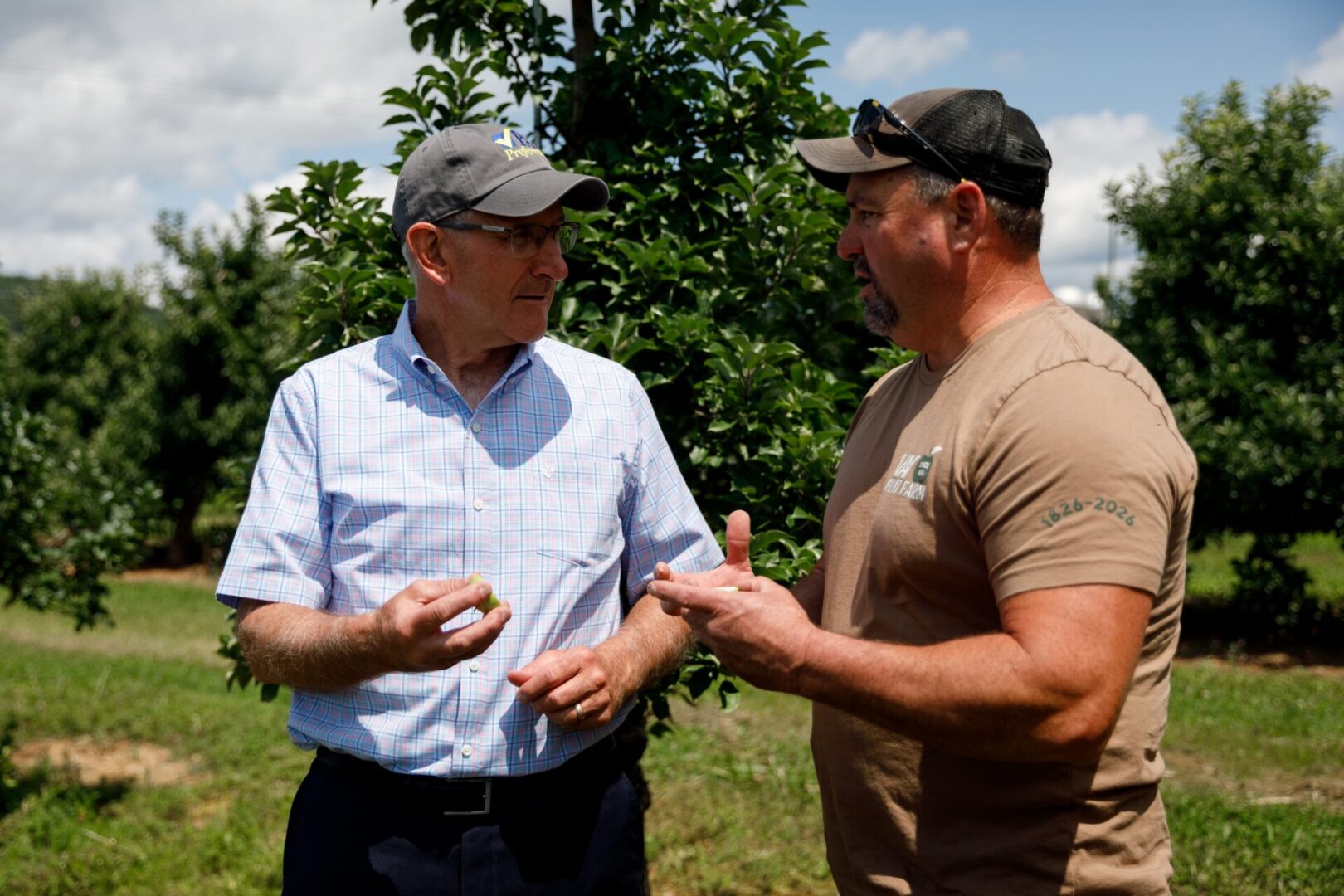
State and local officials gathered at Way Fruit Farm in Halfmoon Township on Wednesday to discuss a new $10 million fund to help Pennsylvania growers recover from a late-spring freeze that devastated fruit crops.
The funding included in the 2026-27 state budget will be used by the state Department of Agriculture to develop Freeze Disaster Assistance Recovery Grants. Guidelines for the program are due by mid-August, and Secretary of Agriculture Russell Redding said the grants will be targeted to have the most significant impact in aiding recovery.
“We are working to design the program to drive out those dollars as quickly, efficiently and fairly as we possibly can,” Redding said. “They will not replace the lost apples or cherries or peaches. It won’t replace them, and it won’t help our processors and packers, unfortunately. But it will provide some meaningful financial assistance to help farmers weather this difficult season and build a bridge to a better day.”
After a late-winter and early-spring warm-up caused crops to begin growing, temperatures plummeted into the 20s on April 21, leaving significant damage for fruit and specialty crop growers around Pennsylvania, projected to total $150 million to $200 million.
At Way Fruit Farm, co-owner Jason Coopey pointed to a row of trees behind him that would normally be flush with hundreds of apples for the farm’s you-pick operation. Now, there are few to be found.
“It’s going to be a challenging year, especially from our u-pick operation because they’re just not here,” Coopey said.
Coopey and his wife, Megan (Way) Coopey are the sixth generation of Ways to own the 200-year-old farm on Halfmoon Valley Road that started its fruit growing with a wedding gift of 1,000 apple trees still yielding fruit today. The Coopeys estimate a 50% loss of apples, but a near total loss of stone fruits, with 20 acres of peach orchards producing only about 25 pounds of fruit.
“Our goal is to make it another 200 years, but to make it 200, we have to make the 201,” Coopey said, “We are grateful, in a year like this where the trees have not held up to their half of the bargain, helping us through because of the cold weather that we received. We are so grateful that between the secretary, the representatives and the commissioners, we are getting some help to help us make it to that year 201.”
Way Fruit Farm’s experience is not uncommon across the state. Pennsylvania Farm Bureau President Tommy Nagle said 65% of the bureau’s members who were surveyed about the freeze reported a 75% loss, while 29% reported a total loss.
The Shapiro administration petitioned the U.S. Department of Agriculture early on for a disaster declaration that would open up financial assistance for affected farmers. The declaration was granted for 28 counties, but Redding said Pennsylvania is continuing to advocate for more.
The commonwealth also has pushed for expanded crop insurance flexibilities and expedited payments from the USDA, which have been partially approved, and is leading a multi-state effort for federal block grant funding that would enable the creation of tailored disaster response funding.
With the extent of the freeze damage, federal assistance will be critical in recovery, Redding said. But for farmers needing to make it through the season, the $10 million state grant program will be vital in the short-term, according to Sarah Zost, president of the State Horticultural Association of Pennsylvania, which represents the commonwealth’s tree fruit growers.
Fruit growers are faced with “very hard decisions” to make it through the next year, Zoost said, noting that her own Adams County farm has experienced a 75% loss and barely has the income to make it to 2027.
“The state aid will help right now to help cover the costs that we have between now and then,” Zost said. “Federal aid may be on the way, but there are farms that cannot wait that long. We have farms right now who count on their summer income from those peaches and nectarines to pay for their harvest staff, and right now they’re scrambling to try to figure out how they’re going to make ends meet just to get the apples in the door, so they can sell those to make it to next year.”
The legislation to provide the assistance was a bipartisan effort, and state Rep. Scott Conklin, D-Rush Township, helped to champion it in the House.
He credited the growers for quickly making the impacts clear, and for continuing to try to make the best of a bad season.
“Just because Mother Nature threw a curve doesn’t mean that the growers still did not have anywhere from 80 to 95 percent of the work to do not to have a profit,” Conklin said. “So it’s so important that we make sure that we’re here next year, that those growers are still viable, that they’re still able to make a living and they’re able to give to us, the citizens of this state, exactly what we need and not what we want, but we need to have that fresh fruit and those things put on our tables to feed our families.”
Centre County Commissioner Mark Higgins noted that long before Penn State became the anchor, agriculture culture took root in the valleys throughout the county and remains a major economic driver today that help communities thrive.
“When our farms thrive, our communities thrive with them, because farming has never been easy, and it’s not getting any easier,” Higgins said. “Rising costs, unpredictable weather, development pressures and the challenge of passing a farm down to the next generation are real and constant concerns. That’s why it matters so much that we, as a community and leaders like Secretary Redding at the state level, commit to supporting our farmers.
“Farms like Way Fruit Farm don’t just feed us. They anchor our small towns and villages, preserve our open spaces and connect generations.”
While no deadline is set yet to get grant money to growers like Way Fruit Farm, Redding said he’s hopeful the payment process will begin in the early fall, matching up with when fruit crop income would normally be available.
In the meantime, Coopey said it is important that communities continue to support their local farms.
“So many times when you have a disaster and problems, it doesn’t seem like anybody truly notices,” Coopey said. “So we’re just grateful that people are paying attention. What we hope that people will do is — even though we might not have as much as we normally do, we’re still going to have some — we want them to come out and still keep supporting farms like ours, and even if it’s not us, please go out and help support your local farms. That’s the only way we’re going to keep them strong, and it’s very important to keep them strong. We need that diverse food chain. We need Pennsylvania farming.”
More Local News
View all Local News
Centre County Commissioners Award $215K for Affordable Housing Rehabilitation Projects
Centre County commissioners on Tuesday approved $215,000 for four projects aimed at creating and repairing affordable housing across the county. The funding will support the rehabilitation of three homes in […]

Judge Orders Sandusky Hearing to Proceed After Motion to Cancel
Updated 8:30 p.m. Sept. 4, 2026. A judge has denied Jerry Sandusky’s request to cancel an upcoming hearing originally scheduled for a claim that one of his accusers is recanting […]
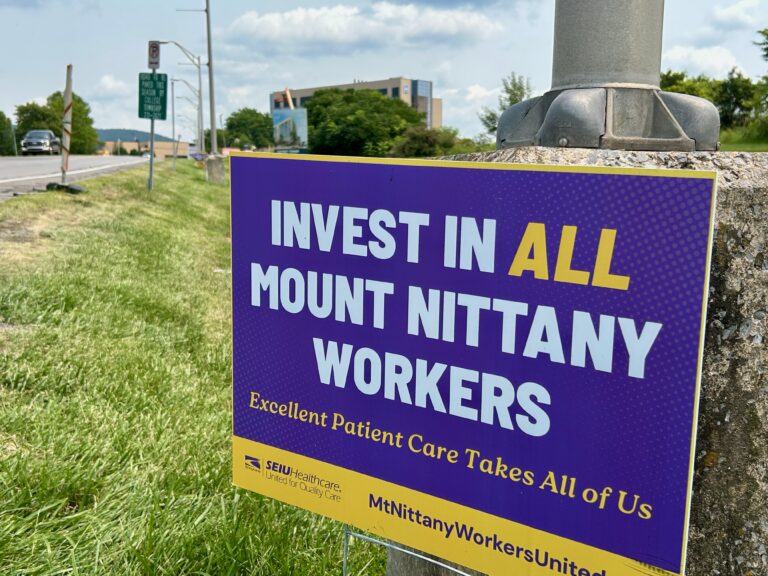
Still No Deal Between Mount Nittany Medical Center, Union After Latest Negotiations
Mount Nittany Medical Center executives and the union representing 950 of the hospital’s workers once again were unable to come to terms on a new contract after the latest round […]


