
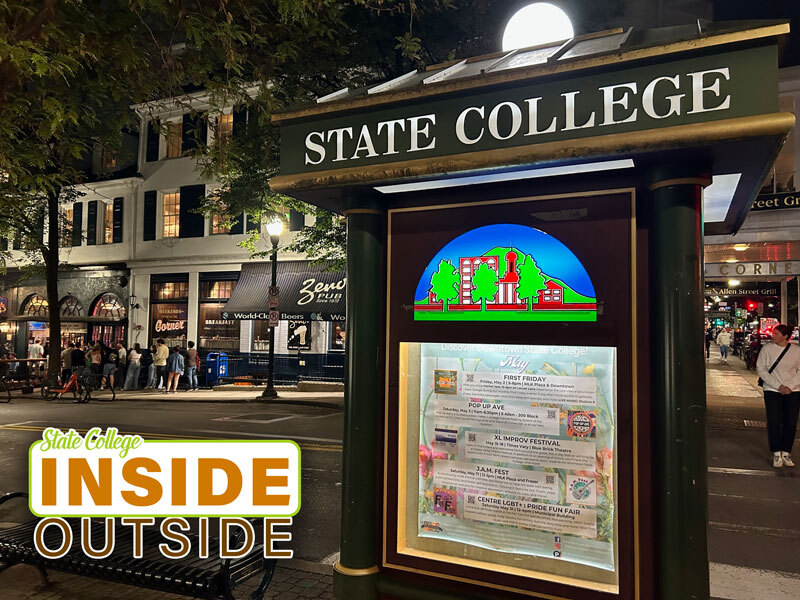
Inside/Outside State College is a regular column by Jeff Deitrich offering views on downtown and the outdoors within a 30-minute driving distance.
State College last month was named the Best College Town in America by USA Today. Congratulations to my favorite town! It’s nice to see it be recognized, even if it may have been driven by popular vote from the largest alumni association in the world.
We certainly do have a unique town. We’re blessed with a tightly-knit, compact location far that builds a special bond among the students, alumni and residents. While 60 million Americans could wake up tomorrow morning and drive to State College in time for lunch, we’re still isolated enough that we grow together over that fact and love this place, as I do. We should never take that for granted.
Am I happy that we have received this recognition? Absolutely!
Could I be happier if I saw some still-obvious needs being addressed? Absolutely!
In my first StateCollege.com column last summer, I noted that the majority of our higher end restaurants downtown went away for a variety of reasons and were never replaced. That’s still true. Two months ago, I wrote about what people want to see downtown. Based on more than 90 responses, more and better-quality dining topped the list by a mile.
So, why hasn’t it happened in the five years since COVID started breaking?
It’s a curious thing when you write a column that calls out an obvious issue. You can almost feel the chord being struck. You get comments from people, sure, mostly in agreement, along with a nitpicker or two.
But then you also hear from some people in a position to know the reasons behind that issue. They want to explain—even if they don’t want to take credit publicly for those explanations. They want you to know some of the real barriers to entry for new businesses downtown, restaurants included.
That’s what happened here.
So, after numerous comments and several background meetings and conversations, I’ve learned that some of my suspicions about why we haven’t seen better dining return to State College were true. I’ve also learned that there is a lot more to the story, which also is no surprise. The revelation is exactly what some of those things are.
Let me quickly summarize what I’ve learned about the barriers to entry, not just for restaurateurs, but for businesses in general:
Confirmed Suspicions
- High-rise owners make their money on the apartment beds and in general don’t care much about the retail space.
- Property owners in general, with exceptions, care more about collecting the rent than about the specific businesses that occupy their spaces—or whether the businesses even open.
- Both owners and prospective businesses can do the simple research to learn that the foot traffic in town is primarily students, meaning they cater to that demographic and largely forget about the rest of us.
- Borough regulations for new properties have sometimes been counterproductive for businesses to develop spaces meant for retail and offices.
What I’ve Learned
- High-rise owners don’t build spaces outfitted for retail, office or restaurant space. Instead, they build “gray shell”—blank spaces, meaning it’s up to the business owner to foot the bill to outfit all of that space. That means everything: walls, ceilings, floors, HVAC and any needed interior features, including kitchens or any other features.
- Many of our new high-rises have already been sold multiple times and are owned by people from out of town or even out of the country, so they have no particular incentive to improve the town.
- Downtown land itself is frequently more valuable than the building that sits on it, which is a disincentive to investing more money in your building. Why would you try to improve it when selling is so profitable?
- As in many other towns, the cost of renting business space is NOT like the cost of renting living space. Property owners use “triple-net” leases that require business operators to pay a portion of the property taxes, the insurance and the maintenance in addition to the square footage. The perks of renting that we think of for living spaces don’t exist for businesses. The only perk is that a tenant can leave when the lease expires. A property owner can’t; they can only sell.
- Likewise, prominent locations downtown often require a 10-year lease, meaning businesses must see profits soon and over time or they may lose everything in that time span. The risk is high. Again, there are exceptions to this. Side streets and hidden locations often have shorter lease requirements.
- Regarding restaurants, the economics show that liquor sales are required to survive, but the state restricts the number of licenses available on a per capita basis. The result is that the cost of a liquor license on the open downtown State College market is now about $400,000. That’s an enormous capital cost and is prohibitive to a venue that otherwise might survive on a nice wine list for its liquor revenue. Instead, those who pay the cost of a license focus on high-volume alcohol sales, which caters to the student demographic.
- A knowledgeable source suggested that our almost-entirely volunteer borough council is not always willing to fully engage with local subject matter experts to develop a comprehensive plan for downtown. The reason? Fear of playing favorites. The borough staff is largely very capable but is hindered by this reticence to engage. I might humbly suggest to the borough that it recognize when it’s out of its depth and get some help from those in town with expertise. It’s OK to have some in town benefit. It should have a ripple effect.
- Business owners, restaurateurs naturally included, need to have a good business plan. If they don’t have one, the Downtown State College Improvement District most definitely can help with that. Likewise, they can direct prospective business owners to a variety of property owners who may be in a position to help significantly.
- Which brings me to a very good learned lesson: There are some property owners who are indeed more concerned with getting quality businesses into their spaces than they are about rent. They would rather give a business a chance and see whether it can be successful on a short timeline and will sometimes eschew rent to do so. They understand that a successful and sustainable business will provide steady rent down the road. I was very happy to learn that. The DID can help direct prospective businesses to such owners, or other owners who have something else that a particular business needs.
An Incorrect Suspicion
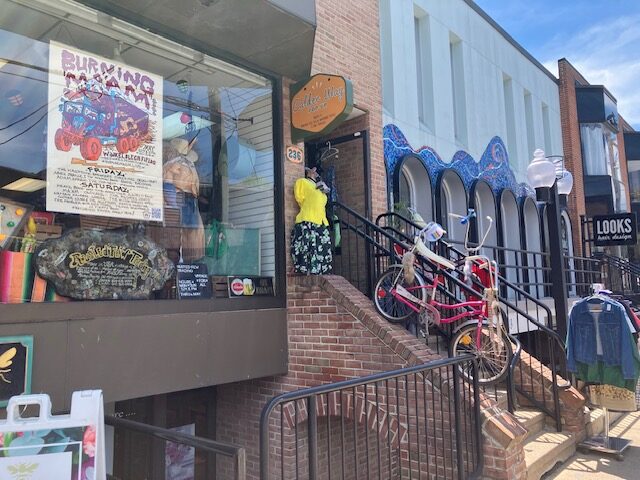
I was also happy to learn that I was wrong about something. I learned that business occupancy of retail spaces is quite high at more than 93% within the Downtown Improvement District, and the DID expects several new businesses to be added this year to some of those empty spaces. I think it seemed that occupancy was lower to me, because several of the locations are large, prominent, and have been vacant for a very long time. I’m thinking of the corner of College and Pugh where Spats used to be and the first floor of The Standard high rise. It’s good news that most spaces really are filled.
A Most Important Lesson
All of this brings me to another important lesson. The last thing I learned that confirmed a suspicion and added to it is this: There has been no common vision among the business leaders and property owners—or the borough council—or the elephant-in-the-room-that-is-Penn State—about what State College should become. Have you heard of one?
I haven’t. Nor have the owners and staff I’ve spoken with. Nor, mind you, are those folks willing to come forward and share their own vision. They’re worried about the perils of speaking out publicly, even while they fully understand that a rising tide lifts all boats.
Many of us would like to see positively-directed growth in this town. Instead, we often see the wild west of support for that growth.
While that all seems true, the Borough and the Downtown Improvement District have, at least on paper, had a vision on paper since as early as 2013 and are in the process of updating it. Let’s hope we use a megaphone to make sure everyone knows about it so that we can rally to that cause once the revised edition is ready.
Since I have a megaphone of sorts with this column, let me use it. I call for borough council and borough staff to put aside for a time their worries about playing favorites and engage with business leaders and property owners to develop a unified vision. I call on businesses and property owners to work together and recognize that they are not all in direct competition and that the town will do better when more of them do better.
I call on Penn State to take a more active role in engaging with businesses to provide not just what students want but also what its staff, alumni, and families want downtown. The Penn State Alumni Association might well use some of its influence and expertise toward that end.
I call on our government leaders to work together with all of the above groups—and each other. The Borough of State College is not in this alone. I also ask borough leaders to take actions to promote the economic viability of the types of restaurants that prosper in other towns.
And I’d like to see a vision broadcast widely and our citizens get on board to support it, even if they don’t agree with every single thing.
This town is a wealthy town; it does have a lot of resources. Let’s synergize them. Downtown should feel alive for more than just students and on more than just event weekends. Despite our accolades, some adults feel like outsiders here in their own town. That shouldn’t be.
Recognize an obvious fact: A rising tide does indeed lift all boats. State College is on a rising tide, and it will rise higher and more sustainably for everyone into the future if we do it together.
I, for one, would like to see an even more walkable town that provides more than just student-centered amenities. The Hiester Street pop-up park open this summer for a limited time with allowable open containers, music and vendors is a start. The pop-up shop on Calder Way that allows potential business owners to get a start and see if their business idea is viable is another.
Let’s build on that momentum. Let’s look toward a vision where Hiester and sections of Calder Way and perhaps other minor streets become pedestrian-centered.
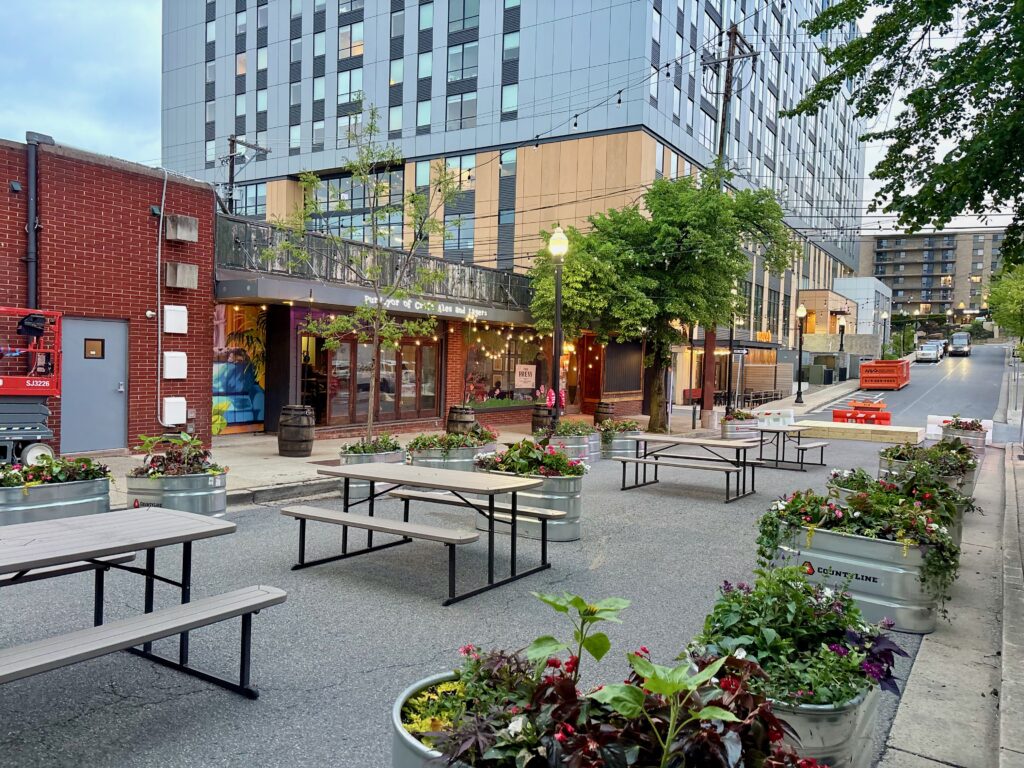
In March, I was in Cleveland for the NCAA Wrestling Championships, and Fourth Street a couple of blocks from the venue was just such a place. It was bustling with activity and really made the city feel alive. We can make that happen in State College, too.
And, while we’re at it, my vision includes having at least one nice steakhouse, or one great seafood restaurant or one upscale Italian restaurant, or something along those lines downtown. I think our town and its people deserve at least that.
It’s up to us—especially those who own the properties and those who make the regulations. We can make this an even better town. We can and should do it together. Let’s not just let this tide roll where it will. Let’s direct it to the most beneficial places and in the most beneficial ways that we can.
Or we can rest on our self-congratulatory USA Today laurels and just collect the rent.
Writing this column is the part that I know I can do. I’m also willing to get involved with any group of people willing to engage.
Now let’s see some of our stakeholders and the university and our governors, including the county and even the state, do more than just pick the low-hanging fruit provided by Penn State students, staff, alumni and families. How can we better allow all voices to be both heard and responded to?
Let’s roll! Roar, Lions, roar!
Jeff Deitrich is a retired hotelier and outdoors writer living in State College. He welcomes comments at psumohs@yahoo.com.
More Columns
View all Columns
Penn State Game-Planning and Play-Calling: What Campbell, Mouser and Becht Have to Say
Over the course of his 2024 and ’25 seasons at Iowa State, offensive coordinator Taylor Mouser called 1,813 plays. Give or take. The Cyclones’ offense ran that many. But head […]
Greek Life at Penn State: Plus Ça Change
It was back to business as usual among the Woo people last weekend, which meant very loud outdoor parties, very many shirtless young males and very many young females wearing […]

It’s Time to Watch Penn State Linebacker Tony Rojas… Again
Watch Tony Rojas. He’ll be back at linebacker for Penn State on Saturday against Marshall, the culmination of a journey that seemingly took him everywhere, but ultimately brought him back […]


