
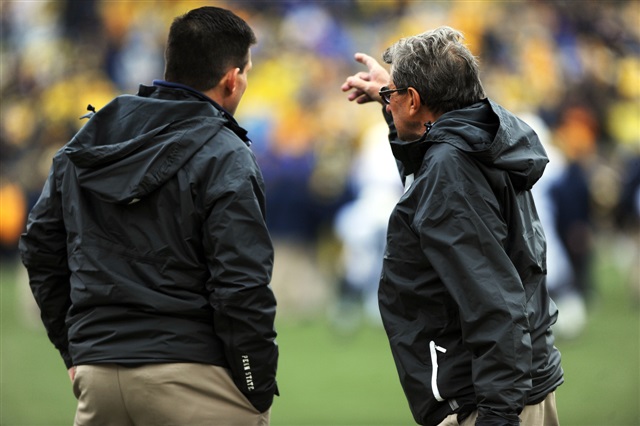
It is natural for those who’ve lost a father to think about them as Father’s Day approaches. Over the past several days, I’ve found myself thinking about my father and his life.
Today would’ve been one of intense interest for him. The United States Senate Commerce Committee will be marking up the Protect College Sports Act, a bill designed to put uniform federal regulations in place at a time when college sports have gone way off the rails.
Joe Paterno was a coach who believed in rules that ensured a level playing field. He believed college sports were here to foster growth for young women and men through education and in the valuable life and leadership lessons that come from preparation and competition.
Recently I’ve been asked a few times where Joe Paterno would’ve stood on this bill. That is something I’ve thought about a lot across the past several months as this bill was being written.
No one can definitively speak for the dead. But history is instructive.
Joe believed that coaches should have a voice in the NCAA, because they were the ones who knew best how decisions made by leadership would impact the lives of student-athletes. As you look at this bill, it covers many of the things that coaches have expressed publicly and privately.
Overwhelmingly coaches want to have a national solution that establishes a fair and reasonable transfer portal, that gives legal protection to the revenue sharing cap and that eliminates outside third-party Name Image and Likeness (NIL) payments. They want protections against tampering and illegal recruiting. They want age-based eligibility requirements that make sense.
That wish list is covered in this bill.
The NIL payment scam is of particular interest to coaches. NIL payments have largely become a shifty way around the revenue sharing cap, a massive loophole that has placed most schools at a competitive disadvantage.
No matter how many billionaires a school has, it is not a sustainable business model to rely on “donors’ ponying up an extra $20-40 million dollars a year to create a phony NIL payroll just for a football team.
So how did past leaders handle changes in the college football landscape?
In the early 1980s, when television rights were deregulated by the Supreme Court, Big 8 Commissioner Chuck Neinas, Notre Dame President Father Theodore Hesburgh, Joe Paterno and others worked together to create a national television solution by forming the College Football Association.
But he knew what drove people to watch the games. In a 1983 speech at the American Football Coaches Association Convention, he stated: “The NCAA Television Committee speaks of how television planning was responsible for the increase in attendance and television ratings. I feel it is the superior athletic ability of players such as Magic Johnson, Marcus Allen and Herschel Walker.”
Around that same time, there was widespread disparity in admissions standards for athletes which allowed many players to be admitted and then passed through college without progress towards a degree. Joe Paterno went to the 1983 NCAA Convention to argue for national academic eligibility standards.
He also served as Penn State’s athletic director for a few years in the early 1980s and used that time to increase opportunities for women’s sports at Penn State. It was a strategy that helped establish competitive foundations when the NCAA finally began to recognize and support women’s sports in 1982.
And a few years later, when the Senate Judiciary Committee held hearings on the rampant use of steroids in college football, Senator Joe Biden called a few high-profile coaches to testify. As then Vice President Joe Biden told me in 2013, Joe Paterno was the only coach with the guts to show up.
All these years later, the changes occurring are even bigger.
The Protect College Sports Act levels the playing field, getting much of the phony NIL money out of the game, money that given its very nature has the power to corrupt.
Some have argued that the revenue sharing caps and the regulation on NIL are things that will hamper players’ ability to make money. That may be partially true, but this bill has major provisions to improve the lives of student-athletes.
There are academic protections for student-athletes. It prevents schools from pressuring student-athletes to take or avoid certain majors. It does not allow schools to revoke or reduce scholarship support for performance reasons or because of illness or injury.
It has health care protections, both as players and for years after they’re done playing. It creates regulation of agents and caps agent fees at 5% (some unscrupulous agents have taken 20% or more of players’ contracts).
It prevents coaches from leaving one school to coach another school while the season is still going on.
It gets a handle on the transfer portal which helps schools and players. It gives schools more certainty year-over-year after they’ve invested coaching, revenue, training, nutrition and academic support into each player.
It helps players facing pressure from family members or shady advisers looking to cash in by transferring every year. Often players are pushed to enter the portal and leave the school where they want to stay. Now, after one transfer a player will have some legal leverage against those often-unrealistic pressures. And no one really likes to talk about all the players who enter the portal and end up with nowhere to go.
On a recent call, the president of Fresno State, Saúl Jiménez-Sandoval, shared that the graduation rates for players dropped nearly 56% after one transfer and almost 90% after a second transfer.
The bill has medical coverage requirements and a $60 million trust set up to help smaller schools with those expenses. It requires student-athlete representation on the boards of college sports’ governing bodies. After all, many of us are curious to hear how football players would feel about the health risks of another two rounds of playoff games.
And the bill controls costs to help schools that will be required to maintain healthy support for women’s and men’s sports beyond football and basketball. Both Senators Cruz and Cantwell have stated that these programs boost Olympic Sports while creating generations of future leaders across society.
The bill even has some proposals that benefit fans, including some local broadcast access requirements for major college sports.
Given the nature of Senate deliberations and procedures, drafting this bill was never going to be easy. That’s what is truly amazing about this bill, Senators Cantwell, Cruz and their staffs have listened and created a truly bipartisan bill that is being sponsored by multiple Democrats and Republicans.
And in sports we like to say that game recognizes game.
Notre Dame has joined over 20 Division I conferences to endorse the bill. The NFL, the NFL Players Association, Major League Baseball, the NBA Players Association and the United States Olympic Committee are supporting the bill. The National Association of Basketball Coaches has supported the bill with a letter whose list of signatories include Michigan State’s Tom Izzo, Duke’s John Scheyer, Purdue’s Matt Painter, Marquette’s Shaka Smart and Arkansas’ John Calipari.
Seeing all this, I remember sitting in coaching staff meetings and hearing Joe Paterno remind us that “Football is here to serve the university and not the other way around.”
I was reminded of that on a recent call with some trustees and presidents from around the country. Washington Senator Maria Cantwell spoke about the runaway expenses of major college football and basketball and the potential threat to the academic resources and missions of our great universities. This bill is bigger than sports.
As tuition dollars, tax dollars and involuntary student activity fees are being shifted to support sports programs and their massive payrolls, we know this is an intrusion into the academic resources that cannot continue. Massive bond issuances for facilities are being backed by the balance sheets of the academic side of universities.
Donors are being encouraged to divert donations to foot “payroll/NIL money” for sports teams rather than endow scholarships for students with need, or endowments to attract great faculty.
It circles back to the reality we now face. There are now only two options. One is to stick with the status quo, an unsustainable existence that, if left unchecked, will gnaw at the soul of great universities. The second is to pass this bipartisan bill.
As I think of my father, and my former boss of 17 years, I can’t help but think that he’d be glad to see a bipartisan effort towards solutions for a fairer future. These first important steps can help all of college sports as we look to educate and develop future generations of leaders.
More Columns
View all Columns
Can Penn State’s Rocco Becht Be Another Brock Purdy?
When it comes to former Iowa State quarterback and current San Francisco 49er star Brock Purdy, can Penn State’s Rocco Becht be QB Too? The answer is yes, at least […]

A Penn State Hockey Legend Who Should Never Be Forgotten
“Dr. Lawrence ‘Larry’ Hendry, 81, a distinguished chemist, pioneering entrepreneur, and passionate sports enthusiast, passed away August 30, 2026, leaving behind a legacy of profound scientific and athletic contributions.” This […]
A 3-0 Start May Be SOP for Penn State, but for Matt Campbell It Means ‘Opportunity is Now Here’
Penn State is off to a 3-0 start against an anonymous and fairly rag-tag trio of non-conference, non-combatant opponents. That’s typical for the Nittany Lions of the past decade or […]


