
This story originally appeared in the April 2026 issue of Town&Gown magazine.
The sight of a 1983 Topps baseball card takes Jason Dambach back to his childhood in Punxsutawney.
“My grandfather worked in a grocery warehouse and they sold baseball and football cards for Topps and the other companies. He would bring me home wax boxes of cards,” recalls Dambach, who was 7 in 1983 when he started collecting. “Anytime I see a 1983 Topps baseball card, it sort of melts me. Ryne Sandberg, and Wade Boggs, and Tony Gwynn had rookie cards. They’re not exceptionally valuable in the grand scheme of things, but anytime I see those cards, I’m just smitten.”
Dambach’s love of the collecting endured, but took a back seat through a minor league baseball front office career that took him to the Altoona Curve as a broadcaster, followed by stints as general manager of the State College Spikes and the Frisco Roughriders in Texas. Family eventually drew him back home to State College. “I met my wife, Erica, who’s the head (women’s) soccer coach here at Penn State, in 2014. We got married in 2016, and I was running a team in Texas,” he says. “When we got married, we were actually living apart. And obviously, that wasn’t going to last very long, especially when our kids started to come along. And so, I transitioned out of baseball.”
For a few years, Dambach stayed at home raising the couple’s two daughters while his wife worked. “I knew I wanted to own a business, just wasn’t sure what,” he says. “It was during that period that I got reintroduced to cards, became a hardcore collector again, and realized we didn’t have a shop here in State College that serviced this community or really the surrounding area. That became my focus.”
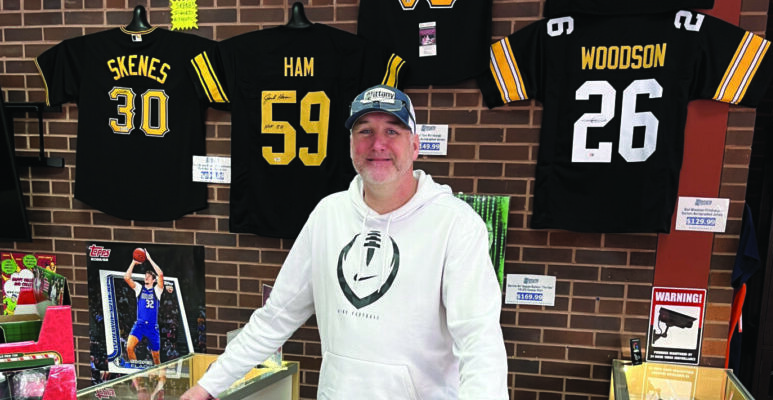
After developing a business plan, Dambach opened Nittany Cards Plus at 1631 S. Atherton St. in January 2024. At a time when much of the sports collectibles market does business online, Dambach focuses on offering a friendly community gathering place for collectors of all ages, where business — or just talking sports — happens face-to-face.
He hosts quarterly events to bring the collecting community together. In February, a “rip night” celebrated the release of the 2026 Topps Series 1 baseball card set. The pizza party included giveaways, and an appearance by Penn State football wide receiver Brett Eskildsen. As the name suggests, collectors tear open new foil packs of baseball cards to reveal what coveted cards — called “hits,” might be inside.
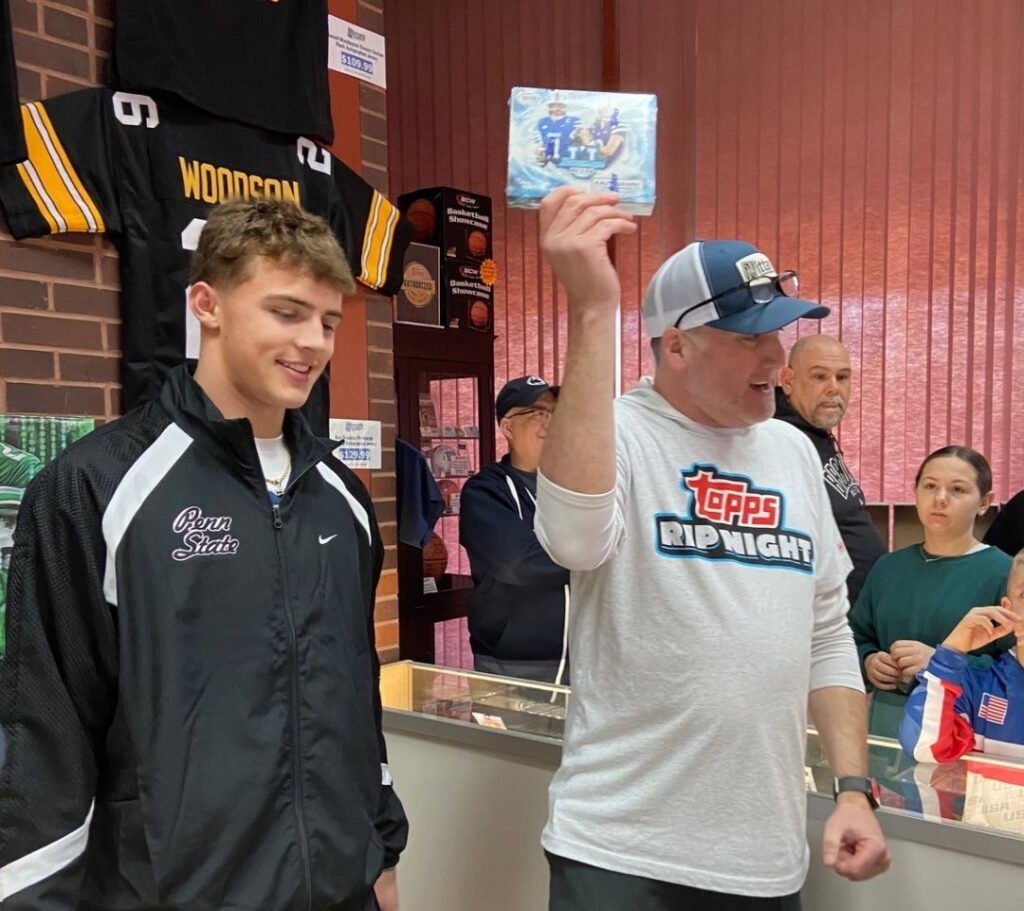
Unlike in Dambach’s childhood, when every card of a player looked the same, today companies like Topps and Upper Deck now produce multiple variants of a player card — called “parallels” — some rare and valuable. Certain 2025 cards autographed by Pittsburgh Pirates star Paul Skenes have re-sold for several hundred dollars or more. At the extreme end, an autographed Skenes card that included a uniform patch from his Major League Baseball debut sold for $1.1 million at auction last year.
Dambach’s focus, however, isn’t on big-money items, but on keeping the hobby accessible and fun. “I’ve always been a customer service person. I worked in professional baseball for 20 years, and I walked around the ballparks and just got to know customers. And it’s very similar. That was an outlet for people, coming to the ballpark. And this is an outlet for people, too.
“Yeah, we’re running a business, but at the end of the day, we’re having fun and talking sports.”
Here’s more from our conversation:
When you opened the shop, you said you would let the customers tell you which direction to take the business. What have they told you?
Dambach: The biggest thing we’ve learned is that our customers don’t want us to be a collector. They want us to service the hobby, and that’s really what we’ve done. We don’t have this big personal collection. Everything that we do is to service our customers. I’d say the other big thing, too, is that the tendency for a lot of shops is to have big, flashy, expensive things to show off. But at the end of the day, when it comes to what our customers want, they still want affordability. They still want your business to be clean, friendly. Customer service is such a big part of what we do here. When it comes to the actual products that we offer, everything we sell on a daily basis is under $100. We don’t have the big, fancy, expensive 1952 Mickey Mantle cards here.
What are your most popular items? Is it more the newer stuff or vintage collectibles?
Dambach: What’s new and relevant is really most popular. We thought early on that people would want to see more of the vintage, the older stuff. That, honestly, is a bit of the minority. Most people come in, especially the college-age population here, the younger folks, even those that are into the hobby, they like to collect what’s hot and new. So, it’s football cards. It’s baseball cards. It’s Star Wars.
How do you coexist with online sites like eBay?
Dambach: It’s challenging. It’s so easy now for somebody to walk in here and get on their phone and price-check what they could get that box off Amazon or off of Walmart or one of the big online retailers, and they could have it in a day or two. It’s our goal to be very competitive with that. Fortunately, we were able to get a deal with Topps and also Upper Deck, two of the biggest card companies out there. We’re able to get product direct from them. They cut out the middleman. It allows us to be very competitive.
Being here in the heart of Penn State country, how big a part of your business is that, especially now that Name, Image and Likeness is in place?
Dambach: Whether it be Penn State football games, Arts Fest, THON, you name it, (w)e always see bumps in traffic in the store when we have those unique events. … We’re very fortunate with our location here to be in an area where tourism is so big, where we get so many visitors. And we definitely get a lot of out-of-state, out-of-the-area customers, typically around those types of dates.
One of the things that coincided with us opening the shop here is the boom of NIL in college athletics. Five years ago, we would not have been able to offer a licensed football card of a Penn State player. Now we can. And Topps and a lot of the other major brands produce cards with Penn State football players on them. It was great in 2024 when Penn State was making that big run all the way through the College Football Playoff. We sold a lot of Drew Allar cards. We sold a lot of Tyler Warren. We sold a lot of Nick Singleton and players like that.
Having Gavin McKenna, for example, here — a huge hockey star on campus — that’s been very impactful for us because five years ago, we wouldn’t have been able to offer those cards. They wouldn’t make licensed cards. And it’s not just cards. It’s jerseys. We’ve got jerseys and helmets and other unique collectibles as well that we can offer that we wouldn’t have been able to five years ago. It’s still sort of in its infancy, but we’ve definitely seen a big bump from being able to carry not just Penn State stuff, but just college football, college basketball, college sports licensed products is really a new, growing sector of the industry.
Why do you think sports cards have endured in popularity given we’re in such a digital world now, but people still want these pieces of cardboard?
Dambach: That was the big debate maybe four or five years ago when you started having the NFTs (non-fungible tokens) become very popular, or the digital products. The card companies got involved in that, and they quickly found out people want to be able to see, hold, and feel something they own. There’s no pride in owning an image. That was put to the test within the last five years, and you don’t hear much about it anymore. I’m sure they’re still out there, digital and NFT; there is that segment of the collectible market. But more and more people just continue to gravitate to just being able to hold and own what they want. And nowadays, it’s even more fun because there’s rare items out there. You can walk into a shop like this and come away with a card that’s a one-of-one or something extremely rare. There’s that thrill of the chase that wouldn’t be the same if you couldn’t physically hold it.
What advice do you give to someone who comes in here and wants to start a collection?
Dambach: I would say first and foremost, don’t think that you just automatically have to buy the most expensive things. Collect what you like. Collect your favorite team. Find a niche, but narrow in on it. We see a lot of people that come in and they’re spending and spending and spending, and then they disappear because they burn out. They don’t have an end game. I think having an end game is very important.
If you want to get involved in the card hobby because you want to make a little extra money, that’s great. But I would say you want to make sure you have a way to liquidate. Get an eBay account. Find an online consignor. Find a way to be able to churn through, reacquire some extra money, and continue to grow because we see a lot of people that they come in, they want to get involved in cards. They know they’re valuable. They actually get valuable cards, and then they don’t know what to do with them. And obviously, we’re not going to be able to buy every single card that is out there. So, to have a plan and an end game is really important.
Follow Nittany Cards Plus on Facebook for information on upcoming events. T&G
Mark Brackenbury is a former editor of Town&Gown.
More Community
View all Community
Women’s Clothing Boutique Opens New Location in Downtown State College
A locally owned women’s clothing and accessories boutique is now open at its new location in downtown State College. By A Thread opened its new store at 210 S. Allen […]

State College Soccer Celebrates 50th Anniversary of State Title Win
Players and coaches from State College's first state champion soccer team gathered to celebrate the 50th anniversary of that magical 1976 season.
Nittany Valley Symphony to Launch 2026-27 Season With ‘Dreams of the Forest’
The Nittany Valley Symphony will present its 2026–27 season opener, “Dreams of the Forest” at 3 p.m. Sunday, Sept. 20, at Bellefonte Area High School. Tickets are $33.85 including fees […]


