POTTER TOWNSHIP — The Juniata Valley Council of the Boy Scouts of America hosted its 46th annual Klondike Derby at the Seven Mountains Scout Camp in Potter Township on Jan, 28.
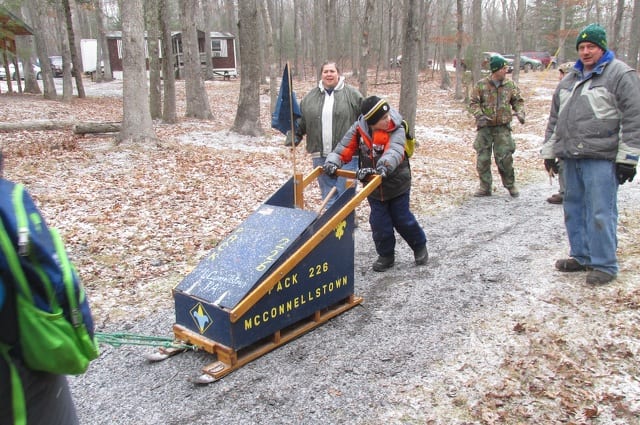
This event is a competition between Boy Scout patrols pulling dog sleds to several stations located around the campgrounds. Each station presents a task for the boys to complete while being judged by scout leaders and local volunteers on their skills, efficiency, and teamwork. The Klondike Derby, which is the largest annual event held in the Seven Mountains Camp, is sponsored by the Juniata Boy Scouts Council, which includes Mifflin, Juniata, Huntingdon, and Centre counties.
Organization of the Klondike Derby was headed by Paul T. Fagley, who was a participant in the third Klondike Derby as a Boy Scout in 1974. Fagley’s father, the late Paul J. Fagley, was chairman of the event for 36 years. This was Fagley‘s 36th year serving either as chairman or co-chairman of this popular event, tieing his father’s record of service.
About 350 scouts from all around Pennsylvania and northern Maryland brought 71 sled teams to compete in this year’s derby. The sleds are manned by patrols of three to five boys in either the Scouts (Iditarod) class or the Webelos (Malamute) class. The sleds are started in groups of eight: four Scouts, and four Webelos at a time. The boys spend several hours moving from station to station, completing their tasks, which include cooking breakfast, archery, skeet shooting, first aid, and several others. The boys learn lessons in teamwork, leadership, and working in cold weather at this event. Chatter, laughter, and clouds of steamy breath were the order of the day as the scouts traversed the snow-covered grounds pulling their equipment-laden sleds.
The theme of this year’s derby was “The Chisholm Trail,” celebrating the 150th anniversary of the famous cattle drive trail of western lore which ran from southern Texas to Kansas, where cattle were shipped eastward. The trail was used in the post-Civil War era to drive cattle overland, from ranches in Texas to Kansas railheads. The trail was named for fur trader Jesse Chisholm, whose portion of the trail went from his southern trading post near the Red River, to his northern trading post near Kansas City, Kansas. It is estimated that about five million head of Texas cattle reached Kansas over the Chisholm Trail from 1867 to about 1880.
Following the Civil War, returning soldiers to Texas found the southern part of the state over-run with unbranded longhorn cattle. Few wanted them, but there was money to be made in the east, if a way could be found to get the cattle there. Cattle drives had been going on since the 1830s, but they were more regional. Now, the idea was to get them across the country. Texan Joseph McCoy took advantage of changes in the law that allowed cattle drives into Kansas. To make it work, he enticed the Kansas Pacific Railway to build a spur line to Abilene, Kansas. The first drive arrived there in September of 1867, and the days of the Chisolm Trail had begun.
A typical cattle drive included 2,000 to 3,000 head of cattle, 10 cowboys, a chuck wagon, and a horse wrangler. They travelled about 8 to 10 miles a day, allowing the cattle to graze along the way. They had to ford rivers, outwit bandits, and deal with prairie storms and flooding. The slow pace meant that there was much time spent around the campfire, telling stories and singing songs, many of which became part of American folk music. Songs such as “Home on the Range,” “Red River Valley,” and “The Old Chisholm Trail,” were popular with the cowboys. This was the basis of the romantic image of the American cowboy, which ultimately led to a host of popular western movies and television shows half a century later.
The Klondike Derby featured a living history presentation by comedian, historian, and singer Ray Owens, who sang those songs and more for the scouts. ”Come along boys and listen to my tale, I’ll tell you of my troubles on the old Chisholm Trail. Come a ti, yi, yippee, yippee yay, yippee yay, come a ti, yi, yippee, yippee yea,’ sang Owens, opening his show. Fagley noted that “The Old Chisholm Trail” has over 1,000 documented verses, and an unknown number of undocumented verses, composed by cowboys along the trail. Fagley said the scouts would collect written verses of the song at each of the 12 stations in the derby, then they could write their own verses, and the 10 best scout-written verses will be posted on the Juniata Council’s Facebook page.