
This story originally appeared in the May 2026 issue of Town&Gown magazine.
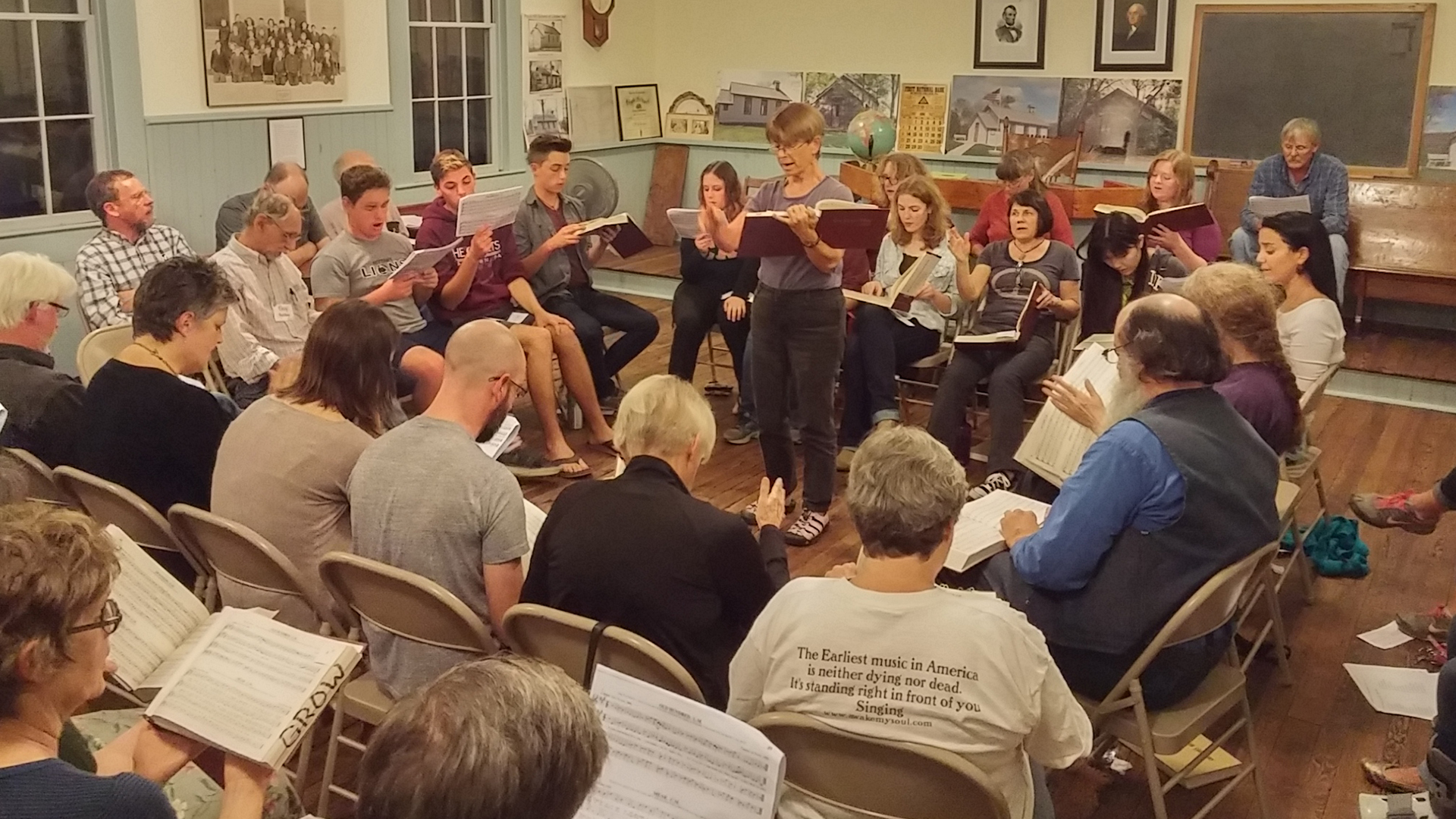
The 200-year-old Early American tradition of shape-note singing is experiencing a resurgence in popularity. Singers of all abilities can try this unique folk art at the free, twice-monthly State College Sacred Harp singings held at University Mennonite Church. While the songs have Christian lyrics, everyone is welcome, and there’s no expectation of any religious affiliation.
“It’s loud and full-throated and uninhibited. And you can lose yourself in it,” says organizer Hal Kunkel. “Vocal quality is not important.”
The music is sung in four-part harmony without accompaniment (a cappella). Singers sit in an open square formation, soprano, alto, tenor, bass, facing inward, singing for each other.
Singers have the option of standing inside the square to lead the song they choose, moving their arm to keep the beat, immersed in the sound of the joined voices.
“The way we operate, it’s egalitarian and there is no one leader,” Kunkel says. “We all take a turn picking a song.”
“I’ve tried really hard to make it a casual thing. We can laugh. There’s no judgment. There’s nobody saying you’re out of tune or not keeping up.”
Fans of the music also call it Sacred Harp singing, after the most popular song book, “The Sacred Harp.” Originally published in 1844, the most recent edition was released in 2025. State College Sacred Harp also sings from “The Shenandoah Harmony,” and provides both books for the group singings.
The music is loud and rhythmic, and the harmonies can sound strange to modern ears. Kunkel says much of the music has folk origins and is written in a pentatonic (five note) scale, instead of the modern eight note scale. “It is harmonically starker with fewer notes in the scale. … If you sing “Amazing Grace,” it uses that scale.”
“Amazing Grace” is included in “The Sacred Harp: 2025 Edition,” as “New Britain,” on page 45. The written music uses four shape-notes — Fa (triangle), Sol (circle), La (rectangle), and Mi (diamond).
Kunkel says the shapes were developed by a teacher in the early 1800s to help people on the frontier and in rural areas, without music education, learn the intervals between the notes.
The music is sung through once using the names of the notes before singing the lyrics. Kunkel encourages new people not to worry about keeping up with singing all the shape names. It’s fine to relax and just sing “La, La, La.” Many prefer to sit next to an experienced singer at first to learn that way.
He discovered shape-note music in 1988, when he bought the record “Rivers of Delight” by the Word of Mouth Chorus. Years later, WPSU announced a local shape-note singing. He went and realized, “I have to be part of this.”
In 2007, Kunkel was able to recruit enough singers to start State College Sacred Harp. Two original members, Chas Brua and Betsy Gamble, are still active members.
Gamble, a local musician, first sang the music in 1978, helping a grad student in Ann Arbor who was doing his dissertation on Sacred Harp. After moving to State College, she heard Sacred Harp music coming from the church while walking her dog. Her dog joined them for the first singing.
“I find it interesting that in a lot of church choirs, there are hardly any men who sing. There’s lots of men who come and sing Sacred Harp.”
She says in the 1840s, it was one of the first places where women could stand up in front of a mixed audience and lead a song because it was egalitarian. Women composers are also in the books from the 1800s.
Maura Sugg started shape-note singing in 2018 while studying music history for her master’s degree at Indiana University (Bloomington). “It was so much fun!”
She moved here and began singing with State College Sacred Harp in September 2025, while working on her PhD dissertation at Case Western Reserve University. “It’s just a really nice release. … I also like the sound of the music … When it really kicks in, it’s so powerful. The sound just strikes you.”
“I’m obsessed,” says Nick Occhino, a musician, choral singer, and cleaning business owner, who travels from Williamsport to sing Sacred Harp.
About 10 years ago, he came across shape-note singing while researching other musical interests, and was amazed to discover, “America has our own home-grown a cappella tradition.”
He studied and tried to learn on his own. In early 2026, he attended a Sacred Harp singing at Taste of Folk College in Bellefonte, and committed to singing with State College Sacred Harp. He’s attended three large Sacred Harp conferences in other cities.
“It’s a much different experience, doing it with others. There’s something about being there in person that you can’t capture in a recording. There’s something magical that happens.”
Occhino says, “I think people are looking for something like this. A sense of community, a place to sing together and be together. … It gives me a lot of hope in humanity to be able to set aside our differences and just sing.”
State College Sacred Harp meets from 7 to 8:30 p.m. on second and fourth Mondays at University Mennonite Church, 1606 Norma St., State College, with beginner instruction at 6:45 p.m. For more information, contact hal.kunkel@gmail.com or visit statecollegesacredharp.com. T&G
Karen Dabney is a freelance writer in State College.
More Community
View all Community
Ironman 70.3 Happy Valley Returning With New 3-Year Contract
The Ironman 70.3 Pennsylvania Happy Valley will continue through 2029 under a multi-year contract extension announced Wednesday. The triathlon event drawing athletes from across the country and around the globe […]

Penn State to Honor 9/11 Victims with Flag Display, Memorial Events Marking 25th Anniversary
Penn State will commemorate the 25th anniversary of the Sept. 11, 2001, terrorist attacks this week with a series of remembrance events at University Park and several commonwealth campuses. Events […]

Great Insect Fair Bringing Live Bugs, Honey Tasting to Snider Ag Arena
Live insects, honey tasting and hands-on activities will take over Penn State’s Snider Agricultural Arena this weekend as the annual Great Insect Fair returns for a day of free, family-friendly […]


