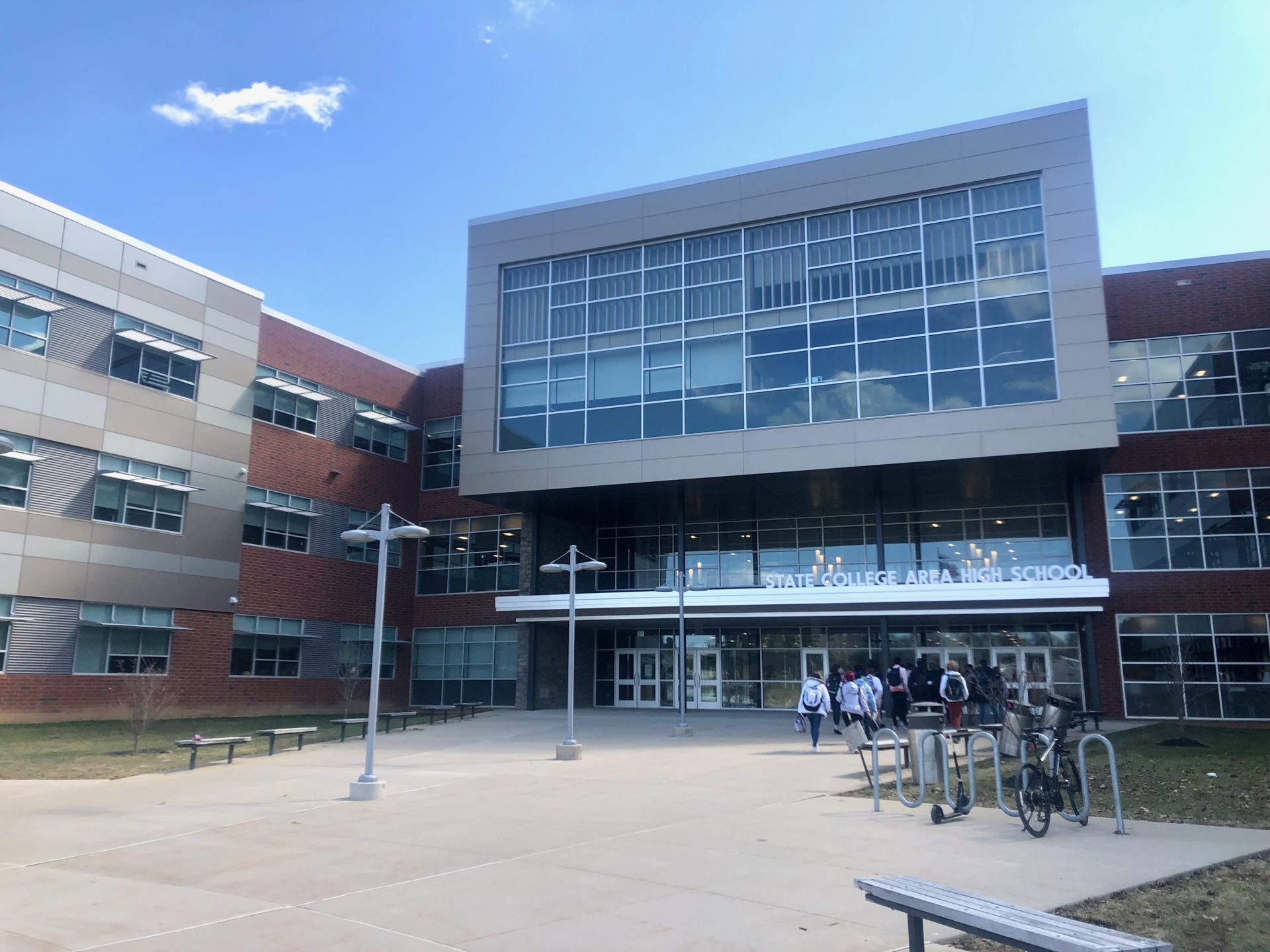
State College Area School District has updated its pandemic health and safety plan with a different approach to masking policies for the new school year.
Masks will be optional regardless of Centre County’s COVID-19 community level, as determined by the Centers for Disease Control, but will be highly recommended if the county is at the high community level, according to the updated plan presented by district administrators at Monday night’s school board meeting.
Community levels measure new COVID-19 cases, new COVID hospital admissions and percent of staffed inpatient beds occupied by COVID patients over a seven-day period. Centre County has been at the low community level for the past six weeks and for all but four weeks since the levels were introduced in late February.
Last year, SCASD required masks indoors until mid-March and then again for a few days at the end of the school year in late May when Centre County was briefly at the high community level, at which the CDC recommends universal indoor masking in public places.
Masking also will be optional outdoors and on district transportation at all community levels. Board Vice President Amy Bader recommended that the plan encourage masking for large indoor gatherings and prioritization of using outdoor space when possible.
A district-wide mask mandate would only be considered if one was implemented by local municipalities. In that case, the health and safety team would first consider transmission and case numbers within the schools, Director of Student Services Jeanne Knouse said.
The district will, however, continue monitoring possible transmission at the classroom, grade or school levels. If three or more COVID positive cases are connected as close contacts, temporary, targeted mandatory masking would be considered on a case-by-case basis.
“The class-by-class is pretty easy because when you see three that are connected that are close contacts to each other that’s usually the trigger of a spread,” Knouse said. “In the school it gets a little bit trickier because you’re vastly different and the connections could be family or other things, so that’s why we like to dig into those pieces and see a little bit further.”
Mitigation easement plans developed for high-risk students when the mask mandate was dropped in the spring will continue, with district personnel expected to follow up with families on what will be needed for their students this year, Knouse said.
“That was really writing a plan that they created where they would be masked and the people around them would still continue to mask,” she said. “That’s something we’re still going to continue to implement… That’s part of the process we’re going to present to administrators, following up with their easement plans and making sure that those students are in a good place, either continuing it or discontinuing it based on where the family is.”
Aside from masking, the updated health and safety plan, which is effective Aug. 15, has minimal changes from the spring, offering what Knouse and interim Superintendent Curtis Johnson called in a memo “a layered prevention plan to provide multiple safety measures and flexibility,” with the goal of maximizing in-person learning.
A health and safety plan is required for schools to receive Elementary and Secondary School Emergency Relief Fund.
“We’re trying to come up with a plan that meets all our scenarios as much as possible so that we don’t have to constantly guess or come to a meeting to figure out what the next steps are,” Johnson said. “We’ve been through this a couple years now and have learned from what we’ve done so far. We’ve hopefully come up with a plan that will help us for this school year at least.”
The district will continue to offer elementary Virtual Academy this year and is hiring four part-time teachers for the secondary Virtual Academy, Johnson said.
The health and safety team’s core membership — Knouse, senior administrators, school nurses, a Penn State infectious disease expert and two pediatricians — will remain in tact but expects to meet quarterly or as-needed instead of weekly.
“In talking with superintendents across the country and county and talking to our safety team, they’re thinking that this is something we’re always going to have,” Johnson said. “It might not be the pandemic but there will be other scenarios or situations that we would need to call on a health and safety team to come on board to help us make a decision. I think it’s good that we have people in the community that are willing to volunteer and come forward to help us make these decisions.”