
Raising a child is challenging. As the oft-cited African proverb states, it takes a village.
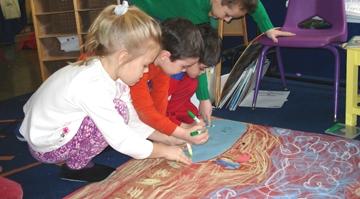
Although parents and other primary caregivers undeniably play the most influential part, many pieces of a child’s development begin to fall into place when they have opportunities to observe, play, and learn alongside their peers.
Introducing children to group learning opportunities at an early age greatly expands their experiences, observations and vocabulary at the time when their neural networks are developing more quickly than at any other time in their lives. It also helps them to strengthen human bonds with caring adults and a wider circle of friends.
Many studies have shown that young children have the greatest aptitude for learning language through stories, participating in discussions, making music, and forming relationships. Loving interactions with caring adults play an important role in their ability to accept and explore new situations without fear, enabling them embrace new opportunities.
Parents play a vital role by reading, organizing play dates and visits to the library, or encouraging their children to participate in organized activities. Add to that a quality, caring preschool environment with the right balance of structured learning and play, and you have a rich tapestry of unique opportunities for social development and exploratory learning.
The Pennsylvania Child Care Association, a leading voice for childcare in our state, underlines the importance of early learning programs that offer stimulating environments and responsive teachers.
The National Institute of Child Health and Development (NICHD) reports that when children are exposed to high-quality child care, it results in stronger outcomes — even during their teen years — including higher academic achievement.
Since children learn both by observing others and by trying to accomplish things on their own, they are bound to learn something from adults and their peers in any group situation. However, since their impressions, experiences, and discoveries build neural networks that are the foundation and framework for all future learning, don’t we owe it to them to ensure they are placed in the best, most caring environments with access to passionate and compassionate teachers from their earliest years?
Options for early childhood education abound, from daycare to playschool or nursery school to the more structured learning opportunities that a preschool typically offers. Although passionate teachers with a good education can be found in many different environments — both public and private — a faith-based preschool offers something unique: a different motivation for what we do.
A faith-based preschool is typically led and staffed by people whose passion for teaching is matched – and even driven – by a common sense of mission: to care for each child as one of God’s unique, loved creations. Helping children to care about others as well as themselves; to put the proverbial shoe on the other foot (as soon as the idea can be grasped); to have good manners; and to make positive contributions that help those less fortunate than ourselves, become goals we not only discuss, but strive to live by example.
Although Christian, Jewish and other faith-based early childhood learning centers take different approaches, each has a “village” of caring people who can help children to learn values as well as to develop socially, academically, emotionally, and spiritually.
Faith-based care challenges its workers and volunteers to care for the whole child. By doing so, we carry out our individual and collective mission, helping children to discover and develop their God-given gifts so they can use them fully both for their own enjoyment and to make the world a better place.
Whether you work with young children, are parenting (or once parented) your own, interact with students regularly, or only do so occasionally, you are a teacher — if not by choice, then by your everyday modeling. Don’t be fooled when children seem disinterested, distracted or aloof, for they are studying your voice, reactions, observations, discoveries, and interactions with others.
By recognizing the opportunity (and responsibility) we have to shape our children, we should realize we do, indeed, have a say in the future of the ‘village’ around us. If we take our role seriously at home, in public, and in our decision regarding where to place our children as they enter the world of group learning, individually and collectively we have the opportunity to make our world a better place.
More Arts & Entertainment
View all Arts & Entertainment
‘Rock the ’80s’ Benefit Concert Set to Return to State Theatre
2023's "Rock the '80s" concert will mark the annual fundraiser's first in-person event since 2019.

Your Vote Could Help Bring a Free Outdoor Concert Series to State College
You can vote by visiting levitt.org/vote or by texting 866-267-2023 and using the keyword "STATECOLLEGE".

Happy Valley Cornhole tourney returns
STATE COLLEGE — The second Happy Valley Cornhole Tournament will take place on Sunday, April 5 at the American Legion’s Post 245 location at 1950 Pine Hall Road in […]


