
While visiting my parents in Florida last Thursday I was drawn to a black-and-white photograph of me and my two daughters taken by my friend Charles Moore around 1993. I have my own print of the image, but seeing it in my parents’ place reminded me of how lucky we were to have a family portrait by the guy responsible for some of the defining images of the Civil Rights era.
Weirdly, when I got home I learned that Charles had died less than an hour’s drive from where I was on the very day I was contemplating that family portrait. He was 79.
When I met Charles Moore in California he had left photojournalism to “shoot beauty,” as he put it in a quote that appears in his New York Times obituary. (One of Charles’ “beauty” photos, a ristra of red peppers against an ink-blue sky, hangs in our dining room.) He had an elfin look – ruddy-faced, snub-nosed, with a fringe of white curly hair. A sweet man.
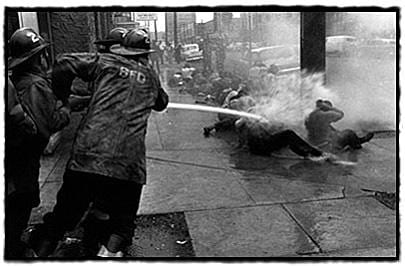
After reading of Charles’ death I borrowed a collection of his Civil Rights-era photos, “Powerful Days,” from Schlow Library. Here are the photos of Martin Luther King being manhandled by police officers at the Montgomery, Ala., jail; of officers clubbing participants in the march from Selma to Montgomery; of police dogs tearing at a marcher’s pants leg in Birmingham, Ala.; of Birmingham firemen blasting demonstrators with high-pressure hoses — “a weapon that could skin bark from a tree at a hundred feet,” according to Gene Roberts and Hank Klibanoff, authors of the 2006 book, “The Race Beat.”
Charles grew up in Alabama, but as a photographer for Life magazine he became an enemy in the eyes of his own people. Recalling a confrontation with a white student protesting James Meredith’s enrollment as the first black student at the University of Mississippi, Charles said, “I have never seen such hate on anyone’s face before…To him I was worse than ‘a nigger,’ I was a white nigger…and worse than that I was a white Life magazine nigger.”
From the late 1950s until, exhausted by all the violence, he walked away in the mid-‘60s, Charles was jailed, tear-gassed, threatened and pelted by rock throwers. He tried to explain, over and over again, that he was “simply here to cover a story.” But people who are using attack dogs and baseball bats and fire hoses to prevent their fellow citizens from registering to vote or getting an education do not want their story to be covered.
They were right to be worried. Charles’ photos horrified the world. And changed the world: Several of his obituaries noted that his Life photos played a significant role in the passage of the Civil Rights Act in 1964.
While paging through “Powerful Days,” I muttered something about what a “messed-up history” our country has had.
My daughter, a ringletted toddler in Charles’ family photo, now home from college for spring break, disagreed. Look at how much the world has changed since those days, she said. It’s true. Charles noticed the difference when he returned to the South in the 1970s:
“Birmingham by this time had a black mayor and a black police chief …This was a city in my home state – where I had been arrested, where I had seen violence, where I had been injured – and there had been a turnaround here. Although they had a long way to go in rebuilding race relations and a long way to go for the economy, Birmingham was a better city. It made me feel good that my pictures had something to do with that.”
At the same time, Charles warned against considering the battle won when it comes to social justice.
“At time I feel we are a complacent society,” he wrote, “and in a complacent society lies decay.”
The same day Charles’ obit was posted on The New York Times’ Web site, the front page of USA Today featured a photo of male and female college basketball players under the headline, ‘Time to get SERIOUS.”
Friends, if there’s one thing the NCAA tournaments are not, it is serious. I’m a sports fan myself, more pumped for the start of baseball season than for the Big Dance, but lately it seems like we live from one big, fat entertainment to the next – from the Super Bowl to the Olympics to March Madness, with a little Oscar night thrown into the mix – while the world is collapsing all around us.
Yes, we need our distractions, especially during a time of high anxiety. But all distraction (the next day’s USA Today front page asked, “Can Tiger make it back?”) and no engagement is a symptom of a complacent society.
Charles Moore mirrored America at its worst, but by showing us the determination and courage of those who fought for civil rights and by exhibiting that same determination and courage himself, he also gave us America at its best.
More Columns
View all Columns
Greek Life at Penn State: Plus Ça Change
It was back to business as usual among the Woo people last weekend, which meant very loud outdoor parties, very many shirtless young males and very many young females wearing […]
It’s Time to Watch Penn State Linebacker Tony Rojas… Again
Watch Tony Rojas. He’ll be back at linebacker for Penn State on Saturday against Marshall, the culmination of a journey that seemingly took him everywhere, but ultimately brought him back […]

Hook: Weather Wonders and School Stress
Six days a week, my wife and I like to get out for a walk around the neighborhood. We skip Sunday – a day of rest and all – but […]


