
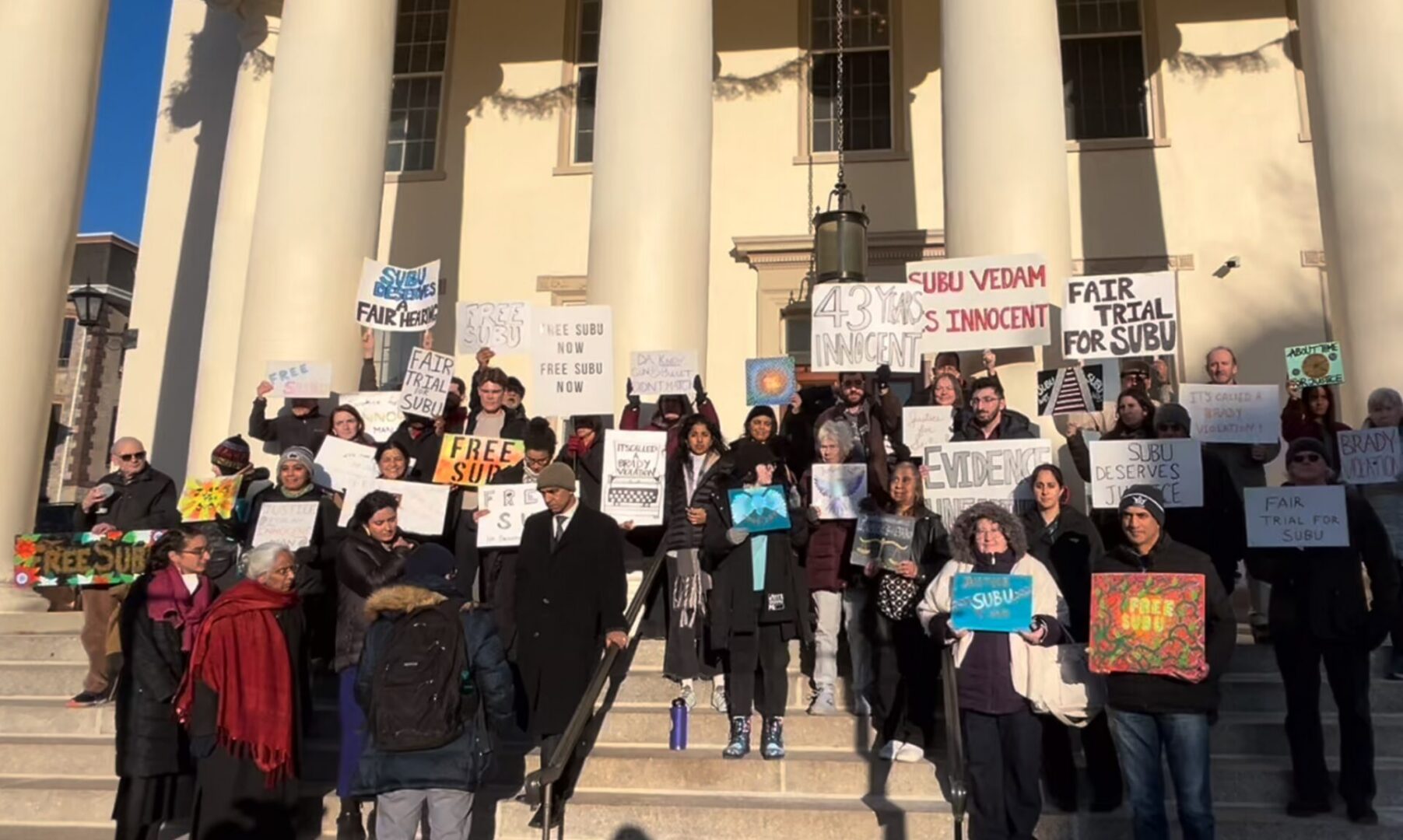
Updated 10:57 a.m. April 17.
The Department of Homeland Security on Monday appealed an immigration judge’s decision to allow a State College man who spent 43 years in prison on a now-overturned murder conviction to remain in the United States.
It was one of two legal setbacks this week for Subramanyam “Subu” Vedam, as a federal district court judge gave the government a month to respond to his petition to be released from the Moshannon Valley ICE Processing Center on bond until his immigration case is resolved.
The two decisions mean Vedam will remain detained at the facility near Philipsburg until at least mid-May. A spokesperson for Vedam’s family said the the DHS appeal and the timetable for a district court review “has pushed the staggering hardships Vedam has withstood into a new level of surreal territory.”
Vedam was released from Huntingdon state prison in October after a Centre County judge vacated his conviction for the 1980 murder of Thomas Kinser, but was immediately detained by ICE for a deportation order issued in the 1990s based on his separate, decades-old conviction for selling LSD when he was 19 and has been in ICE custody for the last six and a half months.
The government is seeking to deport Vedam to India, where he was born in 1961 during a brief period when his parents returned to their home country. He has lived in the United States since he was nine months old and was a legal permanent resident, or green card holder, close to earning his citizenship when he was arrested in the spring of 1982.
Vedam has no immediate family in India and does not speak any of the country’s languages.
Immigration Judge Adam Panopoulos on April 2 granted Vedam’s request for a waiver from deportation, saying that the 64-year-old demonstrated “good moral character” over the last four decades and that it “would be in the best interest of the United States” for him to remain in the country.
His sister, Saraswathi Vedam, called the government’s decision to appeal a “callous act” that has left her family “deeply disappointed and confused.”
“Even after all the gross injustices Subu has suffered, we could never have fathomed that he would remain behind bars more than eight months after he was exonerated for a crime he didn’t commit and more than two weeks after a court ruled that he deserves to stay in the country where all of his family are,” she said in a statement on Thursday. We urge the courts to rectify this debacle before it does more damage to Subu, his family, his community, and the integrity of the justice system.”
Though Panopoulos ruled that Vedam should remain in the U.S., citing his exemplary record as an inmate during his lengthy incarceration before he was exonerated and strong family bonds, the government had 30 days to appeal. Panopoulos subsequently denied Vedam’s request for release on bond during that period, upholding another judge’s previous ruling that he is subject to mandatory detention while the case is ongoing.
Vedam asked the U.S. Western District Court of Pennsylvania to intervene by ordering his release or a bond hearing, and on Monday Judge William S. Stickman gave the government until May 13 to respond to the request.
Vedam’s attorneys argued that had he not been incarcerated for the murder for which he has since been exonerated, he would have been released from prison on the drug conviction no later than 1992. A deportation order had not been issued then, and if it were Vedam would have been eligible for bond under federal law at the time.
“To subject Mr. Vedam to mandatory detention because he remained in prison due to a constitutional defect in his criminal proceedings grotesquely punishes him for being the victim of violations of his constitutional right by the state,” Vedam attorney Tamara L. Jezic wrote in the petition.
Vedam was first arrested and jailed for selling LSD, and soon after was charged with the murder of fellow 19-year-old State College area resident Kinser, who was last seen in December 1980 and whose body was discovered by hikers in Harris Township in the fall of 1981.
He was convicted of murder in 1983 and again at a retrial in 1988. But in recent years his post-conviction attorneys uncovered suppressed ballistics evidence that Centre County Judge Jonathan Grine determined had a strong likelihood of swaying the jury to find him not guilty, had it been presented.
Grine overturned the conviction in August. Centre County District Attorney Bernie Cantorna then dropped the charges on Oct. 2, saying that the case would be nearly impossible to prosecute with key evidence and witnesses no longer available and that he believed Vedam posed no danger to society.
On the day of his release, however, Vedam was taken into custody by ICE and later was transported from the Moshannon Valley facility to Texas then Louisiana in preparation for his removal. He was then returned to the Clearfield County facility after a federal district court granted an emergency stay.
The U.S. Justice Department’s Board of Immigration Appeals in February put a moratorium on ICE’s efforts to deport Vedam while his case proceeded through immigration court, with a judge writing that his case “presents an exceptional situation.”
After more than three hours of testimony during a hearing earlier this month, Panopoulos’ ruled that Vedam could live freely in the U.S., saying that during his time in prison “the choices that he did make consistently point to a man who has good moral character.”
“He never engaged in any fights and was never accused of violence of any kind. He felt compelled to act in response to what he saw as injustices within the prison system, such as the high rates of illiteracy in the prison population. He dedicated himself to connecting with his U.S. citizen family members, just as if he was not inside prison and was building those relationships with his family members throughout his life. He consistently read and studied to sharpen his mind and achieve advanced degrees.
“All this evidence taken together indicates to this court that [Vedam], from his 20s until his mid-60s, took actions that objectively demonstrate that he is a person of good moral character.”
More Local News
View all Local News
Subu Vedam: It’s Now One Year in ICE Custody
What is there to say about the case of Subramanyam Vedam at this point? Only this: Subu was released because, after 43 years in prison, a Centre County judge agreed […]
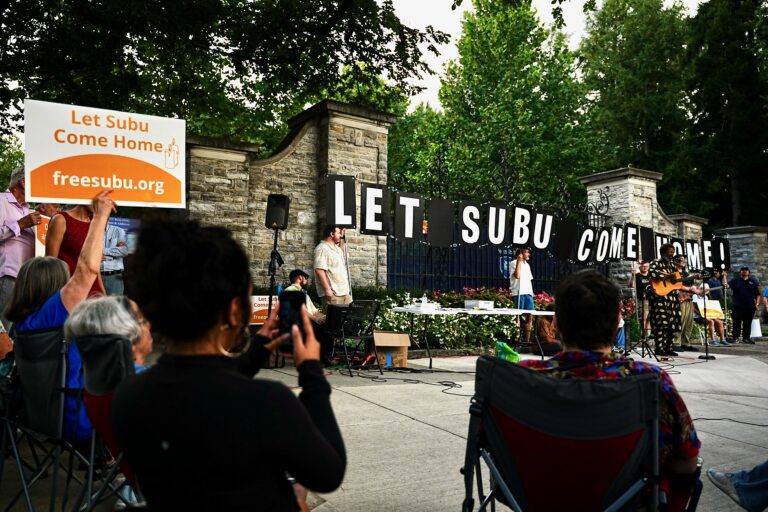
One Year After Subu Vedam’s Exoneration, Supporters Hold Vigil Calling for His Release From ICE Custody
Dozens of people gathered at the Allen Street Gates Thursday evening for a vigil calling for the release of Subramanyam “Subu” Vedam, who remains in federal immigration custody while the […]

Judge Denies Subu Vedam’s Release From ICE Custody While Feds Appeals Immigration Ruling
A State College man who was detained on a deportation order upon his release after four decades in prison for a now-overturned murder conviction will remain in custody while the […]


