
Since the great recession of December 2007 to June 2009, U.S. interest rates have been kept artificially low to invigorate the economy. Rates were kept at zero until December of last year when the Fed raised by 25 basis points, which was the first rate increase since 2006.
In addition to emergency level interest rates, the Central Bank put into effect Quantitative Easing (QE), which increased the money supply and supported the low interest rates. The third round of QE ended in October 2014. These measures were put into place to avoid deflation, which can take a recession and turn it into a depression.
Deflation is a decrease in the general price level of goods and services and when the inflation rate falls below 0 percent. Thus, deflation is a negative inflation rate. The Federal Reserve had two objectives as they continued to keep interest rates low: 1. Full employment and 2. Steady 2 percent inflation.
Reaching these objectives would show we had recovered from the real estate bubble bursting.
How bad was it? In 2008 and 2009, the U.S. labor market lost 8.4 million jobs and official unemployment (U3) peaked at 10 percent. A much darker picture was painted by the U5 unemployment rate, which includes discouraged workers. This wider benchmark of unemployment hit highs of 11.3 percent while the U6, which includes workers who are part-time merely for economic reasons, hit 17.1 percent in December 2009.
From the unemployment highs, the rates began to decrease until the latest reading which shows U3 (official) unemployment at 5 percent, U5 at 6 percent and U6 sitting at 9.7 percent. The latest reading has the San Francisco Federal Reserve President, John William saying, “We’re basically at full employment. That’s very good news.” For two years, the U.S. has been adding about 200,000 jobs a month.
Wage growth still lags a typical recovery. Wages are currently growing at 2.5 percent a year compared to a usual 3.5 percent growth in a full employment environment.
The loose monetary policy here and overseas to reverse global economic slowdown leads to an expectation of higher inflation. Printing money was used to help fight deflation (negative inflation) so too much money can go too far and lead to high inflation. As we have a tighter labor market and wages increasing, this could lead to “cost push inflation.” When costs increase for firms, firms will pass those costs onto their consumers. Wages are the most significant cost for many firms. In addition, higher wages can lead to rising demand as discretionary income increases.
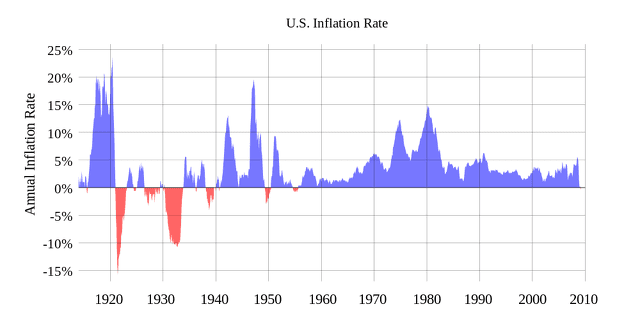
The goal for the Fed is 2 percent inflation, which indicates healthy growth but not harmful inflation. Typically, over 4 percent is considered high and the average inflation since the government started tracking in 1913 is 3.22 percent. U.S. inflation decreases the buying power of the U.S. dollar. For instance, a loaf of bread in January 1913 cost $0.056 and in January 2013, it cost $1.422 — a 2439 percent increase. That’s why often “real returns” or “real wage increases” are quoted. Real returns show the annual percentage return realized on an investment, which is then adjusted for inflation. In simplest terms, if you get a 2 percent raise but inflation goes up 3 percent, your buying power technically went down by 1 percent, decreasing your ability to buy goods and services. You may have more cash to spend from the raise but inflation dilutes the advantage by decreasing the value of your money.
There are different ways of tracking inflation. The Consumer Price Index (CPI) measures changes in the price level of a market basket of consumer goods and services purchased by households. This includes gasoline, shelter and food. Social Security adjusts for inflation by using the COLA (Cost-of-Living Adjustment) based on the CPI. Given the large drop in energy prices last year, no COLA adjustment was given for 2015.
Core inflation is the Consumer Price Index (CPI) excluding energy and food. The argument for using core inflation is that it excludes items that face volatile price movements. This inflation measurement is used to forecast future inflation because of the decreased volatility.
The Producer Price Index (PPI) is an index of prices measured at the wholesale or producer level. The PPI is more a measure of producers, thus the name.
Finally, when Janet Yellen and company say they want to reach 2 percent inflation, what are they looking at? Well, none of the above. The Federal Reserve tracks the PCE Inflation (or Price Index) for Personal Consumption Expenditures. It is a measure of inflation, which measures goods and services targeted toward and consumed by individuals. PCE price index is up year-over-year .82 percent as of March 2016 and the Core PCE Index (excluding food and energy) was up 1.56 percent for the same time frame. The core is approaching the Fed’s target.
Types of investment created to benefit from inflation are Treasury inflation-protected securities or TIPs. Many exchange-traded funds and mutual funds invest in TIPs. Securities linked to commodities also tend to do well in inflationary environment.
It has been a while since we had to deal with inflation and it can be very damaging at higher levels, particularly to retirees. It is definitely something to keep an eye on moving forward.
More Business News
View all Business News
Mezeh Mediterranean Grill Set to Open in Downtown State College
Update: After the publication of this article, a Mezeh spokesperson said the State College restaurant is now scheduled to open on Feb. 22, not Feb. 10 as originally reported. Hummus, […]

Back in Blonde and Brewing
When she opened The Blonde Bistro in downtown Bellefonte 12 years ago, owner Ciara Semack—she puts the blonde in Blonde Bistro—was glad to provide a comfy atmosphere where customers could […]

State College Residents Launch Hand-Crafted Charcuterie Board Business
Not many people can say they got a business idea from a girls’ night with friends. But for Heather Heverly and Sarah Ehrlich, a seemingly normal do-it-yourself charcuterie board activity sparked the idea to create their own business.


