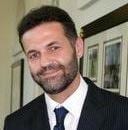
Saying that Osama ‘bin Laden has hijacked our faith,’ author Khaled Hosseini told a Penn State audience Thursday that not enough moderate Muslims are speaking out against radical influences on Islam.
‘I will say that moderate Muslims have a lot to answer for,’ Hosseini, the author of ‘The Kite Runner,’ said before a crowd estimated at 1,500 in Eisenhower Auditorium.
He said that the U.S. news media deserve some blame for negative perceptions of Islam. But moderate Muslims also need to look inward to see how they could be communicating better in the public sphere, Hosseini said.
When moderate Muslims do speak out, he said, too often it’s about the wrong things — such as a Danish cartoonist’s depiction of Islam.
Hosseini’s remarks about his faith were a relatively brief element in his roughly hour-long appearance Thursday night. Visiting as part of the university Distinguished Speaker Series, Hosseini did not offer a monologue; instead, he engaged in an extended question-and-answer session with Schreyer Honors College Dean Christian Brady and with the audience.
At a press conference before his public appearance, Hosseini said he thought the more interactive format would provide ‘a better sense of the individual.’ He prefers a conversation over a speech, he told reporters.
Born in Kabul in 1965, Hosseini said he has enjoyed writing since his youth, but never planned to become a career writer. His father was a diplomat with the Afghan Foreign Ministry — a job that prompted his family to move to Paris in 1976.
From there, four years later, Hosseini and his family moved to the U.S., where they were granted political asylum after the Soviet Union’s invasion of Afghanistan.
Hosseini went on to become a doctor in California, even though ‘medicine was more a job for me than a calling,’ he explained in the press conference. He continued in his spare time to write short stories, including a 25-pager that he penned in 1999.
It was tucked away in the family garage, Hosseini said, when his wife found and read it two years later. She told him it was really good.
Hosseini challenged himself to extend the piece into a full-length novel, and ‘The Kite Runner’ was born — published in 2003. It has become an international bestseller. Hosseini has since left medicine, written a second book — ‘A Thousand Splendid Suns’ — and become a goodwill envoy to the United Nations Refugee Agency.
Still a California resident, he also leads the Khaled Hosseini Foundation, which helps provide returning Afghan refugees and other poor Afghans with housing, education and economic opportunities.
While ‘The Kite Runner’ follows two fictional characters during the fall of the Afghan monarchy and the Soviet invasion, Hosseini said Thursday that the piece is not a memoir. He emphasized that it’s a work of fiction that draws on his own experiences.
‘It’s about very basic human things,’ Hosseini said, such as the destruction of innocence and profound guilt. ‘People who read this book are rarely left indifferent.’
But ‘I’ve never intended for this book to be anything other than me telling myself a story,’ he went on.
In the process of chronicling the tribulations between two Afghan characters, Hosseini said, he managed also to chronicle a historic period in Afghanistan history. He said ‘The Kite Runner’ has helped illustrate, to non-Afghans, how Afghans see that period in their country’s past.
Among other points that Hosseini touched on Thursday:
- Few parallels exist between the Soviet invasion of Afghanistan and the U.S. military’s presence there, he said. He said Afghans despised the Soviets, who propped up a communist regime that ‘no one wanted to see … succeed.’ But the U.S. military goals in Afghanistan are similar to the goals that Afghans have set for themselves, including self-governance and stability, Hosseini said.
- What Afghanistan needs now is ‘a political solution,’ not a military one, Hosseini said. He said he is glad that the administration of U.S. President Barack Obama recognizes that. Hosseini underscored that the Taliban has very little support among Afghans — the backing of perhaps 10 percent of the population, if that, he said. He said the Taliban represents 20,000 to 30,000 ‘militiamen’ in a country of ’40 million peaceful people.’
- Hosseini said Afghans deserve more transparency in their government. He believes that government corruption is a serious problem there, he said. But it’s important that change on those fronts come from the Afghan people, not from the outside; otherwise, any campaign for reform will lose credibility, he said.
- Hosseini is optimistic for Afghanistan’s long-term future, but is concerned about the next five to 10 years, he said. He hopes that in a generation or two, the country will have made substantial strides, he said.
- On the issue of the Muslim community center planned in lower Manhattan, Hosseini said he is undecided. He can see an ‘elegance and beauty’ in the plan’s concept, but he also can understand why people have legitimate concerns with the idea, he said. He said he hopes that matter can reach a peaceful resolution that will serve as a teaching point.
Hossein’s talk was free and open to the public, though tickets were required. The next Distinguished Speaker Series event will be an appearance by author and inventor Eisenhower Raymond ‘Ray’ Kurzweil. He will speak at 8 p.m. Oct. 26 in Schwab Auditorium.
Ticket information will be posted at https://spa.psu.edu.
Earlier coverage