

How does having a specific month labeled “Breast Cancer Awareness” help in the fight against breast cancer? For one thing, it simply points a highlighting finger at it.
For years now, women have been urged to do breast self-exams and get yearly mammograms. Despite that, there are many women who get their diagnosis late or when their options are limited. Nearly 240,000 people in the United States are diagnosed with invasive breast cancer every year and nearly 41,000 die from the disease, according to an article by Ingrid Strauch on EverydayHealth.com.
Breast Cancer Awareness Month is an annual campaign that raises awareness of breast cancer risks, the value of screening and early detection. Treatment options are pointed out as well during this campaign. It is important to note that breast cancer also affects men.
Much has been accomplished through various programs, including those run by the Breast Cancer Research Foundation and the Susan G. Komen Race for the Cure. The many products that have the familiar pink ribbon on them proclaim that the company manufacturing the product is donating a percentage of their sales to breast cancer research and treatment.
In spite of all the money being spent on research and treatment, the most important factor in preventing death from breast cancer is still early detection. That can only happen if women listen, learn and follow up on the advice from their doctors that includes performing monthly breast exams and reporting anything unusual. As you do the exams faithfully, you will recognize what is normal in your own breasts. Some things to look for are:
■ Any unexplained change in the size or shape of the breast
■ Dimpling anywhere on the breast
■ Unexplained swelling of the breast or shrinkage of the breast (especially if on one side only)
■ A nipple that is inverted
■ The skin becomes scaly, red or pitted
■ Asymmetry of breasts (although many women have one breast that is slightly larger than the other)
■ Any discharge from the nipple
Remember that eight out of 10 breast lumps are not cancerous, but any symptoms need to be checked and identified so that treatment, if needed, can be started sooner rather than later.
Once a diagnosis of cancer has been made, then what? Much is written about staging the cancer and what that means. According to the National Breast Cancer Organization, there are four stages of breast cancer. At Stage 1, the cancer cells are confined in a very limited area. Stage 2 and 2A is still an early stage, but shows evidence that the cancer has begun to spread. It is still contained to the breast area and is generally effectively treated.
Stage 3A, B and C is considered advanced cancer, with evidence of cancer invading surrounding tissues near the breast. Stage 4 indicates the cancer has spread to other parts of the body.
Those with a breast cancer diagnosis are no longer subjected to extensive scans and tests, as was once the norm. The National Comprehensive Cancer Network put out new guidelines in 1998. The most extensive testing is now commonly reserved for patients with locally advanced disease, such as someone with a large tumor affecting several lymph nodes or one whose long-term physical symptoms suggest a spread to other organs. Even with a seemingly dire report, treatment options are available and so is help for your coming journey.
A patient navigator program is one such help. Most hospitals have the program in one form or another.
Locally, Mount Nittany Health System has a breast cancer navigator. Angelique Cygan has been in that position since 2014 and came in with more than 20 years of valuable experience.
“As the breast health navigator at Mount Nittany Medical Center, I am an advocate for our patients,” said Cygan. “Patients battling breast cancer need a strong support system, especially on the clinical front because it’s usually all new territory for them. I act as educator, consultant and liaison, helping patients navigate their breast care journey.
“An important part of my job is facilitating a monthly breast cancer support group,” added Cygan. “Receiving the news of a cancer diagnosis can be frightening and overwhelming, and having a quiet place to organize thoughts with access to accurate reading material and safe websites is important.
“Another crucial component to the group is a connection with others who have been where a patient currently is or is headed in their journey. Our monthly support group brings a mix of newly diagnosed individuals, as well as, those who have completed treatment. We offer a safe and private environment where patients learn that the path to breast cancer diagnosis and treatment is a well-traveled one and they are not alone.”
The Mount Nittany Health Breast Cancer Support Group is held the first Monday of every month from 5:30 to 7 p.m. in the ground floor conference rooms at Mount Nittany Medical Center, 1800 E. Park Ave., State College.
Cygan’s position is made possible through the year-round fundraising efforts of the Pennsylvania Pink Zone, Lady Lion Basketball and Mount Nittany. There is no cost to a patient to receive services from a navigator.
For more information, contact Cygan at (814) 231-6870 or angelique.cygan@mountnittany.org.
More Health News
View all Health News
Local Leaders, Hundreds of Community Members Rally to Support Mount Nittany Workers Amid Strike
Hundreds of healthcare workers, elected officials, labor leaders and community members packed the Teamsters Local 8 union hall Tuesday afternoon, rallying behind striking Mount Nittany Medical Center employees as they […]
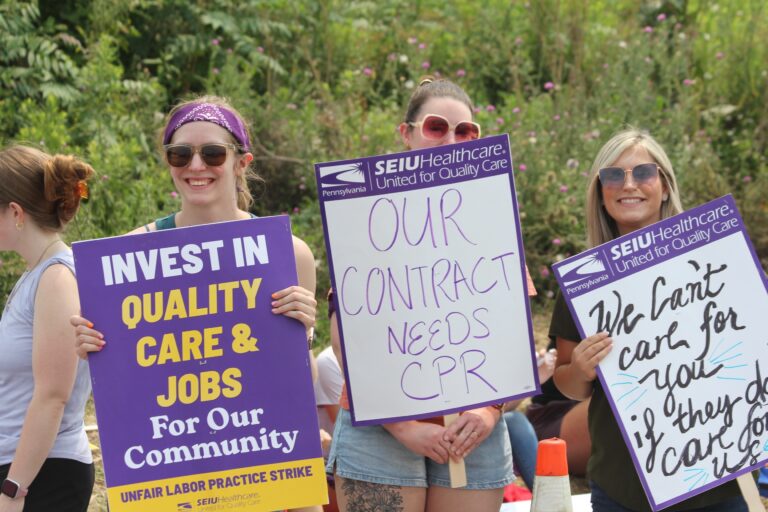
Mount Nittany Medical Center Workers Begin Strike
Mount Nittany Medical Center's unionized employees are officially on strike for the first time since 2004.

With Strike Imminent, Mount Nittany Updates Patients and Takac Urges Return to the Bargaining Table
Approximately 950 Mount Nittany Medical Center employees are poised to begin a five-day strike on Monday, but a Centre County lawmaker is urging a return to negotiations in hopes a […]


