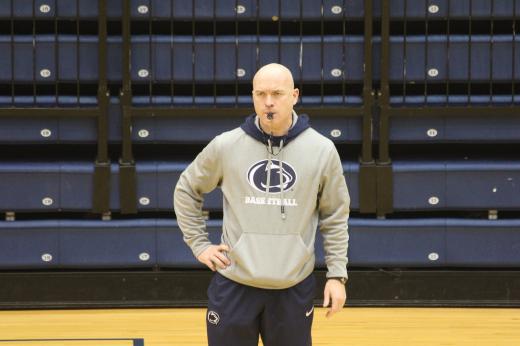
The last time Penn State hired a basketball coach who was not a part of its own firmlyrooted coaching tree was in 1983. The hiring of Patrick Chambers changed that.
While the efforts and successes of all three coaches prior to Chambers are an essential part of Nittany Lion hoops history, almost three decades of a single coaching lineage led to a certain level of staleness in the program.
Bruce Parkhill, hired in 1983 to take over the helm from Dick Harter, left the program a year before his assembled team eventually became a No. 5 seed in the NCAA tournament in 1996. That 1996 squad was inherited by Parkhill assistant Jerry Dunn.
The Nittany Lions saw their fair share of ups and downs under Dunn, making the Sweet 16 in 2001 before plummeting to a 7-21 record the following year. After that 7-21 season Dunn stepped down and Parkhill assistant Ed DeChellis returned to his alma mater to help rebuild a program dealing with the fallout of the previous year. DeChellis won the NIT Championship in 2009 and returned to the NCAA tournament in 2011, but left the program that offseason with the cupboard growing bare.
Chambers took the job facing a task similar to his three predecessors: building the program again from the ground up and doing the best he could with what he was given. For a man who has survived a stabbing to the neck, succeeding at Penn State isn’t about “can” you do it, it’s about “when” it will happen and “doing whatever it takes.”
“I’m tired of people getting excited when we get close,” Chambers said following a buzzer beater, 63-60 loss to Wisconsin on Sunday. “I don’t want to get close, I want to win.”
All season that has been Chambers’ message in its most basic form. While he was dealt an injured Tim Frazier and a roster lacking true Big Ten experience, Chambers hasn’t once coached a game just hoping to keep it close. He is coaching them like he wants to win. Penn State’s win over No. 4 ranked Michigan, the first victory in almost three full months, was as indicative of Chamber’s ability to motivate his team through over a dozen straight losses as it was the players’ ability to win the game.
“I get emails from people,” Chambers said earlier in the year. “”I get tons of emails complimenting us on our play, how hard we play, how well we share the basketball. For losses. And it bothers me. It’s very nice. Look, it’s very nice. Please, keep sending the emails. I’m not saying don’t send them. All I’m saying is, that’s the perception, and that’s where we are, and I’m trying to change that.”
That’s what makes Chambers different.
DeChellis, in his years at Penn State, once famously compared his situation at Penn State to trying to fit 10 pounds of potatoes into a five pound sack. In a lot of ways the perception of Penn State basketball’s “little brother” syndrome to football was also its crutch. Players and staff were interested in success, it was never a matter of not caring, but culturally Penn State basketball would always be fighting from the lowest rung in the conference. “Because that’s the way it has always been” was an unstated obstacle. Chambers’ approach and personality is a direct change from that discourse.
A product of Philadelphia hoops and a Final Four tested coach, Chambers isn’t interested in the status quo. Games scheduled in the state’s basketball hotbeds, an active and ongoing public campaign to engage fans, and things as simple as labeling the outside of the Jordan Center as the basketball facility are all small steps towards changing that “little brother” perception.
While this season hasn’t yielded results, the 2013-14 campaign has some fans already planning trips to Happy Valley to see four Chambers’ recruited freshman play alongside the likes of Tim Frazier, DJ Newbill, Jermaine Marshall and Pitt transfer guard John Johnson. While 2013 was a season of depleted experience and injury, 2014 will see the addition of six new active faces to the core of a more-talented-than-the-record-shows team. Visions of a successful season in Chambers’ third run aren’t unreasonable, and a strong year in 2013-14 could go a long way toward enduring success.
Asked what he tells recruits watching Penn State struggle to win, Chambers is right to about an undeniable point. “Have you seen how we’ve played lately?” Chambers said. “These guys are working hard and playing hard. We just need one yes.”
For Chambers it is only a matter of time. DJ Newbill and John Johnson both found their way to Penn State thanks to the ever positive, hoops savvy approach Chambers has brought to Happy Valley.
“I was sold to Pat more so than the program. I bought into him and trusted him and the type of guy he was,” Newbill, the once Marquette commit guard said. “Everything he’s told me he was going to do he’s done to this point. He’s coached me as hard as he can, drove me to levels I never thought I’d probably be able to reach. He’s just helped me become a better person. He’s not just building us for basketball. He’s building us for life after basketball.”
Newbill and Johnson aren’t the only ones. 2013 recruits turned down the likes of Wisconsin, Kansas State, Pittsburgh, and Gonzaga to play for Chambers.
For the fans, despite his positive demeanor, Chambers doesn’t mind if they’re upset when they lose. Because he is too.
“I know what you want me to say, ‘That’s great. We hung in with the number four team in the country.” Chambers said following Penn State loss to Michigan on the road. “I’m not saying that, because that’s what’s been said here for the last twenty years. I’m tired of losing. We lost. We lost. I don’t like losing.”
Judging by how he coached through this year, he won’t be losing for much longer.