UNIVERSITY PARK — Penn State will highlight the art of science and the science of art at a booth at this week’s Central Pennsylvania Festival of the Arts. The booth, The Art of Discovery, brings together Penn State faculty, staff and graduate students to spotlight the intersection of art and science with educational workshops and hands-on demonstrations on 3-D printing, artistic robots, 360-degree virtual reality technology, painting with natural pigments and more.
The booth will be located next to the Willard Building on campus and will be open for visitors from 10 a.m. to 8 p.m. Thursday through Saturday. Each morning and afternoon will feature art-meets-science demonstrations by Penn State educators showcasing their crafts.
Festival visitors of all ages are invited to stop by the booth to watch and participate in the free demonstrations and learn about the impact Penn Staters are having on the arts and the world.
“There are so many connections between the arts and sciences, and I hope this booth will help showcase some of the really interesting and impactful projects in the works at the University that are blending these subjects,” said Heather McCune Bruhn, instructor in art history in the College of Arts and Architecture, who will host a painting workshop at the booth. “I believe that good scholarship and investigation cross the lines among disciplines. For example, the workshop I’m leading will touch on art and history by highlighting how ochre, a natural pigment, was the first paint ever used by humans for Paleolithic cave paintings.”
For a peek into McCune Bruhn’s and other Penn State projects, visit The Art of Discovery booth during Arts Festival to:
— Look through a 360-degree virtual reality viewfinder and see 3-D printers in action with staff from Teaching and Learning with Technology (TLT) at Penn State. TLT’s the Dreamery is a co-learning space where students, faculty and staff can explore emerging technologies and leverage innovative tools in their teaching and research pursuits. Thursday, noon to 2 p.m. and Friday, noon to 2 p.m.
— Take a journey into Penn State’s past with a “Throwback Thursday” exhibit with librarians from the Penn State University Libraries Archives. Thursday, 3 to 5 p.m.
— Experience data as sound and visuals during a demonstration by Mark Ballora, professor of music technology in the College of Arts and Architecture. Ballora creates sound out of data by turning large data sets — for everything from underwater acoustics to arctic squirrels’ body temperatures — into video and audio files. Thursday, 5:30 to 7:30 p.m.
— Take a virtual 360-degree field trip to Brazil, Belize, Iceland and Penn State’s University Park campus with Alexander Klippel, associate professor of geography. Klippel and his colleagues created an app that lets people tour favorite campus spots like the Old Main Bell, Obelisk and Veterans Plaza while wearing virtual reality headsets such as Google Cardboard. Friday, 3 to 5 p.m.
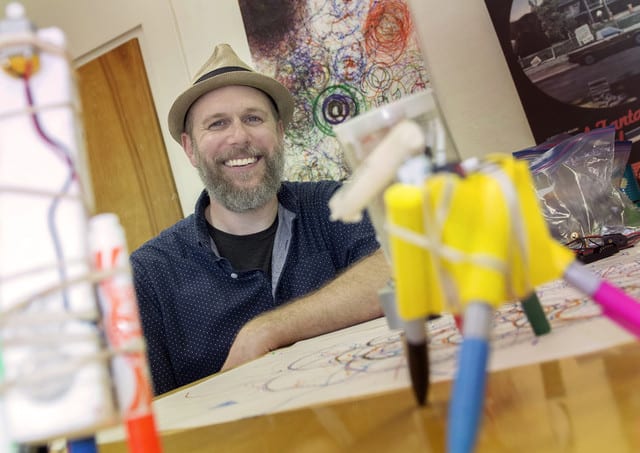
— Watch a robot draw and build one yourself at a demonstration and workshop with Aaron Knochel, assistant professor of art education in the College of Arts and Architecture. Knochel will showcase hand-built scribble-bots — miniature robots that draw — that are made out of everyday objects like rubber bands, strawberry baskets and markers. Friday, 5:30 to 7:30 p.m.
— Mix watercolors to paint with honey, gum arabic and natural pigments like ocre with Heather McCune Bruhn, instructor in art history in the College of Arts and Architecture. Bruhn and a colleague from the College of Earth and Mineral Sciences are developing a course on rocks, minerals and the history of art through a grant from Penn State’s Integrative Studies Seed Grant. Saturday, noon to 2 p.m.
— Make glass candy with Carlo Pantano, Penn State’s “glass guru” and distinguished professor of materials science and engineering. Glasses are not all the same and are used in many different applications beyond windows and bottles, such as fiber optics, biomedical implants, displays and touch-screens. Saturday, 3 to 5 p.m.
— Create a cyanotype with Holly Veenis, a master of fine arts student with a focus on photography. Cyanotypes are an alternative photographic process developed in 1842. During the demonstration, participants will find out about the history of cyanotypes, how to create a cyanotype and create their own. Saturday, 5:30 to 7:30 p.m.