
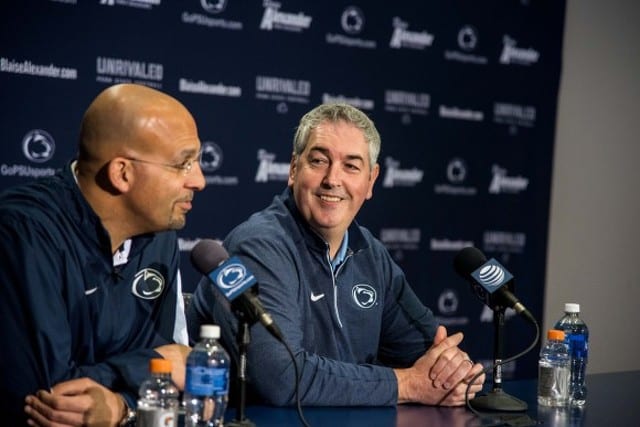
James Franklin has to hope his hiring of up-tempo savant Joe Moorehead helps solve an identity crisis that has lingered throughout Franklin’s five years as a head coach.
And, to be honest, maybe even longer than that.
An offensive identity crisis, that is.
At the same time, and not coincidentally, the subtraction of 12-year colleague John Donovan and the addition of first-time co-worker Moorhead has solidified, crystalized and magnified Franklin’s identity as a head coach.
James Franklin is the CEO of Penn State Football, a relentless recruiter and the hopeful re-builder of a program still — and once again — predicated on the decades-old brand of blue-collar football, academics, a firmly-entrenched staff, family and, Franklin promises, meeting high expectations. (That last one is a doozy.)
It’s just that now, Franklin is a bit less about family. (Three coordinators gone, threatening to go or maybe going in the past 13 months.) And a bit more about being CEO. This is a seminal moment in the professional growth of one James Geoffrey Franklin.
THE CROSSROADS OF AN IDENTITY
The scenario, which you know all too well: At the end of a three-game slide to end the 2015 regular season, Franklin was at a crossroads, at the corner of Loyal Boss and Major College Football CEO.
Does he stick with who he brought with him and produced a two-year record of 14-11 at Penn State, with its attendant .560 winning percentage and zero wins over a team shouldn’t have beaten?
Does he stand pat with his offensive partnership with Donovan that lasted over eight seasons and three stops, with a dozen years on the same staffs (longevity now only exceeded by strength coach Dwight Galt)? And make no mistake, it was a partnership. It was a pairing that had not produced the best of offenses as well as a 58-44 record. With Donovan by his side, in his last eight seasons as an offensive coordinator (2008-10, Maryland) and then as a head coach (Vanderbilt, 2011-13) and Penn State (2014-15), Franklin has directed offenses that have struggled to be average.
(Over those eight years, their offenses have averaged 25.6 points and 348.5 yards per game. Only once in that time did a Franklin-Donovan offense rank better than No. 55 in the nation in points — 29th, 32.2 points, at Maryland in 2010 — or better than 80th in total offense, at No. 69, with 353 yards at Maryland in 2008.)
Or, given that history, does Franklin make the decision that comes with a $4.1 million base salary, a $200,000 bonus for reaching a bowl and a $300,000 bonus for being employed on Dec. 31st — making his 2015 take-home pay a staggering total of $4.6 million — and also comes with the responsibility of filling a #107k stadium despite home games vs. Buffalo, San Diego State, Army, Rutgers, Illinois and Indiana?
We know the answer: James opted for Joe instead of John.
$36.1 MILLION PROFIT
It’s part of the territory that comes with being the CEO of a Power Five football program that is called Penn State. It’s a cash cow program that made a net profit of $36.1 million on gross revenues of $71.3 million in FY 2014-15, according to paperwork Penn State has filed with the U.S. Department of Education under its federal Title IX obligations.
In some ways, Franklin had no other choice. In the words of Hyman Roth, “This is the business we have chosen.”
As such, then, Franklin fired Donovan. Franklin had been a man without an offense – or offensive identity – long enough. To be fair, with Danny O’Brien at the helm at Maryland in 2010, Franklin’s pro-style offense had an identity. Nonetheless, during Franklin’s run there the Terps were just 19-19.
When Franklin got to outmanned Vanderbilt and the rugged SEC, he had to – admittedly – “score points any way we could.” He inherited a string of above-par quarterbacks with heaps of experience, an NFL-caliber wide receiver (Jordan Matthews) and a big-league back (Zac Stacy). Then he and Donovan scrapped and fought their way to an average of 29.3 points per game and 24 victories, some of them sleight of hand against SEC foes and over half of them against the likes of Elon, Presbyterian, Wake Forest, Kentucky, UAB, UMass and Austin Peay.
The offense worked. Mostly. But no with big identity. Hell, winning for a change was identity enough for Vanderbilt. A new identity at that. But it wasn’t a James Franklin Offense the way that Fordham was a Joe Moorhead Offense. When Donovan and Franklin got to Penn State, they had Christian Hackenberg. And that’s about it. They weren’t sure what to do with him and his supporting cast, so they did a little bit of everything. Which often equaled nothing. Minus Hack, Penn State and Franklin would have surely had two straight losing seasons. With him, they all nearly end up in straitjackets and averaged 22.1 points per game.
The identity? Sacks, a beat-up Hack, a bad O-line and finally, some Saquon.
Not a very good identity. A mistaken, a misshapen identity.
WINNING THE PRESS CONFERENCE
Not what was expected. Franklin came to Penn State all gung-ho, promising a fired-up offense with fire and brimstone the day he was introduced to the press on Jan. 11, 2014:
“…We’re going to run multiple pro‑style offense, defense, and special teams,” he said then. “To me, I’m not a guy that’s going to pigeonhole what we’re going to do. I think my philosophy is you go out and hire really smart people, and you have a system that has flexibility to take advantage of all your strengths and hide your weaknesses. I think that’s what we all try to do in whatever organization or whatever business you’re in. You play to your strengths and hide your weaknesses, and that’s what we’re going to do.
“I don’t believe in one offense or one defense or one special teams philosophy is the end‑all, be‑all. It’s about taking advantage of the assets that you have, and that’s what we’re going to do.
“We’ll be pro‑style, multiple pro‑style offense, defense, and we’ll be aggressive in everything we do. When we get off the bus, we’ll be aggressive. The way we call the game, we’ll be aggressive. I think that’s very, very important. I think the fans want to see an exciting style of defense. I think the fans want to see an exciting style of offense and special teams.
“We’ll take calculated risks. We’re going to have fun. It always helps to have a quarterback. I don’t care whether it’s Little League, high school, college or the NFL. If you have a quarterback, you’ve got a chance. We feel very, very good about the quarterback we have in our program right now.”
Well, except for the defense part, none of that really came to fruition.
So, after firing Donovan on Nov. 29, Franklin not only went in search of an offensive coordinator. He went looking for an offensive identity, a philosophy, a system that everyone could believe in.
THE TERP TREE
He was Google, not only looking for a new app, but the guy who invented it. No time to build from the ground up. And Franklin wasn’t wedded to a singular offense anyway. Franklin, who was exposed to the West Coast offense in a singular season at Green Bay, is nothing if not adaptable. He’s had 11 jobs at 10 stops in 21 years. Six were for a single year, two more (including Penn State) for two years. He is an amalgamation of many things.
The only coaching tree to which he belongs or has started is the Ralph Friedgen Tree, and given how things went down at Maryland – Franklin was named head coach-in-waiting while Friedgen was still head coach there and wanted to still stay there – that tree has been somewhat chopped down.
On Wednesday, Moorhead came right out of the box and said he was part of the Walt Harris Tree, dating to back to 1998 (Franklin was a one-year GA at Washington State that season), and that has shaped Moorhead’s offensive philosophy to this day, now into his fifth stop since then. It is a West Coast offense identity he has clung to, modified, sharpened and fine-tuned. It is his calling card.
Not so with Franklin. His Penn State defense is Shoopian in its origins, with elements of Pry. The special teams lack any sort of identity, actually showing little of the “nektons and Steve Prefontaine recklessness” moniker that Charles Huff had bestowed on it. Even at that, it’s been Huff’s unfilled vision, not Franklin’s.
To his credit, Franklin’s vision was to become a head coach. That was the identity to which he yearned. And that is the person he became.
So, now, Franklin is like an established firm in need of an upgraded division – an offense that works – but is unable to generate it internally. It has neither the time nor talent. So, when he was interviewing potential coordinators Franklin was also in search of an offensive identity Penn State could call its own. After four years as a college quarterback and two decades as a mostly offensive-minded coach, Franklin was not wedded to an offensive philosophy. Penn State, he decided, would change to match the coordinator. Franklin was shopping for an offense as well as a coordinator.
“I was looking at a couple of different coordinators with different backgrounds, with different philosophies,” Franklin said of his interview process. “But the more we thought about it, the more we talked about, the more I kind of researched those things, I thought that (Moorhead’s up-tempo offense) was going to be helpful for us.”
It was that identity thing.
“I looked at it a little bit about making sure we had an identity on offense, and that starts from the top,” Franklin said on Wednesday. “That starts from the head coach. It starts from the offensive coordinator and the defensive coordinator – that you have an identity that you are not only able to implement a plan and have a vision, but get everybody in the room excited about that plan and excited about that vision moving forward.”
A STRENGTH OR WEAKNESS
So, you can look at it as a Franklin weakness – that there’s not a singular offense that he knows, loves, believes in, grew up on. Or, you can look at it as a strength – that Franklin is flexible enough, big-picture enough to change his company (Penn State) in a big and nimble way if it’s going to help him be successful.
And that’s Franklin’s job, more than anything else. To win.
Franklin is not a hands-dirty X’s and O’s guy, absolutely wedded to calling every play like a Bill O’Brien. That’s not Franklin’s identity. He always wanted to be a head coach.
The New York Times ran a terrific article the other day, “Opportunity Seldom Knocks For Black Head Coaches.” In it, Franklin is featured prominently. In fact, the article begins this way:
Several years ago, David Williams, the athletic director at Vanderbilt, was approached by Kansas State’s offensive coordinator at a gathering for young minority assistant football coaches.
“He came up to me,” Williams recalled, “and said, ‘Hi, my name is James Franklin, I’m an assistant coach, and I just wanted to meet you because I wanted you to know who I am and for me to know you, because one day I’m going to be a head coach.’ ”
A few years later, Williams hired Franklin to be Vanderbilt’s head football coach. After a three-year run, during which Franklin’s Commodores went 24-15, he was named the coach at Penn State.
Franklin was not an offense rat like O’Brien. Nor a defensive junkie like Bob Shoop. He was a head coaching nerd. And still is, reveling in all 360 degrees of the job. Franklin’s late-night texts to coaches and staff are as much about off the field as on it. Hashtags, bench-marking, branding, recruiting, consensus-building, team-building, PR to multiple constituencies, organizational dynamics, PowerPoints, motivation. That’s a big part of what Franklin is all about. He’ll do what he needs to – or get people who can – to help him win. Or what he thinks will help him win.
Example: Franklin bristled this summer when a reporter prefaced a question by saying. “I know how much you like to recruit.” Franklin cut him off and corrected him: “I recruit because we need to do that to win.”
Example: He shifted fields and didn’t go all relationships when hiring Moorehead. He went metrics. Over the past year, Penn State has utilized SportsSource Analytics – an Atlanta-based firm built by a Vanderbilt grad — to help analyze and implement statistics and trends across 100 different statistical categories using 100 million statistical data points.
BIG DATA
SSA was a key player in Franklin’s coaching search. In a big way, squared.
“For me, it was the data,” Franklin said of the hire. “As you mentioned I have a list (of potential coaches) at each position, but with the coordinator positions you want to study data…
“At the end of the day, you take all of those guys on the list and you run all of that data. You look at third-down percentage, scoring offense, red zone and every other piece of information you can get and you look at who is consistently at the top of each of those categories. Joe kept jumping out in almost every single category and I was very impressed.”
So were the folks at SSA. On Monday, Dec. 14 – with Moorhead firmly committed to Penn State and the hiring process complete — @SportSourceA Tweeted out these Moorhead stats that just didn’t come in over the transom:
— Compared to prior 5 yrs, @BallCoachJoeMo increased avg scoring O at Fordham by 61%, yds per play by 20%, rush yds by 14%, & pass yds by 25%.
— 5 years before Moorhead, Fordham scored 30+ pts 23% of games & 40+ pts 4%. Under Moorhead, scored 30+ pts 71% of games & 40+ pts 49 of games #PennSt
Moorhead aside, an important never-changing part of Franklin’s identity has been relationships and family. It works in recruiting and it has been an on-going theme of his head coaching make-up – at Vanderbilt and at Penn State.
In his five seasons as a head coach, Franklin has fired just three of the top 14 people – nine full-time assistants, Galt and Franklin’s top four staff assistants — in his organization. After his first season at Vandy in 2011, Franklin replaced defensive back coach Wesley McGriff with George Barlow and wide receiver coach Chris Beatty with Josh Gattis. Donovan was Franklin Fire No. 3. The number grows to five if you count the two assistants – Barlow and special teams/tight end coach Charles Bankins – that he didn’t bring along with him from Vanderbilt to Penn State in 2014.
Do the math: 70 positions, five seasons, five changes. That’s a lot like the guy named Joe whose office James now has.
WHAT IT’S ALL ABOUT
So, you have to believe Franklin when he says that firing Donovan wasn’t easy. But here’s why it helped to solidify Franklin’s still-emerging head coaching identity:
It’s all about relationships. Except. Except when it no longer is.
Eventually, even with James Franklin – who is 38-26 with one win over a Top 25 team in five seasons as a head football coach – winning trumps all.
As a CEO, Franklin is all about success, even moreso than football. Which is OK. And with Joe Moorhead now on board, the tempo at which Franklin might just get there just got faster.
More Columns
View all Columns
Penn State Football’s Identity? Déjà Poo All Over Again
Penn State football’s identity? We found it on Saturday, though it never went away: It’s an incredible fan base that turned out. Once again. After being punched in the stomach. […]

Column: It’s a Long Way Down for Penn State Football
Have you ever been scammed before? Merriam-Webster defines a scam as a fraudulent or deceptive act or operation. Joel Haas defines it as Penn State football in the first half […]

Paterno: Keep the Faith and Stand Your Ground, Penn State Fans
One of the great leadership lessons from Lincoln was the lesson of the letter. When he was angry, he would write a letter to the person who’d angered him. He’d […]


