
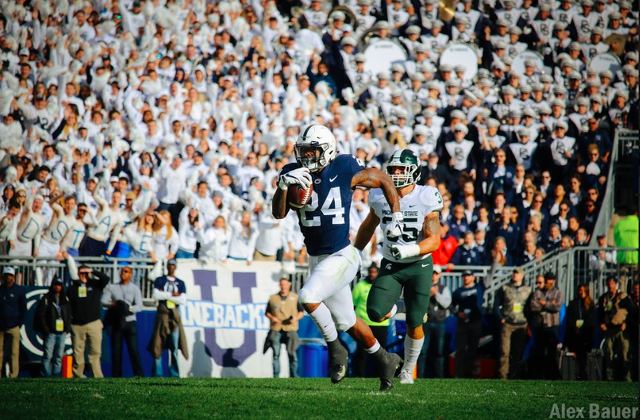
Trace McSorley looked tired. For the first time in a long time the senior quarterback seemed exhausted. Saturday evening was death by a thousand déjà vus.
It was a game that you could see coming: Michigan State lingering around, Penn State letting the Spartans stay within reach as a once potent Nittany Lion offense continues to render itself more memories than realities. An homage to a team it once was, not a fully realized reinvention sharing similar motifs.
At the center of it all stood McSorley, a quarterback who has the honor, ability and curse of being the most well-equipped player on the field to muscle Penn State out of the corner and land a knockout blow. Once again the weight was on his shoulders.
And once again, for a host of reasons, in the biggest moments Penn State couldn’t get over the hump.
While Michigan State marked the first loss to an unranked team in 30 games, the Spartans are not far removed from the Top 25, perhaps set to return there after this weekend. Whatever national recognition Michigan State receives, the Spartans fit snugly into the profile of teams that had handed Penn State its previous four losses.
As he answered questions from reporters for over 10 minutes it must have felt all so familiar. It must have felt like Pasadena, Columbus or East Lansing. A fourth quarter lead against some of the best teams in the country turning into a loss in the final moments. A familiar death rattle to playoff hopes. Three years of the same kind of pain, three years of the same moments of ‘almost.’
‘I pressed,’ McSorley said, playing the game again in his mind, a 19-of-32 for 192 yard night not his worst, but far from his best. He never looked in rhythm, his receivers not always open. Everyone expected McSorley to do it all, but even he has moments where the weight is a bit too much.
There’s something to be said for pressing, for urging an answer out of a riddle that Penn State has yet to solve. Pressing is at least trying, even if it fails, at least it was different.
But as every player would go on to say after the game Saturday, it all sure is frustrating. Of all the answers the Nittany Lions have found over the past two years, this is a question still left blank at the bottom of the test that is shouting back at them: ‘How do you win these games? And why haven’t you figured it out yet?’
‘I’m not going to sit here and say that I’m shocked we haven’t figured it out, it’s Big Ten football,’ McSorley said. ‘You’re going to have close games you’re going to have to win. There’s not one close game that’s going to be exactly like the other. So you’ve got to learn and put it all together and when you get in those situations you kind of have to lean on each other and push through that wall and figure out as a team how to win those games. That’s something that we’ve done in certain situations and in other situations we haven’t. That is Big Ten football and it’s tough to win in this conference. The games aren’t all similar but we’ve got to figure it out.’
Figuring it out is Penn State’s challenge now, in truth the same challenge it has had for year. During all five of Penn State’s losses the Nittany Lions have started 11 drives with 10 or fewer minutes to go in the game. Penn State has failed to score on all of them, averaging 15 yards a drive.
There have been six punts, a turnover, and four turnover on downs.
And it’s not for a lack of diversity. Over the span of those same 11 drives Penn State has run the ball 19 times and passed it 24. Only in the Rose Bowl did Penn State lean on the ground game almost exclusively in the final minutes, running it five straight times on a drive that started with 3:50 to play.
The Nittany Lions would lose that game at the buzzer.
Michigan State 2018: Three drives inside 5:19
- Five passes, four runs: 42 yards
Ohio State 2018: Two drives inside 6:41
- Five passes, five runs: 58 yards
Michigan State 2017: One drive inside 6:55
- Six passes, two runs: 62 yards
Ohio State 2017: Two drives inside 4:10
- Four passes, three runs: -9 yards
USC 2016: Three drives inside 8:15
- Four passes, seven runs: 13 yards
The difference?
‘They made plays,’ Shareef Miller said after the game, the defense slowly running out of gas for the second straight outing. Two dropped interceptions sitting in the box score.
‘Mistakes, self-inflicted wounds and not executing,’ McSorley added, Penn State having gone 6-of-31 on third down over the past two games.
Much of it comes back to what James Franklin said after Penn State’s loss to Ohio State in 2017, an identity change in those crucial moments. Trying to become something that Penn State has never really been when it’s at its best, a methodical offense that can grind the clock to zero.
‘Four-minute offense is something that hurt us last year. And it hurt us again,’ Franklin said in 2017 after the loss, the Nittany Lions running it three straight times on their second to last drive. ‘I thought we changed our identity. We tried to run the ball. And it’s easy for me to say this now guys. But as the playcaller, we’re not protecting well and we’re not running the ball.’
The real problem might be found somewhere in that answer. Penn State has for two years and counting struggled to find an identity in those moments. They have tried to pass. They have tried to run. Nothing has worked, or at least nothing has worked well enough.
Be it coaching, talent, execution or all three, until Penn State figures out what it wants to be in those moments — and is able to do it — the painful losses might not be gone just yet.
So far the Nittany Lions have tried just about everything. And in a few short games McSorley will be gone, and there will be more questions, not fewer, that will need answering.



