The first day of classes at Penn State is on Monday. At this time every semester, I get out my calculator, research the latest University Park campus tuition charges here and then do what I tell my sports journalism students to do:
The math.
I figure out what it costs a full-time student with 15 credits to attend just one of my 75-minute classes – we meet twice a week for 15 weeks, 30 classes overall. (I know all monies are not divided that way, but go along with me on this one.) That’s tuition, fees and facility charges only, not room and board, not books. One class.
For the 2010 Fall semester the results are in:
In-state: $50.83 per class. Out of state: $90.36 per class.
A big-ticket item, to be sure. Reminds me of the obligation of a professor, lecturer or adjunct to bring his or her best each and every class.
By comparison, it will cost a Penn State undergrad only $9.99 to see comedian Seth Meyers in the BJC this fall. And that same student has to pay only $20 to see hip-hop artist B.o.B. of ‘Airplane‘ fame and Travie McCoy on Aug. 31, also in the Jordan Center.
The students have an obligation, too. To attend class, to participate, to prepare. To get their – and their parents’ – money’s worth.
A good education like the kind that is available at Penn State is not cheap. But, at times, it is free.
For the 85 Penn State football players on full scholarship, a free quality education is the reward for their year-round labor. They get tuition, room, training table and books at no charge.
THE FOUR-YEAR TALLY
Let’s do the math and figure out what a four-year full ride at Penn State is worth.
Assume our sample player is a running back who is a freshman marketing major in the Smeal College of Business. He carries 12 credits in the fall, 15 in the spring. As many players do, he goes to Penn State for three summers, attending both sessions so he can get room, board and tuition if he’s on scholarship. He graduates on time, attending four years plus the summers. He lives on campus every semester. And he’s a Pennsylvania resident. Finally, we allow for an annual increase in expenses of 4 percent.
Counting tuition, room, board, books and fees, his scholarship covering Fall 2010 and Spring 2011 is worth $26,124.
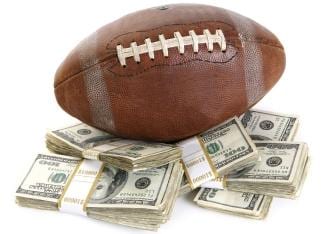
Over the course of four years, including summers, his scholarship is worth $144,389. That’s for in-state.
If the same player came from out-of-state – let’s say from New Jersey – the four-year price tag would be $212,340.
That doesn’t count such perks as expert medical care and two sets of workout clothing a couple of times a year. Plus four free football tickets to every game (for friends and family, not to be sold). Plus tutors, free printing in the Lasch computer lab (ask any undergrad – this is huge) and office supplies.
THE UNIVERSITY GETS…
In my book, that’s a good deal – for both the university and the student.
The university gets a wonderful marketing tool, a bond that extends beyond the campus throughout the state and country, a reason for alums to return to campus, nationwide exposure, licensing, royalties. It’s a big list.
At least as important is the revenue that football brings in at Penn State. It funds all of intercollegiate athletics, facilities, recreational areas and fields, and IM sports. The overall university does not pay a dime to athletics.
University President Graham Spanier, who is a national leader in intercollegiate athletics and a really smart guy about this stuff, says that less than two dozen universities across the country operate self-sustaining athletic programs. Penn State is one of them.
Doing so is a lot of pressure on athletic director Tim Curley, but under his leadership Penn State has a broad-based program that is among the nation’s best on and off the field.
‘Football,’ Joe Paterno has said back to the 1980s, when he was A.D., ‘pays for a lot of field hockey sticks.’
(Field hockey aside: Char Morett, the wonderful longtime coach of the Lady Lions and a two-time Olympian, is bearing in on 400 career wins, just like JoePa. She has 396.)
SHOW ME THE MONEY
At times, for some football players, the scholarship is not enough. They see their labor as free. I see their labor as being amply rewarded with a full ride to a great university, top to bottom – a prize package often worth more than $200,000.
I hazard to guess that most scholarship players on the Penn State team want to receive some money, too. They’ve told me that in interviews, and argued so in writing and in class. Paterno himself says that his players could use a little walking around money, ‘to buy some pizza or go to a movie.’
OK, I might — might — buy that. The small stipend, not the pizza. (That would be an NCAA violation.)
But what about the non-football players on athletic scholarships? Do they get paid, too?
The argument can be made that since many of the football players are ‘working’ year-round, they do not have the time to be employed at a money-paying part-time job. But I do know that there are players who work in the summer, some of them while taking classes. Some players, their parents free of a $100,000-plus obligation (exact figures to come), receive walking-around money from their folks.
Others may not have the means. They occasionally take out loans. For them, a stipend would make the most sense.
Let’s say football players receive $100 a month for expenses. After all, they bring in hundreds of thousands more, in ticket sales, jersey royalties, Big Ten shares and television revenue.
Even at $1,200 a year times 85 players, that’s only $102,000 a year. Let’s say they get a ‘salary’ of $10,000 a year; that’s still less than a million dollars a year — $850,000, to be exact. One would think that there’s some money to be found in Curley’s $100 million budget.
Sure, right. After increases in insurance and salaries, and new and updated facilities, and keeping 29 varsity sports up and running, the surplus doesn’t look as big. Tuition increases also hit home. The athletic department must pay from its own coffers the bursar in Shields Building for the tuition of every scholarship athlete. And the more out-of-state student-athletes, the higher the bill.
NET LOSS
If they had to, I bet Curley and Co. could find the money. Not easily, though. And probably at great expenses – like no gymnastics or no tennis, for starters.
And where would it stop? Do football players get bonuses for a BCS berth? What about paying athletes in other sports, like basketball or soccer or wrestling? Or field hockey, for that matter. What if a team – like Penn State football in 2000-2004 — has a down year, will those student-athletes take a pay cut?
Then there’s the idea and the ideal of true students and athletes. Paying them is not what college is supposed to be all about. Smart sociology scholars and perfect promising pianists also get free rides to Dear Old State. And they don’t get extra money.
‘Yes,’ say the critics, ‘but they do not bring in millions of dollars, create a rallying point for the university or wear jerseys that sell by the score. Football players do.’
And for doing so, that running back from New Jersey, will earn $4,083 game a game. Not bad.
The student assistant in the press box that day gets as much as $40. The Collegian reporter, writing and blogging away, will get — at max — $30 a week. And then there’s the Blue Band; it plays for free.
Now that’s priceless.