

As an offensive line coach, Matt Limegrover is a heckuva teacher.
So says Ryan Bates, a first-year starter at both guard and offensive tackle for the Nittany Lions in 2016.
“What Limegrover is, he’s a teacher,” says Bates, who started all 14 games for PSU on the O-line in 2016. “And that’s what I like about him.
“He wants us to know what we’re going to do more mentally more than physically. He’s all about teaching us what to do. He’s not a big yeller – although he can yell sometimes, trust me.
“But, most of all, Coach Limegrover wants us to learn. He’s all about developing and us learning what we’ve got to do.”
Bates & Co. certainly had a lot to do – and learn — in 2016.
Last season was Limegrover’s first on the Penn State staff. After five years as offensive coordinator at Minnesota and 17 seasons working with Jerry Kill at four schools, Limegrover returned to his home state to succeed Herb Hand as the Nittany Lions’ offensive line coach. He not only had to learn a whole new workplace and offense, he also had to teach Joe Moorhead’s spread game to a bunch of players he had never coached before.
Limegrover knew the pressure was on him. Especially with 45.45% of the entire offense under his direct purview.
“An old coach once told me, ‘You never have a good day as an offensive line coach. There’s always something that is getting screwed up. You’re never 100%,’” says Limegrover. “If you have five guys and you grade them individually, and one guy does something wrong you’re down to 80%. If two guys do something wrong, you’re failing. It always comes down to that.”
In Bates’ opinion, after a 2-2 start the Nittany Lions never failed again. They just kept getting better, despite key injuries to tackles Brendan Mahon, Andrew Nelson and Paris Palmer along the way.
“You know,” Bates pointed out three days before the Rose Bowl, “where we started in the beginning of the year vs. Kent State, it’s very different personnel we have right now due to injuries. We’ve grown together as a unit. I feel like, collectively, we’re a bunch of ass-kickers right now. It’s going real good right now.”
GRADE A
Grading the O-line is never on a curve. On most plays, even with – or especially because of Penn State’s run-pass option offense – success is strictly pass/fail. That’s where the teacher inside of Limegrover comes in. His credentials certainly aren’t lacking. He has been in the coaching game for 27 seasons, including 16 as an O-coordinator. And he understands the cerebral side of college life as well, having earned a B.A. in public policy from the University of Chicago and a master’s in liberal studies from Northwestern.
Limegrover has known Moorhead since their childhood days in Pittsburgh, dating back to St. Bartholomew’s Elementary School. Moorhead not only knew Limegrover knew football, he was convinced he could teach it the Moorhead Way as well.
That’s why, when Limegrover interviewed with James Franklin last January at the American Football Coaches Association convention in San Antonio, Moorhead politicked to make sure his new boss hired Limegrover before the potential O-line coach left town – or interviewed anywhere else.
“First and foremost, I think Matt is an incredibly intelligent guy,” says Moorhead. “Matt is very thorough, with great attention to detail. He’s a great teacher, both of fundamentals and scheme. He has a way about him with the kids. He does a fantastic job. You have a stereotypical thought process of an offensive line coach – a screamer and all those things. Matt will raise his voice when necessary. But on the field he’s more of a teacher who’s more concerned with the message than the tone, which I think is a great compliment to him.”
Limegrover complemented Moorhead’s presence in a big way. The Nittany Lions’ offensive line faced a number of challenges in 2016, including nine different starters and seven different starting combinations. Still, the numbers improved greatly.
Sure, Moorhead’s offensive scheme and in-game play-calling had a lot to do with it. But so did Limegrover’s skill and swiftness in getting a relatively inexperienced O-line up to speed. Four Nittany Lion offensive linemen made their first start in 2016 – Bates, Chasz Wright, Steven Gonzalez and Connor McGovern. In addition, Brian Gaia played center for the first time in his career, while Limegrover helped Paris Palmer rebound from an awful 2015.
THE NUMBERS
The numbers bore out Limegrover’s influence: Penn State’s offense averaged 14.4 more points per game in 2016, in addition to gaining almost a half-yard more per carry. Overall, Penn State averaged more than a yard per play and 85 yards more per game in 2016. QB sacks were cut in almost half, from 42 in 2015 to 24 in 2016.
Penn State’s offensive linemen learned their lessons well. Limegrover’s teaching strategy was simple in some ways – i.e., when possible, keep it simple. Whereas the Nittany Lion O-line had pages of prep to learn in previous seasons, they had basically a one-sheeter to master per game in 2016. And line calls were minimal, too – often a single word keyed how the five-man unit was to block in concert.
Tell Limegrover his players and his co-workers say he’s a good teacher and nothing could make him happier.
“That’s something, since I began my career, I have always taken a great deal of pride in when someone says you’re a really good teacher,” Limegrover said in the days leading up to the Rose Bowl. “At its heart, that what coaching is a big part of. It’s a form of academia, almost, in the sense that you’re constantly trying to take these young men and you’re trying to get them from Point A to Point B. What’s the best way to do it? Teach them the path.”
Watch him in practice, and that’s exactly what Limegrover is doing – teaching.
“I’ve always taken a lot of pride when professors come to a practice and compliment me on my teaching methods,” says Limegrover. “That’s when I feel I’m really getting the point across to my players. I enjoyed my educational process and that whole journey. I know what I liked from teachers and I know what I didn’t like. I pattern myself in that regard as well.”
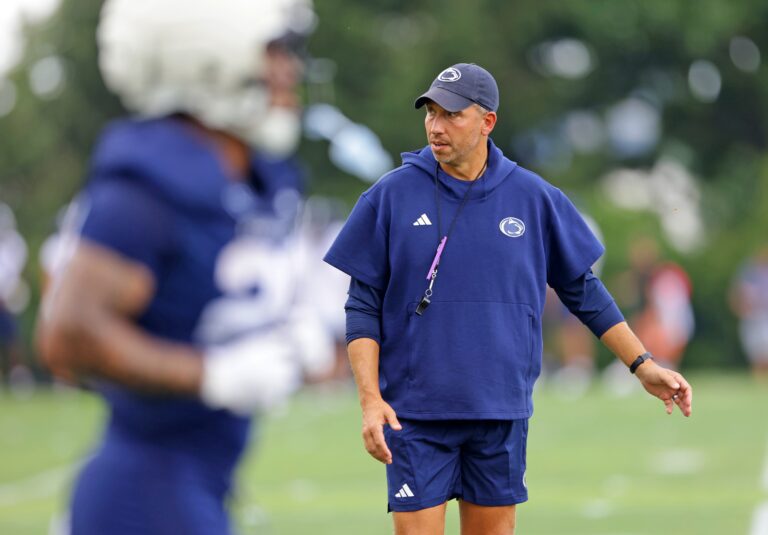
When Limegrover isn’t doing hands-on work with his players during Penn State’s practices, you’ll likely see him standing near Moorhead – watching the entire offensive unit run plays in tandem. The two work hand-in-glove. It’s an interesting relationship and one in which they both feel comfortable.
Credit Franklin in a big way for some smart hires, devoid of ego at multiple levels:
Moorhead is the former head coach who is now an offensive coordinator. Limegrover is the former offensive coordinator who is now the offensive line coach. They appreciate what each other brings to the meeting room table – and practice field. The two Pittsburgh Central Catholic grads don’t try to intentionally to stand side-by-side at practice. It just happens.
2 PITTSBURGHERS
“It’s organic,” laughs Moorhead. “You walk around and see different things during the course of practice. You have to be in concert with your O-line coach as a coordinator, because if you can’t get it done upfront there’s little chance for success. In terms of our communication, it’s a matter of talking about what needs to be done. With Matt’s years and years of experience as a coordinator, he does a great job of bouncing ideas off of me while we still stay on the same page.”
Here’s how Limegrover, five years the senior of Moorhead although both are greybeards in body and spirit, sees it: “What’s nice about it is that I have sat in Joe’s chair. One thing that always got me and I struggled with when I was the coordinator — sometimes you got too much input, then you got overwhelmed. So, right away I said to Joe, ‘I’m not going to beat you up with stuff. If I feel strongly about something, I’ll let you know. But I’m here to be your O-line coach and provide what I can within the structure of what you want to do.’
“And I think that’s worked out, because Joe has such a vision of what he wants this offense to be. He’s a great teacher as well. He had to teach us what the offense was. So as I’m learning it, I’m thinking, ‘We can I fit without it becoming too much?’”
This is how that relationship works in practice – literally, as on the practice field, according to Limegrover: “There will be times I’ll walk over to Joe after a play in practice, and I’ll say, ‘Shouldn’t he have…’ and before I can finish Joe will go, ‘Yeah, he should have…’ That’s a neat kind of complementary set-up that we developed very quickly.”
And this is how it works in the coaches meeting room, when the staff gets together to review film and game plan: “Joe will look at me and recognize that I am the expert on the staff when it comes to the offensive line. He just won’t say, ‘Figure out a way.’ He’ll go, ‘Here’s how we did it. What do you think?’ Then I can go, ‘My experience in the Big Ten is that this is the way you want to do it.’ That’s worked out really well for us.
“I’m not the only one. All of the coaches on offense – Charles (Huff) and Josh (Gattis) and Ricky (Rahne) – have a hand in it. They’re all so knowledgeable. When Joe came in, he presented it in a way that we were encouraged to give feedback, to have that interaction. There isn’t that pound-the-table, this is the way it’s going to be kind of approach. I think Joe would admit that it’s made his system – which is now our system – even stronger.”
SIGNAL-CALLING
Moorhead is open to Limegrover being a part of the entire offensive process. When Moorhead is with his quarterbacks, it’s commonplace for Limegrover to listen in.
“I want to hear what Joe’s telling the quarterbacks because of that communication the quarterback is going to have with my guys,” says Limegrover. “I want to make sure it’s one voice coming from me so that if there’s a play on film and we are showing it, I’m telling the O-line what the quarterback sees. So there’s a reason why he will check into this protection or get into this play or something as simple as, ‘Hey, we’re going to block this play, but don’t be surprised if the quarterback goes here and guys, here’s why.’
”My guys don’t need to know why he’s doing that, it doesn’t change what they’re doing. But that bigger-picture understanding is really important. It’s really good when we can get connected that way – I love listening to the quarterbacks, getting connected with Joe in practice and hearing what he’s saying.”
Limegrover spent nearly two decades as the guy giving the offense directions and direction. So one would think that shifting to somewhat of a subordinate’s role would have been difficult for Limegrover.
By all indications, it wasn’t. A big piece of that has to do with Limegrover’s personality and even-keeled approach to things. His linemen say that he’s a rock, a coach who is consistent day after day.
That’s the kind of praise Limegrover relishes most. While he’s growing lines, his tried-and-true coaching lines never get old. He’s for real.
“The time spent with the players can’t be an act,” he says. “You can’t say, ‘Once I leave my house in the morning I’m going to be like this when I’m with the kids. And I’ll be that when I’m not with the kids.’ That would drive you crazy. You have to be consistent and stick by who you are and what you believe in, so you don’t have to play that game.
“You can wake up every day and be who you are. That’s what I love about coaching the O-line. I am who I am and I love what I’m doing. And hopefully it shows.”
More Columns
View all Columns
Penn State Football 2026: Floor, Ceiling, Expectations and Predictions
Kirk Herbstreit of ESPN has high hopes for Matt Campbell and his Nittany Lions in the new head coach’s first season in Happy Valley. Higher, perhaps, than even the top […]
How Does Penn State’s Matt Campbell Do in Head Coaching Debuts and Season Openers?
Matt Campbell and the Nittany Lions open their 2026 season Saturday afternoon in Beaver Stadium against Marshall. It’s Campbell’s first game as Penn State’s head coach, and even though he’s […]

New International Students Adjust to Happy Valley With Hearts Still Connected to Home
Each August for the last 10 years, I’ve written a column about Penn State’s newly-arrived international students. Why that emphasis, you ask? Well, to put it bluntly, our campus and […]


