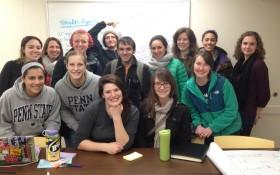
When you made your first drive to Penn State you probably noticed that every other building you passed was a farm house. Central Pennsylvania has a rich agriculture history and a group of students at Penn State want to keep that tradition alive right here on campus. Several interested students, lead by Rachel Hoh (a Community, Environment, and Development major) are talking about creating a student-run farm: feasibility issues, funding, and community outreach were just a few of the topics discussed.
Hoh explained that Penn State actually had a student-run farm on campus about 40 years ago. Although it has long since closed the Penn State Sustainability Institute has been working on getting a new one up and running for the past ten years. The Sustainability Institute has gone through a recent organizational change and has now combined all previous sustainability organizations into one large entity. Their first major aspiration? To start a student-run farm. So far, there have been several meetings with faculty and members of the community, but a meeting this past week was the first to have any major student involvement.
After introductions, Hoh had the students split into four groups: Education, Outreach, Research, and Operations. These groups represent the major concerns and goals of the student-run farm. Students split into the groups based upon interest and brainstormed ideas for their particular focus. Below is a compiled list of the topics discussed in each group.
Education: How the farm could be used as an educational tool within the university.
Make farm accessible to a variety of students and majors (for example, how Business and Nutrition could use the farm as an educational tool)
Focus on how anyone could get involved and why they should; not just ‘farmers’ or Agriculture students
Exploration of different cultures and their farming techniques
Internships
Operations: Practicality of the farm and the actual operations within.
Location (land behind the Arboretum is highest on the list at this point; is desirable as it is large and close to campus)
Establish resources including water, energy, and land
Maintenance, management, storage, and (if needed) transportation
Research: What type of research would be conducted on the farm and by whom?
Short term/long term research facility (ex: for students’ theses)
Research team or committee of students; keeping track of if the farm is working and what it is being used for
Contract and four season research
Make sure no overlap in research with other student-run farms in the area
Helping small scale farms conduct research; those that don’t have money to conduct it themselves
Outreach: How could the farm be used in ways that involve in the local community?
Get local grade/middle/high school kids involved with the farming process; learning where food comes from
Mt. Nittany Medical Center/The Village possibly using farm for therapeutic reasons; day trips
Local community workshops and discussions on related topics
Alumni involvement and donations
Inclusion of the beekeeping class/club, meat labs, and fungus research
Farm could be used as private event space
As you can see, having a student farm on campus involves a lot more than just planting a few things in some dirt and waiting to see what happens. Having a farm on campus could benefit many students, from providing a work cooperation program where students could get money for class by working on the farm, to a place where private research and learning could be performed. The farm could also help out the local community by providing a space for members to learn about farming and food production.
If you’re interested in learning more about Sustainable Agriculture or the student-run farm you can email Rachel Hoh at rlh301@psu.edu.
image Catie Simpson