
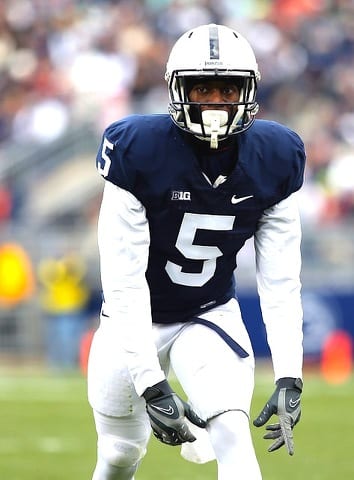
DeSean Hamilton and Akeel Lynch, Penn State’s 2014 regular-season catch and run leaders, also are among the tops on the team in charisma.
Hamilton has a spiky ’do, near dime-sized diamond earrings and a smile that is UltraBrite.
But he also displays the workout discipline and formal-setting respect that comes with being the kid of military parents. And he’s as thoughtful and articulate as you would expect from a communications major who aspires to be a sports broadcaster.
For his part, Lynch usually sports a grin – win or lose. With winter here, he’s taken to wearing a Penn State wool cap, with furry flaps and a big Penn State logo on the upturned brim.
Lynch’s easy-going manner has made him a fan and teammate favorite, as he has that rare ability to look at home wherever he is. After Penn State’s loss last Saturday in Illinois, he conducted his post-game interview perched on the field-level edge of the Memorial Stadium stands, surrounded by about 15 reporters. A few days later, in the stark and chilly Beaver Stadium media room, he was equally at ease.
The two have international roots. Lynch, 20, was born in Toronto, Canada, while Hamilton, 19, was born in Okinawa, Japan.
Together, they represent the best of Penn State’s receiving and running corps in a year where frustration was at a premium. Together, they’ve accounted for almost 40% of the Nittany Lions’ yards in 2014, while getting the ball only a combined 24% of the plays.
Hamilton has grabbed 75 passes for 848 yards, both team highs, and has run eight times for 40 yards. Lynch has rushed 130 times for 603 yards, also team-highs, and has caught seven passes for 57 yards.
Hamilton is a redshirt freshman who sat out all of 2013 following wrist surgery and a lengthy rehab. Lynch sat out his freshman season in 2012 and gained 358 yards in a limited role in 2013. Hamilton has three more seasons at Penn State, Lynch two. Hamilton can’t wait.
“The future is bright,” Hamilton said. “We have a lot of young guys. We have a lot of guys returning so we can be as good as we want to be as long as we build upon the good things that we have been doing all year.”
HAMILTON WELL-RECEIVED NATIONALLY
Against Michigan State, Hamilton had six receptions for 55 yards, doubling the output of any of his teammates and leading Penn State in receiving for the eighth time in 11 games. That was actually an average day for Hamilton, whose 6.3 average catches per game for 2014 is tops among all Big Ten receivers and 27th among the 200 top-rated receivers in college football.
In other rankings, Hamilton’s 848 receiving yards are fourth in the Big Ten and 46th nationally, while his 70.7 receiving yards per game are fifth in the Big Ten and 55th nationally.
Lynch had a tough day against Michigan State, owners of one of the nation’s top rushing defenses that yielded just 103 yards per game before Saturday. Lynch was held to 51 yards on 14 carries, but the effort did cap a three-game stretch for Penn State where he was the featured back and ran for 318 yards on 60 carries.
Hamilton shared an explosive early start to the season with his fellow receiver, Geno Lewis. Hamilton burst onto the scene in his first college contest, grabbing 11 passes for 165 yards against Central Florida. He contributed greatly to Penn State’s 4-0 start, catching 30 passes for nearly 400 yards. Lewis wasn’t far behind, with 26 receptions for 462 yards.
Then the Big Ten hit. Lewis’ playing time was cut. He had only 19 receptions over the season’s final seven games, ending with 48 catches for 669 yards. Hamilton – a master at the bubble screen – became even more valuable to the Penn State offense and Christian Hackenberg. The apex was his 14 catches for 126 yards against Ohio State. The nadir was a three-game stretch of Indiana, Temple and Illinois, when he had a combined 7 catches for 65 yards as Hackenberg struggled and Penn State tried to amp up its running game.
Many of Hamilton’s 2014 numbers have mimicked those of Allen Robinson in 2012, when the current Jacksonville Jaguar led the Nittany Lions in receiving with 77 receptions at an average of 13.2 yards per catch. A big difference is in point production: Much more of a deep threat, Robinson caught 11 of the Lions’ 24 touchdown passes in 2012 (and added 97 catches and six TDs in 2013). Hamilton had only 1 of Penn State’s 9 passing TDs in 2014.
LYNCH’S SIX-GAME RUN
Lynch also had big shoes to fill as he started to carrying the rushing load – and football in the second half of this season. In fact, four shoes sometimes. Lynch entered 2014 firmly entrenched as Penn State’s No. 3 running back behind seniors Zach Zwinak and Bill Belton. ZZ and BB began the season, their last at PSU, with a combined 3,127 rushing yards and 26 TDs.
Through the first six games, as Belton got the bulk of the carries and Zwinak the leftovers, Lynch bided his time. His pass blocking skills, or lack thereof in an offense that needed all the pass protection it could get, helped keep him mostly on the bench.
Through those six games, he carried only 23 times for 105 yards and three touchdowns. Then Zwinak broke his ankle, Belton got beat down and the passing game went on hiatus. Lynch to the (sometimes) rescue. Over the final six games, he had two of Penn State’s three individual 100-yard rushing games. And he nearly quadrupled his output from the first half of the season, carrying the ball 107 times for 459 yards and three TDs in the last half-dozen games of the regular season.
As a part-time player for a good part of two seasons, Lynch has 961 career yards rushing. He’s a lock to join Penn State’s career 1,000-yard rushers club, which numbers 41. And he has two more years to go. Two more 603-yard seasons would give him 2,167 yards and propel him to No. 14 all-time, behind Charlie Pittman. He has the potential to gain a lot more than that.
Lynch’s forte has been long runs. He had a 26-yarder against Michigan State on Saturday, and his 2014 resume also includes rushes of 13, 16, 20, 25, 38, 46 and 47.
Conversely, playing behind a mostly-inexperienced offensive line, he accumulated a very large number of carries for minimal yardage in 2014. Of his 130 carries, 77 went for 3 yards or less. And 24 were for zero or negative yardage — almost one of out every five carries. Against Michigan State, 11 of his 14 runs were for 3 yards or less, the other three going for 4, 4 and 26 against one of the best defenses in the country.
Lynch examined the long and short of it this way, a few days before the regular-season finale:
“Sometimes it’s not going to be a home run,” he said last Tuesday. “Sometimes you take what the defense gives you. You’d rather take the 3 yards than try to make a big play and lose 2 yards.
“A running back has to be patient. As coach (Charles) Huff says, ‘If they give you 2 yards, take 2 yards. But if you keep on pounding the ball, you might break one for 50 or 90 yards.”
More Latest Penn State News
View all Latest Penn State News
Alleged Dealer in Penn State Frat Cocaine Ring Waives Arraignment, Plans to Plead Not Guilty
One man accused of being a primary dealer in the alleged cocaine trafficking ring that operated out of two Penn State fraternities has waived his formal arraignment and intends to […]

Penn State Fraternity Sues Landlord After Being Locked Out of House
A lawsuit filed on Thursday says members of a Penn State fraternity were left scrambling for a place to live just before the start of the fall semester after they […]

Neighborhood Association Wants Forum With Penn State, Local Officials After Cocaine Ring Bust at Fraternity Houses
Updated 6 p.m. Friday, Aug. 21, with comment from a Penn State spokesperson. The president of a State College neighborhood association this week called for Penn State and borough officials […]


