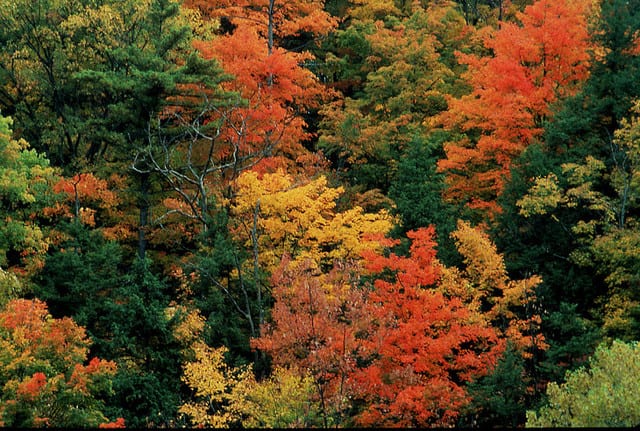
The warm, wet weather that persisted throughout the summer has extended into the early fall, and that will put a bit of a damper on this year’s autumn foliage display throughout Pennsylvania, according to a Penn State forestry expert.
‘This is the opposite of what is needed to bring out the best and timely colors, which require cool and dry conditions with the onset of fall,’ Marc Abrams, professor of forest ecology and physiology in Penn State’s College of Agricultural Sciences, said in a news release. ‘I predict that there will be a late — and muted — leaf coloration this October.’
Indeed, across much of the state there has been little change from the greens of summer to the oranges, reds and yellows of fall into the first days of October, according to a weekly foliage report issued by the Pennsylvania Department of Conservation and Natural Resources Bureau of Forestry.
The same is expected throughout much of the Mid-Atlantic and Northeast, though Abrams said the outlook is a bit better for the Great Lakes and Adirondack regions because though they received heavy rainfall, it wasn’t as high as other areas.
Still, that doesn’t mean central Pennsylvania and the rest of the state will be without some colorful displays.
‘I’m not expecting a total washout because even during the worst of times trees produce good to fair color,’ he said. ‘But it may take a bit more hunting to find the best color this year. What we need now — and what we are not likely to get this fall — is for cool to cold temperatures to arrive by early to mid-October to bring out the best colors.’
Abrams has studied for three decades how precipitation and temperature influence foliage displays. He said that clear, bright days, cool but not freezing temperatures, and dry but not drought conditions result in the best fall colors.
As temperatures begin to fall, trees stop producing chlorophyll, the green pigment responsible for photosynthesis, and in the process other leaf pigments — xanthophylls and carotenes — are revealed to show yellows and oranges in some tree leaves. And as chlorophyll production stops, trees produce another pigment, anthocyanin, which creates the reds and purples seen in other tree leaves.
‘One thing that I have been impressed with in my 30-plus years of gauging foliage is the resiliency of the display,’ Abrams said. ‘Year after year, despite the conditions, there are places where the trees show good color, but perhaps not great color every year.’