
What in the wide world of sports is going on?
That quote is from the 1974 film ‘Blazing Saddles.’
But Slim Pickens’ character, Taggart, may as well have been asking about the current economy. We had a recession that the gurus of recessions say was over in June 2009. Yet we still have numerous government policies, both fiscal and monetary, that are in multi-trillion-dollar stimulus mode.
Unemployment is stuck at 9-plus percent, by Clinton standards, or more than 17 percent by pre-Clinton standards. (In 1994, the Bureau of Labor and Statistics stopped counting people no longer looking for jobs, a.k.a. discouraged workers, as part of the official unemployment total, instantly making data look better.) The Federal Reserve is monetizing the debt under Quantitative Easing Part Two or QE2, essentially printing all the money necessary to cover the entire current federal budget shortfall.
The stock market is humming along like a rerun of “Happy Days.” Does this feel like it is working to you? Me neither! So what is going on?
In the early ’80s, we started down an economic path dominated by increasing consumption. We moved a lot of manufacturing offshore, imported a lot of stuff and gave our Eastern trading partners (China, Japan, South Korea) a pathway to sustained economic growth. As our income growth slowed, we borrowed more to maintain our levels of consumption, created new financial products and leveraged ourselves right into a giant recession. The political response to the recession was to borrow more money to boost consumption levels and, by God, we have nearly done it!
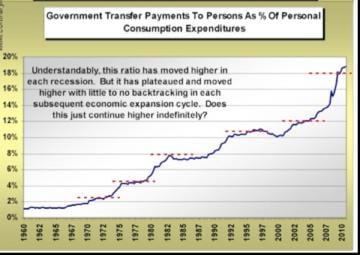
Consumption (70 percent of the economy) is nearly back to 2007 levels. However, there are just a couple problems with this policy. We have amassed $4 trillion in debt, and the consumers are still on life support with the federal government providing more than 18 percent of their income through programs like food stamps and unemployment compensation, which is now being extended by nearly three years.
At some point we need to repay all this borrowing. Check out ‘Graph 1’ in the gallery to the right.
So we have done what worked in all of the recessions in the past 30 years. Only this time it isn’t working very well at all. The designers of the bailouts and stimulus programs are gone from the former White House economic team (Larry Summers and Christina Romer, among others), yet their policies remain, now managed by Ben Bernanke and Tim Geithner.
To see where we are with our current policies, click on ‘Graph 2’ in the gallery to the right.
As consumer spending increased over the past 30 years, the growth in the economy slowed. Despite the current stimulus, economic growth is still anemic by historical standards. Furthermore, for those of you with an economic bent, you probably already know that savings equals investment—i.e. if we save less, we invest less. In the short run, that is acceptable, but in the long run, lower investment levels drastically slow the economy. The problem is that in the domain of political economics, all decisions are made for the short run. In other words, only until the next election, be it two years, four years or six years. In short, truly appropriate long-run economic decisions are stifled by the short-run political process.
For a look at what the past five decades of private savings (and therefore private investment) and economic growth data look like, click on ‘Graph 3’ in the gallery to the right.
It is clear that continuing the current economic policies in Washington will not solve our economic problems. The solution lies in an increase in personal savings, less consumption and an upturn in private corporate investment.
We need to go back to work, something at which Americans excel.
We need a substantially lighter government burden on our economy, in both financial and regulatory sectors. This new policy will take years to implement and demonstrate meaningful long-term results.
So as I ponder investing my clients’ funds, I do it realistically, knowing the policies from Washington are wrong and leading us in a direction that in the long run won’t work.
For the time being, the stimulus has juiced up the stock and commodity markets, providing transitory returns. But sometime soon, perhaps this year or maybe next, the folly of the current economic policies will become apparent to nearly all and we will change economic course.
Let’s hope it can be done without a wrenching adjustment to interest rates and stock prices.
More Business Columns
View all Business Columns
The Cost and Benefits of Capitalism
At the beginning of 2022, a Pew Research survey found that 78% of the U.S. population is dissatisfied with the way things are going in our country. In a March […]
Where Are All the Workers?
The rumors were the labor market was suffering from a shortage of workers because of the additional unemployment compensation paid due to the COVID-19 pandemic. Extended unemployment benefits ended for […]
The Basics of Mutual Funds and ETFs
In my last article, I gave an overview of stocks and fixed income/bonds. In this article, I will give an overview of mutual funds and exchange-traded funds (ETFs). Mutual funds and ETFs contain other investments inside of them.


