
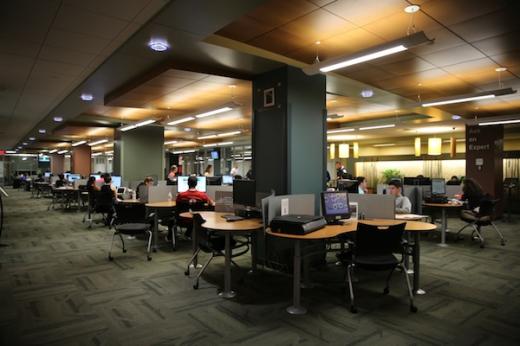
Looking out at the nearby community of students occupying the work spaces and group study rooms that surround his office, Joe Fennewald explained he wasn’t witnessing an aberration.
“We’re fairly new into the semester and it’s been like this all day and it’s been like this all week,” Fennewald said in early September. “Last week was just as crazy as it is right now. It’s incredibly popular.”
As the Head of the Tombros and McWhirter Knowledge Commons, a student-centered workspace located on the first floor of West Pattee Library on the Penn State University Park campus, Fennewald enjoyed a prime view of that day’s activity.
Students occupied nearly every inch of workspace, which included individual computer stations and group study rooms.
“There’s a lot of activity and that’s part of the excitement and that’s part of the learning process going on, is that people are talking with one another about things they’re working on,” Fennewald said. “It just generates a buzz.”
The chattering commotion was noticeable but not boisterous or unnerving. Nobody seemed to mind because students don’t want to study in a vacuum, Fennewald hinted. And with the group study rooms boasting glass walls, nothing goes unnoticed.
“They love the idea of being seen,” Fennewald said, referencing the students. “So this whole kind of social dynamic is going on, as well.”
The project launched in 2007, with Peter and Ann Tombros and John and Jeanette McWhirter providing the private funds for the construction.
Former associate dean Sally Kalin, who helped spearhead the development before retiring in 2011, says the library conducted intensive planning, both internally and with an architect group, and sought the support of the dean and other library administrators. Formal planning committees were created to seek out what students want and need in this new era of college life.
“More than anything else, the Knowledge Commons was a response to the changing learning and study habits of students,” Kalin said.
The Knowledge Commons is a multi-layered project that also includes a new auditorium and Maps Library, an atrium, a new center that offers special services and assistive technologies for students with disabilities and a revamped leisure reading room.
Kalin notes that Penn State looked at what other colleges, including the University of Pennsylvania and the University of Delaware, were already offering with similar technological spaces. Penn State students also offered insight, saying that they preferred chairs with wheels on them, so they can easily be moved, and plenty of outlets on worktables for charging their devices.
And those glass walls that the Knowledge Commons implemented? They were partly inspired from Delaware students, who Kalin says, “seemed to thrive on the openness of it.”
“It’s fascinating to kind of see how the students are using the space,” notes Fennewald, who regularly roams the space to talk with students, asking them what they like about the Knowledge Commons, what they’re working on and if they need anything else. “One of the things that we make a real effort in doing is not telling students how to use the space, but letting them tell us how they’re using the space.”
Kalin says the library began noticing a significant shift in the last 10 to 15 years, in regard to how students complete their work. One campus librarian told Kalin that the students on her campus no longer wrote papers, but instead produced videos to tell their stories, backing up Kalin’s point that students were no longer watching or listening to the media offered in class, but creating it themselves.
Students stopped relying on using the desktop computers the library offered. Cellphones, laptops and tablets began appearing and students needed somewhere where they could not only focus on their work but also have the capability to rest, relax and recharge, not just themselves but their personal items, as well.
A cafe located within the library allows students to bring in coffee and sandwiches while they work, which Fennewald notes the library encourages. It makes studying informal, he said, and less like work.
“Academic libraries have become intellectual gathering places that offer a myriad of services and support,” Kalin says. “Where else can one go and record a podcast, get help with a research paper, meet with classmates about an assignment, practice a presentation, read the local newspaper and get a cup of coffee, and almost anytime they want to?”
The Knowledge Commons is open 24 hours a day, five days a week, and also features a one-button studio, a unique workspace that allows students to practice a presentation as many times as they want without having to set up any video/audio equipment or lighting.
There’s plenty of on-site support for students, with assistance that’s color-coded. Staff members wear blue (hardware problems), purple (software issues) and green t-shirts (personally owned items such as iPods, iPhones, laptops, etc.), letting students know where to go for support.
Additionally, writing tutors are available in the evening. The organic combination of old-school study habits mixing with new-age technology results in an environment that’s part social clubhouse, part academic growth.
The best part is the students have bought in.
“There’s an excitement that is generated in the space,” Fennewald says. “I’ve had students actually come and say they don’t want to study or go elsewhere. They want to be in this space because it’s popular, but they’re also coming in and looking around the room and they’re seeing what people are doing.
“If you look around, you’re going to see people, yeah, checking email, watching a video, but for the most part, most of the students in the space are seriously engaged in some type of research or working on some type of class assignment.”
The group study rooms, which can be reserved up to two weeks in advance, simplifiy the group dynamic. Early in the semester, Fennewald saw someone connect an iPhone to the monitor, which projected the course syllabus onto the large screen so everyone could see. Imagine that same person having to pass around the iPhone to each individual student for inspection, Fennewald says, and it’s easy to see why these spaces have been so popular.
In the short time span between Thanksgiving and the end of the fall semester last year, 560 groups were turned down for reservations because all the rooms already were booked. And between the start of last fall semester to the beginning of this fall term, the Knowledge Commons fielded 22,000 questions, meaning that on average, one out of every two students enrolled at University Park visited the Knowledge Commons in that time frame, seeking support with any number of the services that are offered.
Kalin says the Knowledge Commons was developed with built-in flexibility, allowing for future changes that can be dictated by students and their study habits.
Personal preferences change, especially with some new gadget or gizmo coming out seemingly every few months. Penn State Library administrators know this. That’s why they’re ready and eager to accommodate their most prized possession: the Penn State student body.
“Students vote with their feet,” Kalin says. “The libraries are busier than they’ve ever been, perhaps heading to a record year in usage. In the students’ eyes, the libraries are doing something right.”
Click HERE for more information on the Knowledge Commons and/or to make a reservation.



