
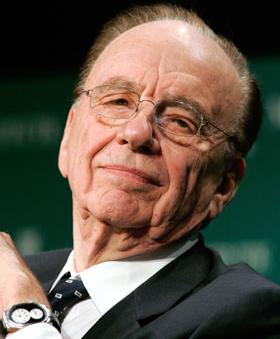
Rupert Murdoch, you are wrong.
You, the News Corp. chairman and chief executive, recently told the Federal Trade Commission you want your publication’s readers to pay for online news content. “Quality content,” you said, “is not free.”
Well, actually, yes it is.
Now and into the future, people will not pay for most content. Why do you think magazine sales (and, for that matter, all print sales) are down? Do you really think it is because a lot of “your” content is free (or, excuse me, “ad supported”) online?
In 1997, I proclaimed to all who would listen that newspapers, magazines and the Yellow Pages were dead — they just didn’t know it yet.
This was just a few years after I claimed everyone would get rid of their landline phone lines in favor of cell phones. Of course everyone told me I was crazy; “People will never get rid of their phone lines.”
Then, I was a pariah. Now, I am a prophet.
I am the little guy running a little city portal: StateCollege.com. It runs on a system I built to drop easily anywhere and become the central force of the hyper-local (an over-used term, I’ll admit) community. Sites like StateCollege.com and independent journalists who write with integrity build up a following in their communities.
Our site is completely advertiser-supported; that pays for running the site, publishing the site, and retaining staff and columnists. Our site delivers tremendous value and traffic to its advertisers for a very reasonable cost, delivering a very good Return on Investment (ROI). The ads are targeted to the users, and the users have a strong affinity with the advertisers. Thus, the ads are very effective.
An online community can form around many things: a specialty, a hobby, a special interest or a geographic locale. Readers will find writers they like, but they will move on if they have to pay to read their favorites. It’s too much of a barrier to have to pay. There will be a few niche communities where people will pay to join or access premium content, but they will be small in comparison.
The old paradigm: Paying for a daily newspaper was kind of like paying for the delivery charge — an inconvenience fee, if you will (and more and more of you will not these days). You did not necessarily see it as paying for the news.
Print/shotgun advertising wasn’t cost-effective and was overpriced. But newspapers were very good at selling ads to their advertisers and wrapping up all of their marketing dollars, so advertisers had to assume any business they got came from the print ads. There used to be many more people seeing those print ads.
Before the Internet, business people had to travel to see their customers. There were far fewer distractions for them and other travelers, as well. People didn’t have cell phones to call everyone on their call list to pass time. They couldn’t text message, Facebook, Twitter, play video games, listen to their iPod, connect to the Internet with their laptop and so forth. (Did I get it all? I doubt it.) Things have changed.
There are obviously a lot of distractions today that didn’t exist during print media’s heyday. The new paradigm: Media will find themselves in smaller, more specialized niche groups. And that specialized audience is and should be worth more to the right advertisers. Gone is the huge global media presence that deals with a few big ad agencies for big national buys.
Now you will have some communities focused around topics like weather (www.accuweather.com) and sports (www.espn.com) — very large communities. But national news and general columns on health, travel, politics have way too much competition from lots of other sources.
Coverage will be done by much smaller niche publications. Some may in fact cost money and have premium content, but most will be free and advertiser-supported. The advertising will be more valuable, because advertisers will be able to reach a niche audience, and ad delivery systems are getting much better at delivering targeted ads. You get true ROI from advertising spends, which you never got previously from buying “traditional” media. Yes, the media got to be fat cats, but the advertisers didn’t get a fair value.
I was traveling last week, went through a few airports including Dulles (Washington, D.C.) and didn’t see a single person with a USA Today or any other newspaper in their hands. Wow, who would have thought?
Murdoch, you might be the media magnate. But the readers are the new big media magnet (especially you, since you are reading this online).
If the record companies had embraced the new Internet economy instead of trying to fight it, where might they be today?
With the Internet economy, you put up a Web site, and A) distribution costs are almost zero, B) packaging is almost zero and C) anyone can be a publisher. The total cost and barrier to entry is almost zero.
Mr. Murdoch, this is where your costs need to come way down and your delivery of results have to go up. Obviously content costs money, and I understand that, but this is your skin in the game to get the traffic, to deliver the results.
Businesses still need to advertise their businesses and their Web sites, whether they are Wal-Mart or the corner store, and they need to advertise online. Will you be where they advertise? Or will it be someone who is delivering RESULTS.
Why do some people even get a newspaper today? In my quick survey, in many cases, “just to get the coupons.” It is a tough economy now, in case you didn’t know. So newspapers are now just a circular delivery mechanism, while their print readership dwindles down to nothing and that evaporates. Besides, most of these coupons are available from your favorite retailer on their own Web sites (or at StateCollege.com/coupons).
Mr. Murdoch, you are going to have to learn to deal with this new economy, and the price you are able to get for your online advertising just might be what your content is worth.
How much did I get paid to write this article? $0. But I hope it was insightful — nay, even inciteful — for those who read it.
See, Mr. Murdoch, our readers and I know what you do not: People will not pay for content.
I hope you enjoyed reading this column. No Charge.
Daniel Myers is President and Publisher of StateCollege.com and has been using technology to solve problems and provide solutions for his clients since 1980. He is a technologist, futurist and entrepreneur.
More Columns
View all Columns
The Following Column Was Written by Russell Frank… Honest
During a strategy session about our fall classes – yes, the 2026-27 academic year is nearly upon us – one of my colleagues confessed to using AI to generate the […]

Hook: Reflections on an Intriguing and Expensive World Cup
According to media reports, the FIFA World Cup final is the most-watched sporting event in the world, and although as I write this the viewership numbers have not been released […]
Paterno: In 2026, Signing Players Is In. Recruiting Is Out
This is that time of year when there are still several weeks until actual football games are played. Excitement for, and anxiety over, the upcoming season is building. While we […]


