

You don’t see something like this very often — at least not in State College. A hi-tech robot named Abe, looking like a castaway from a Hollywood movie, gliding down the sidewalk along College Ave. But there it was, strolling along on motorized treads — sort of like a tank.
The mechanical creature is using the streets of State College as a training ground — running on a computerized brain to learn its surroundings. It “sees” through a pair of fish eye lenses mounted atop a retractable arm. Microphones are on each side, giving Abe an almost human appearance.
This is all part of a project being run by scientists at Penn State’s Applied Research Lab. The U.S. Navy is funding the research which will be used by the Marines.
It’s pretty complicated stuff.
The project leader is John Sustersic, who holds a Ph.D. in computer science and engineering. Sustersic says the goal is to build robotic wingmen that will be, “autonomous partners capable of interacting directly with their human teammates and executing cognitively complex tasks.”
Sustersic says robots like this one are playing a critical role in modern life, “Typical responses to current events like the Boston tragedy routinely involve the use of remotely operated platforms like Abe to approach dangerous or uncertain situations, providing critical information in the form of video, audio, and other sensor data to human partners and interacting with suspicious items when necessary.”
Right now, robots require humans to operate the controls but scientists at the ARL believe their work will help pave the way to building machines that can “think.” “The work we are doing is expected to be a step towards truly autonomous robots capable of independent operation in dynamically challenging environments,” says Sustersic.
In theory, Marines will take a device like Abe into the field and instead of driving it, they’ll simply tell it what to do. Abe would obey orders and take on assignments that are too dangerous for people.
John Koch was the man giving Abe orders though a computer hook-up. Koch is a research and development engineer in the ARL’s Cyber Innovation Division. He says the Marines could tell Abe, “Go pick up that box, or go cut that fence open. And it would know what the command meant, know what a fence is, know how to cut it open. It’s an ambitious project.”
“What we’re doing is we’re gathering data with the sensors that it has which is the microphones, the GPS, cameras. Each of those little bits of video with sound are tagged with… where we were on the GPS, what was the weather conditions, what kind of objects did we see, like people, chairs…”
Again, it’s complicated stuff, filled with algorithms and technical language.
Putting it simply, Sustersic says, “The end goal is to enable robots to interact with humans in much the same way as a trusted dog. Robots could then learn at a similar level of interaction, allowing human partners to teach the robot new concepts, words… in the field.”
Watch Abe in Action
More Community & Entertainment
View all Community & Entertainment
January Is a Call to Action to Respond to Stalking
This column by Centre Safe Executive Director Jennifer Pencek originally appeared in The Centre County Gazette. When we talk about acts of interpersonal violence, oftentimes people will focus on sexual […]

Busy Weekend of Fall Festivals and More on Tap Around Centre County
The weekend of Sept. 29-Oct. 1 is packed with activities around Centre County, including fall festivals, Oktoberfests, fairs, concerts and more. Check out some of the weekend highlights below. For […]
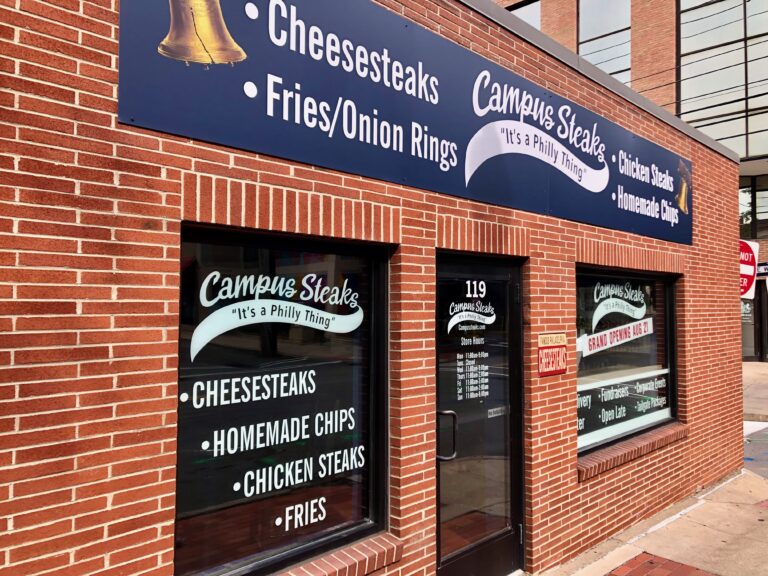
Downtown State College Cheesesteak Shop Sets Opening Date
A new cheesesteak shop that promises a taste of Philly in downtown State College has set an opening date. Campus Steaks plans to hold a grand opening on Aug. 28 […]


