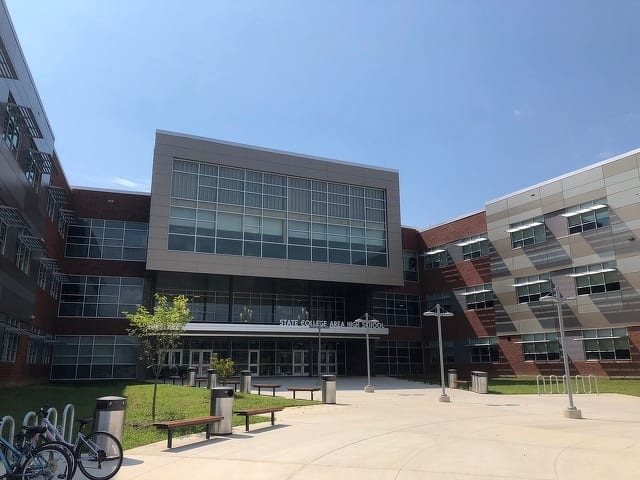
Less than a week into the school year, State College Area School District is preparing for a possible move to district-wide remote learning as COVID-19 cases rise locally with the return of Penn State students to the area.
In a message to district families on Monday night, Superintendent Bob O’Donnell wrote that there have been no confirmed cases among faculty, staff or students who have been in district buildings since the semester began on Aug. 26.
‘Unfortunately, our greater area is facing a different reality,’ O’Donnell wrote. ‘As the overall numbers rise, we still must consider switching to district-wide remote learning for the health and safety of our entire community. While we’re not there today, we want to share some concerning information that will be key to determining when we might make this shift.’
About 73% of district families chose in-person learning for the fall, with the remainder selecting remote and Virtual Academy options.
SCASD’s health and safety plan, approved earlier this summer, contains several parameters for when the district would consider moving to entirely remote learning. Among those is an increase of 50 to 75 cases within SCASD zip codes over a seven day period.
As of Monday morning, zip codes within the district had 62 cases over the past seven days, O’Donnell said.
‘This places us firmly in the range for preparing to move to remote learning,’ he wrote. ‘If the trend continues as it has recently, we could reach 75 as early as [Tuesday]. In that case, we will be looking at shutting down in-school learning.’
Of course, the recent spike in COVID-19 cases locally is largely attributable to testing — symptomatic and asymptomatic — of Penn State students, and how that should be factored into the district’s decision was a point of discussion among school board members and scientific and medical advisers during a work session on Monday night.
On Friday, Penn State updated its COVID-19 dashboard with weekly data that showed 27 new cases among students — 14 symptomatic and 13 asymptomatic — over the past week. More than 1,200 test results, mostly asymptomatic, were still pending.
Maciej Boni, an epidemiologist at Penn State who has been consulting for SCASD, noted that symptomatic testing of 125 students at the university yielded an 11.2% positive rate. A larger number of symptomatic tests through Mount Nittany Health over the same seven-day period had a 2% positive rate, for an overall average of about 3%. (Penn State’s asymptomatic test rate was .46%)
‘It’s not good news that on campus for the very first week the numbers were that high,’ Boni said.
The district’s plan also includes a positivity rate of 5 to 7.5% over seven days as one parameter, or Mount Nittany Medical Center reaching about two-thirds of critical care capacity. A Mount Nittany Health spokesperson said on Monday afternoon that the medical center currently has three COVID-19 inpatients. The hospital is licensed for 24 ICU beds and has capacity for a 21-bed COVID-19 unit.
Since Friday, there have been 44 new cases in Centre County, most in the 16801, 16802 and 16803 zip codes.
‘I don’t expect things to get better based on the number of cases that we saw over the weekend, based on the reports of students with symptoms reporting today at the University Health Services,’ Boni said. ‘The expectation is that the numbers will continue going up all week. That’s not a guarantee. There’s a small chance we could be very surprised and the numbers could go down. I’m not expecting that.’
Boni suggested that if the trend has not changed by Wednesday, it would be ‘a good time to consider closing for Thursday and Friday and evaluating, because what if there’s surprisingly great news on Friday? We could open on Monday. It’s not a high probability but it’s possible.’
He noted, however, that how to use the Penn State student data is subjective.
‘We don’t know who they are or how close of a degree of separation they have to the community and the students and faculty and staff at SCASD,’ he said.
Geisinger pediatrician Dr. Joy Drass, another SCASD adviser, said it’s important to consider that mandatory masking and other mitigation measures may play a significant role in limiting spread between students and the rest of the community.
‘The chances of that student getting someone in Target infected at this point, because of the mitigation measures we have in place, are quite low,’ Drass said. It’s a different conversation about those living in apartments that get together off campus or those living on a dorm floor in close quarters, I understand that. But I think we have to be a little bit cautious about treating this as if it was March 1 and none of us knew what was going on and had no ideas about transmission and exposure.’
Board member Scott Fozard said when deciding about moving to remote learning, he would consider a spike in positives among Penn State students one among the district or broader community, but could not quantify how much.
‘If we had 10 students in SCASD, those 10 would mean a lot more to me and my risk tolerance than would 10 students in 16802,’ he said.
‘It would be interesting to see if there is the level of community spread within the non-Penn State community as there is within the Penn State community. We went into this hoping the Penn State students would behave. We don’t know yet whether they are or not. There’s I think an equal number of data points suggesting both scenarios but we also don’t know how the non-Penn State community is behaving and are they being extra diligent in Target, in Walmart in the grocery store… because they now know the college students are back.’
Drass said she believes increases contained to Penn State students compared to those in the community are important factors to keep in mind.
‘I think as we move forward it’s really important to track that data and continue to compare,’ she said. ‘If Penn State rates go up and the rest of Centre County’s don’t, that’s valuable information too that it’s really not spreading to the community as quickly as people fear it might.’
Boni said that the current infections tallied among Penn State students would be the first generation of an outbreak.
‘By Wednesday or Thursday there will be a second round of individuals who were infected from the first group of individuals generating a new level of infections,’ he said. ‘That’s the point at which these individuals may not be undergraduates. They could be somebody at Target or a staff member that came into contact with an undergraduate.’
As cases rise, opening or closing both have ‘bad outcomes,’ Boni said. As Drass noted, closing schools will put a heavy strain on working families struggling to figure out child care and Boni has previously noted the potential negative impacts of staying home, including the risk of abuse, neglect and mental health challenges. Some students also have individual education plans and need to work directly with a professional educator.
If schools stay open, meanwhile, the greatest risk is to faculty and staff who are more susceptible to the effects of the virus.
‘I do think we should begin preparing for the riskiest outcomes on both ends,’ Boni said. ‘The riskiest outcomes for if we close are for the students and families that suffer the most and the riskiest outcomes for if we stay open and the faculty and staff who are most at risk. We’re going to be in a difficult position no matter what happens and that focus will help us minimize the risk of either of those difficult positions.’
Board member Lori Bedell said the board understand that either decision has negative consequences and will weigh considerations carefully.
‘I don’t think any of us have any interest in jumping to conclusions, so the expression of the way that the data should be read carefully, thoughtfully knowing full well that moving in one direction or another will have serious ramifications is absolutely the way that we are looking at this,’ she said. ‘So I want to be clear to the community watching this there’s no agenda here to move in one direction or another. We are incredibly sensitive to all of the ramifications that come.’
She added that she hopes, as previously discussed, the district will be able to provide learning centers for students who need special professional attention or who have nowhere else to go during the day.
‘We are working on it but we are scrambling with just keeping open,’ O’Donnell said. ‘We won’t be ready for the full plan by any means when we close, but we are working on it.’
In his letter to district families, O’Donnell said another update would be provided on Tuesday.
‘Without a doubt, this is a troubling turn of events, especially so early in the school year, but the circumstances of our area have us moving in the wrong direction,’ he said. ‘It’s disappointing, to say the least, that we find ourselves at this juncture, and I recognize the magnitude of what a shift to remote learning means for our families. For all of us, this year is unlike any other, and I hope we can lean on each other to make it through.’