
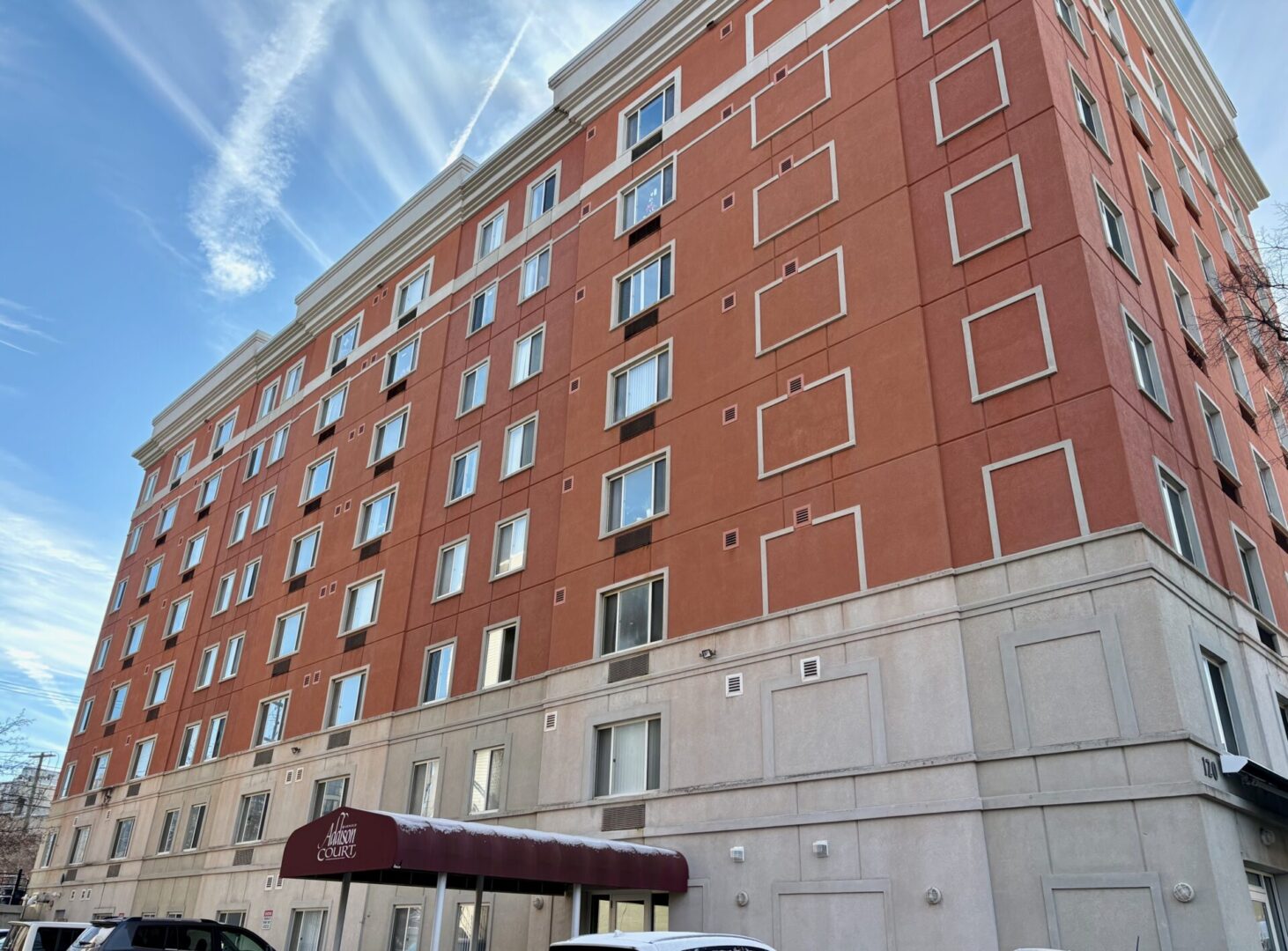
State College Planning Commission on Thursday recommended rejecting a zoning change that would increase the height limit for potential new construction on the Arnold Addison Court site.
The commission voted 3-2 to recommend that Borough Council deny State College-based developer PrimeCore’s request to raise the permitted maximum height from 45 feet to 65 feet on about half of the 120 E. Beaver Ave. property that for more than 30 years has been home to low-income apartments for seniors and people with disabilities.
The recommendation is advisory, and only the council has the authority to approve or deny zoning changes.
PrimeCore CEO Ara Kervandjian said in May that his intention is to pursue Low-Income Housing Tax Credits to preserve Addison Court as low-income apartments. But if that is not successful, he expects to return to his original plan of demolishing the existing building and constructing a student apartment building that mirrors the neighboring Pugh Centre.
Kervandjian said at the time that he will make a good-faith effort to obtain the credits, which would extend affordability requirements for another 40 years, but that the process is costly and time-consuming. If it is unsuccessful, he said on Thursday, constructing the new building with a uniform height of 65 feet, rather than one bifurcated by differing height limits, will “be more efficient in design and in structure and aesthetically.”
In response to a question from commission member Ethan Dean, Kervandjian said the extra height would not create additional apartments, but would instead reduce the depth needed for underground parking.
Prior to the commission’s recommendation, borough Planning Director Ed LeClear said he and his staff “can’t entertain a ‘this-for-that’ situation,” but instead made their own recommendation based Borough Council’s intent for that area of the downtown.
Addison Court opened in 1994 and is 75 feet high. In 1999, council amended the zoning to lower the height limit and in 2007 further updated it to limit building heights to 45 feet on the south side of Beaver Avenue within 200 feet east and west of the 200 block of South Allen Street, splitting the Addison Court property. The aim was to prevent tall buildings that would create a “canyon” effect at the corners of South Allen Street and Beaver Avenue.
In more recent years throughout the borough’s ongoing comprehensive zoning revision, council has consistently maintained that the Addison Court property should be located in a district with a maximum height of four stories and 52 feet.
“We specifically said staff asked council, ‘Do you want to change the zoning to allow additional height at that location?’ And their answer was no,” LeClear said. “One of the reasons their answer was no is that they did not want to provide additional entitlement or additional rights to a property owner that may make it so economically feasible that it would be torn down and Addison Court would become a student housing building.
“That was a specific discussion that was had by council. From a planning staff standpoint, we had that conversation for a year about what they wanted to see from Addison. We can’t recommend something different, knowing that they’ve already had that conversation.”
PrimeCore, with the support of former borough planning and zoning officer Herman Slaybaugh, has contended that reducing the area for the 45-foot height maximum from 200 to 100 feet from Allen Street would essentially only affect two properties: the Addison Court parcel and the parking lot on West Beaver Avenue that is partially owned by the borough and partially by State College Presbyterian Church. LeClear said the borough has considered potentially redeveloping the parking lot “for housing or for some other uses in the future,” and it’s unlikely to be redeveloped without borough oversight.
Sylus Smith, one of four borough residents who spoke during public comment, said amending the height for one property owner negates the basis for incentives for greater height limits elsewhere in the draft comprehensive zoning revision.
“All it would essentially be doing is increasing the benefits for one property owner at the expense of the collective communal interest embodied in the comprehensive rewrite,” Smith said. “… I like to see upzoning, generally. I think it’s good to build more units, but you don’t build more units by giving little exceptions here and there to individual property owners. If the commission thinks that this entire area needs to be upzoned, that’s their prerogative. But there is simply no reason to grant one exception to one man when we’ve already decided that this is what best benefits the community.”
Addison Court resident Kathryn Santoro said the borough simply should not enable the construction of another student high-rise on the site.
“There is a need for one- to two-bedroom apartments in the borough, not condos where you have four or five bedrooms,” Santoro said. “…Community members do not like the tall condos that are not accessible to them. They are for the students, not the local residents.”
Planning Commission member Curtis Shulman, who along with Peter Aeschbacher voted no on recommending denial, said he did not see a downside to allowing the height increase to 65 feet.
“Just based on the current view, if you go on Beaver Avenue and you look around, I don’t feel like those buildings are monolithic,” Shulman said. “This doesn’t increase height from where it’s currently at. There’s protection on the other side of the street. I don’t see why we would not accept this amendment and support it.”
Council is expected to hold a public hearing before voting on the amendment, likely in mid-July, LeClear said.
Addison Court was constructed using Low Income Housing Tax Credits, which required a 30-year affordability period that ended in December 2024. (The borough, which has no ownership in the building, also provided a $440,000 loan from Community Development Block Grant funds in 1993 for property acquisition, which the former owner paid back in full in 2012.)
In December 2025, PrimeCore submitted a land development plan for a new apartment building on the site with ground-floor commercial, six floors containing 40 apartments, including four inclusionary housing units, a rooftop terrace and underground parking.
Tenants of Addison Court, where 50 of the 89 mostly one-bedroom apartments are currently occupied, received a letter in December from the building owner at the time initially informing them that all current leases would have an end date of Nov. 30, 2026.
Staff from the borough and the Pennsylvania Housing Finance Agency, which administers the federal LIHTC program in the commonwealth, reviewed legal documents related to the property and said they believe a deed covenant prohibits the eviction of tenants who resided there as of Dec. 31, 2024 without cause before Dec. 31, 2027 because of a required three-year wind-down period after the affordability requirements expired.
At a Planning Commission meeting in May, Kervandjian said his “plan A” is now to pursue the preservation tax credits that would keep Addison Court in place as income-limited, rent-restricted apartments. Regardless of the ultimate outcome, the process will allow tenants more time to remain in their apartments.
PrimeCore, which recently completed the purchase of the property from Beaver Court Associates LP for $6.95 million, had not yet performed an engineering study, but Kervandjian said he anticipated the building would require substantial renovations, some of which would be mandated by the tax credit program.
That may require residents to be temporarily displaced. Kervandjian said his company will work with the tenants to ensure they have somewhere to live during the construction and to help those who wish to move permanently to different housing.
If the tax credits are not awarded, Kervandjian said his company would redevelop or reuse the property in some fashion and it would not be for low-income housing. LeClear noted that as long as zoning regulations are met, Kervandjian is able under Pennsylvania law and borough code to raze the existing building and construct a new one.
Kervandjian, who has been the most prolific developer of low-income housing in Centre County in recent years, has applied for LIHTC funding for seven projects since 2012 and has been successful each time in his first application.
More Local News
View all Local News
Centre County Elections Office Sees Leadership Change as Midterms Approach
Centre County’s Office of Elections and Voter Registration has undergone a change in leadership weeks before voters head to the polls for the midterms and with mail voting already underway. […]

Happy Valley Casino Posted Its Lowest Monthly Revenue to Date in September
Update 5:46 p.m. Oct. 19, 2026. Happy Valley Casino recorded its lowest monthly gaming revenue to date in September, despite an influx of visitors to the Centre Region that accompanied […]

Penns Valley Community Rallies to Save Pool
The Penns Valley Penguins swim team has exceeded its $100,000 fundraising goal toward restoring the Millheim Pool, marking a significant milestone in an effort to bring swimming, summer memories and a longtime gathering place back to Penns Valley.


