
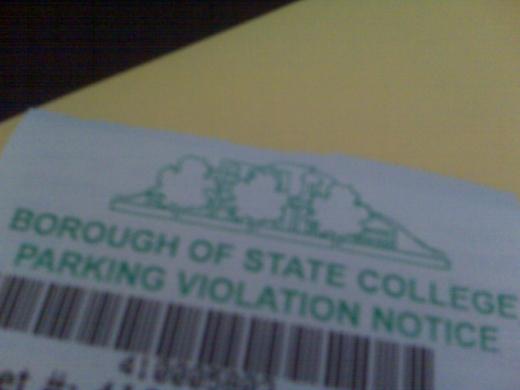
Parking enforcement in downtown State College may be tweaked in 2011, though any potential changes are probably months away, borough and downtown leaders said this week.
Under Manager Charles DeBow, the borough Parking Department has recommended a rethinking of some parking-ticket prices and the hours of parking-meter enforcement downtown.
DeBow said the borough’s overarching goal is to improve availability of on-street and surface-lot spaces. Too often, he said, it appears that those spaces are overused by chronic parking-rule violators.
And in the evenings, after meter enforcement stops for the day, it appears that there’s relatively little turnover in the on-street metered spaces, DeBow said.
He said that trend is worrisome because it may somewhat inhibit downtown business, chasing away would-be customers who want to park briefly and easily.
‘The overall reason why we’re doing this (pursuing changes) is to help State College,’ DeBow said Thursday. He said the borough is looking not to generate additional parking revenue, but to make the downtown more attractive to business customers and other visitors.
His recent, tentative recommendations, presented to the borough Transportation Commission and the Downtown State College Improvement District, include these:
- Increase the parking-ticket fines for offenders who commit more than six meter offenses in one year. Right now, expired-meter violations cost $6 apiece; the price climbs to $15 for those unpaid after three days and to $30 for those unpaid after 30 days. Tentatively, DeBow has suggested that the base fine could be $25 for those with seven or more offenses per year; that would grow to $35 and then to $45 for unpaid tickets. Motorists with more than seven meter offenses annually account for only 2.5 percent of violators, but together they receive about 20 percent of all parking tickets issued by the borough, according to department data.
- Extend on-street parking-meter enforcement from 6 p.m. to 10 p.m. on Mondays, Tuesdays, Wednesdays, Fridays and Saturdays. Hourly rates could be adjusted, and the two-hour parking limit could be extended to four hours, for the period after 6 p.m., DeBow said. Borough surveys have shown that on-street parking spaces are nearly 100 percent occupied by 7 p.m. on weekdays, when the meters are no longer enforced. Earlier, when meters are enforced in the late afternoon, between eight and 13 percent of those on-street spaces are regularly available.
Research has shown that people aren’t unwilling to pay a reasonable price for parking — as long as the parking is easily accessible and convenient, DeBow said. He also pointed to a Downtown Improvement District newsletter published in 1995, when the DID encouraged turnover in on-street parking spaces.
At that point, each on-street space fostered an estimated $20,000 to $50,000 in gross annual sales for downtown businesses, the newsletter suggests. ‘Their (sic) is no excuse for your employees to occupy the downtown’s best parking spaces’ for prolonged periods, the DID wrote to business owners at the time.
Today, business owners have deeply mixed opinions on how the borough should proceed with evening parking rules and parking fines, said Jody Alessandrine, the DID executive director.
He said the DID is working with business owners and the borough to develop a ‘palatable scenario for all business and property owners concerned.’ He’s not sure that any one-size-fits-all solution exists, Alessandrine said.
Both Alessandrine and DeBow said any potential changes, even on a trial basis, aren’t likely to take effect until late summer 2011. In March, April and May, the borough is slated to undertake a nuanced study of three blocks of College Avenue — to monitor turnover rates in the evenings and see exactly how long drivers park there after 6 p.m.
Conceptually, Alessandrine said, what the borough wants — that is, more parking turnover and availability — makes sense. But in a practical sense, he said, it’s tough to find common ground because different types of business have different wants and needs.
‘A lot has to be untangled,’ Alessandrine said.
The core objective behind tougher fines for repeat meter offenders, DeBow said, would be to push those chronic offenders into the downtown garages and open up more short-term parking spaces for more people.
‘Graduated fines are both fairer and more effective than flat-rate fines,’ DeBow wrote in a recommendation. ‘ … When a greater percentage of parkers comply with the rules, then more space is available for the intended user: customers and visitors.’
As of late September, the borough had issued 49,839 parking tickets so far in 2010. DeBow said the borough would like to see that number decrease as more motorists follow the rules and help sustain on-street turnover in the downtown.
He expects that the proposed changes — longer hours of enforcement, steeper fines for repeat offenders — would generate some additional revenue for the parking department, though that’s not the goal, he reiterated.
When the borough increased the fine for overnight parking on neighborhood streets from $15 to $25 last year, it saw a 20 percent reduction in the number of those violations. But it also saw a 22 percent increase in revenue from those offenses, thanks to the higher fine.
‘We really believe that (these changes are) better for State College,’ DeBow said of the latest recommendations. ‘ … I don’t think it’s going to deter people from coming downtown. The bottom line is, we want to create convenient parking.’
Earlier coverage
More Local News
View all Local News
Alpha Fire Company Receives $10K Donation From Bloom Energy During ESPN Radio Tour Stop
ESPN Radio’s College Football Campus Tour made its first stop at Penn State, bringing a $10,000 donation from Bloom Energy to Alpha Fire Company ahead of Saturday’s Homecoming matchup between […]
Charlotte Flights Bring a New Route to Growth at State College Regional Airport
Direct flights to Charlotte beginning in October promise easier travel and broader economic opportunities for Centre County.

Wiz Khalifa to Perform at Champs Downtown
Rapper Wiz Khalifa is set to perform at Champs Downtown in State College, the sports bar and club announced on Instagram. The show at 7 p.m. on Oct. 1 is […]


