
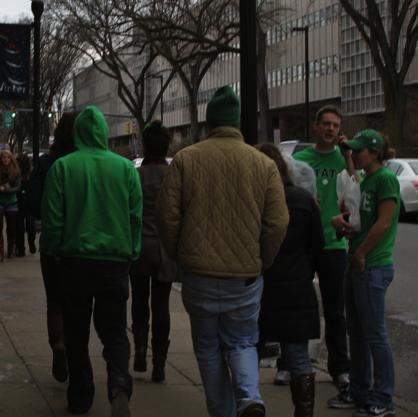
State Patty’s Day 2011 cost State College borough thousands of dollars in public services, from $18,700 in added police costs to $15,441 for extra public-works needs, such as trash collection, a new analysis shows.
But the analysis, prepared by the municipality and released Thursday, also shows that the unsanctioned drinking holiday brought a net financial gain to the borough government.
The gain amounted to $15,144 after the borough accounted for a dramatic spike in parking revenue over the fifth annual State Patty’s Day weekend, held Feb. 25 to Feb. 27.
State College brought in a total of $82,497 from parking tickets and garage revenue that weekend, up from $9,947 on a typical weekend, the data show.
Still, because of the way revenues are allocated in the borough budget, the parking gains seen over the February weekend do not appear to offset entirely the fiscal hits seen by the police and public-works departments.
Borough leaders substantially increased parking-enforcement patrols and raised garage rates for customers who parked more than three consecutive hours on State Patty’s Day weekend. The idea there was to help cover State Patty’s-related expenses, to stave off an overabundance of illegally parked cars, and to help keep some garage space available for non-State Patty’s visitors, according to the borough analysis and independent interviews.
‘Clearly, this event has varying direct financial impacts, some negative and some positive, on individual businesses, agencies and the general community,’ the borough administration wrote in a prepared statement. ‘Specifically, the parking fund realized a large increase in revenues. The off-street parking rates were increased, but solely as a measure to control the demand of the off-street system that was overwhelmed during this event the previous four years.
‘However, regardless of the financial outcomes, this event clearly has very harmful and deleterious effects on individuals, businesses, neighborhoods, the university, and the broader State College community,’ the statement goes on. ‘It is solely a dangerous drinking event that has become the most dangerous and destructive weekend of the year in State College.’
The complete State Patty’s Day 2011 analysis, shared with StateCollege.com Thursday morning, will be released on the official borough website later Thursday. At 26 pages, it’s designed to provide the public with new insight on the impacts of the event, which brings thousands of people to State College for a weekend of drinking and revelry.
After the event’s 2011 iteration, the analysis reads, ‘all borough departments involved in the events were asked to provide factual information to better understand the full effects of the event on the entire community. Additionally, many community programs, as well as the Downtown State College Improvement District, were asked to provide input for this report.’
The analysis also may help the community for State Patty’s Day in the future, it says.
Among the report’s insights:
- Borough police saw 480 calls for service from noon Feb. 25 to noon Feb. 27, up from 365 calls over State Patty’s Day weekend the prior year. They counted 234 criminal arrests, up from 160 the prior year — including 14 DUI arrests. Fourteen people were taken to Mount Nittany Medical Center with alcohol overdoses. (The police statistics do not include calls and cases handled by Penn State police, state police or the state liquor-control officers, all of whom were on patrol locally that weekend, too.)
- Several downtown bars’ decision to close entirely for State Patty’s Day itself — Feb. 26 — was helpful, the analysis reads. And those that did remain open operated responsibly, not offering any drink promotions and keeping crowds well under control, it says. Also helpful, according to the analysis, were the Penn State Interfraternity Council’s restrictions on social functions Feb. 26 and the state Liquor Control Board’s decision to close local wine-and-spirits stores early.
- Expenses directly attributable to State Patty’s Day run a gamut. They include $18,700 in added borough police expenses; $9,295 in added expenses for CATA; $20,200 in private-property damages done at six apartment buildings; $15,441 in extra public-works expenses for items such as damaged signs, garbage collection and street sweeping; and $563 in extra ordinance-enforcement costs.
- Mount Nittany Medical Center saw more than 200 patients on Feb. 26, more than double the patient volume on a typical Saturday. Of those seen Feb. 26, 103 were treated for alcohol-related medical issues. And of those 103, 69 were not Penn State students; 34 were Penn State students. The emergency room had to allocate 120 extra hours of staff time to cope with the surge.
- Community Volunteer Day, held Feb. 26, which put locals on the streets to conduct sober observatory patrols, was largely a success, the report shows. The borough staff recommends continuing the endeavor next year, with a few tweaks.
- Downtown businesses saw varied results over State Patty’s Day weekend. A survey of 10 unidentified businesses indicates that some saw an uptick in business — as much as 60 percent up — while others suffered declines of as much as 40 percent.
The report includes additional details about Community Volunteer Day, along with a post-State Patty’s Day focus group run by the borough. In its prepared statement, the borough administration made a note of ‘several new strategies … employed in an attempt to curb much of the negative behavior and consequences that result from this excessive-drinking event.’
StateCollege.com will have more post-State Patty’s Day coverage later this week.
The event, decried by borough and Penn State officials alike, began when the traditional St. Patty’s Day fell during the university’s spring break in 2007. That prompted some students to create an alternative drinking holiday.
The concept has gained steam over the past five years, largely through social media such as Facebook and through more conventional media coverage. Many State Patty’s visitors come from far outside the Centre Region, even traveling from other states to attend.
Related coverage
More Latest Penn State News
View all Latest Penn State News
Penn State Launches New Student Success Office, Names Interim Leader
Penn State has established the new Office of Student Success and appointed an interim vice provost who will oversee university-wide efforts focused on helping students progress from enrollment through graduation […]
What to Know About Traffic, Parking and CATA Changes for Penn State’s Homecoming Parade
Penn State’s annual Homecoming Parade will bring road closures, parking restrictions and changes to CATA bus services across University Park and downtown State College on Friday, Sept. 25. The parade […]
Homecoming 2026: Penn State, WE ARE the World
It is Homecoming at Penn State. And while the weekend spins on the axis of a football game, it is so much more than that. It is a time for […]


