
It is that wonderful time when we wish each other health, happiness and good fortune in the upcoming New Year.
Indeed, 2011 is just around the corner and at least we have a full year before we come to the supposed apocalyptic end of the world in 2012. If this is so, then concerning ourselves with global warming, all things green, the foolishness of quantitative easing, terrorism, airport body scanners, and everything else seems rather pointless.
Who cares about rates of return on your portfolio if everything as we know it is coming to an end? To be sure, some of our brightest physicists have hypothesized that all matter (right down to the nuclear level, including my excess body fat) will cease to exist at some point in the future. But as I recall 2012 was not the year they were citing. It was somewhat farther into the future. (As a science fiction fan, I am much more interested in when the intelligent extraterrestrials will show up and open a dialog with us.) Even if that did happen, I would still have to go to work, pay my bills and do the laundry. World-changing events do not seem to have much impact on the everyday mundane things that constitute much of our daily lives.
Long-term predictions aside, for now we have a parade of pundits, gurus, politicians, business executives, writers and media folks making comments and projections about the coming year. What we know about their musings is that some things will happen, some things won’t happen and some things will happen that weren’t anticipated by anyone. We can also infer that a lot of things that will or won’t happen won’t matter much at all and a few things will matter greatly. How can we discern whose projections have value? In short, we can’t.
The basic problem with predicting the future is that the tool we use (language) is insufficient to address the problem with certainty. We are very good at pounding the square pegs in the round holes with ever bigger hammers. Just ask the folks—the so-called experts—who hang out inside the Beltway.
Everyone seems to make the same mistake. Statements about the future are assessments (not assertions) and are certainly not true, by definition. While some may be actualized, it is only fortuitously so and in no way reflects on the pundit making the prediction. To be clear, I am referring specifically to those assessments made by market gurus and strategists.
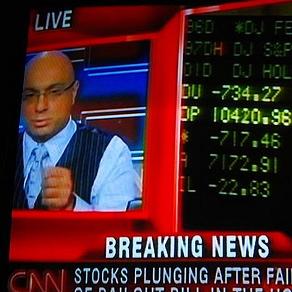
So now all the media comes out with their outlooks for the investment markets in 2011. Most of us want to be wealthier at the end of the coming year than we are right now, so we read these prognostications with rapt attention. The bottom line is that some are right, some wrong, some are partially right or wrong and some will miss the important stuff all together. Nobody announces the validity of their claims ahead of time. And the larger the pundit’s reputation, the more credence we lend to their opinions. Unfortunately, a track record of guessing correctly has no bearing on being right again.
The future is not some kind of continuous thread that can be discerned with a special education, even a Ph.D. Yet we will conveniently craft stories that seemingly encompass everything in a nice neat package, discarding the offending information as spurious. God forbid that we might have to rethink our notion of how the world works.
So as a portfolio manager tasked with preserving my clients’ wealth, I have found only one way to move through 2011 with any hope of success or perhaps avoidance of financial failure. It is to simply show up at work every day, pay attention to the markets and make the appropriate adjustments to my entrusted portfolios. Given the uncertainty of the future, it keeps me gainfully employed as long as I produce a meaningful result as measured by returns against the market averages and such. For me, there is no higher calling that serving others and working to keep them financially solvent through these interesting times.
So make some resolutions, drink something alcoholic and ponder the musings of the gurus about the New Year. Just don’t take any of it too seriously.
More Business Columns
View all Business Columns
The Cost and Benefits of Capitalism
At the beginning of 2022, a Pew Research survey found that 78% of the U.S. population is dissatisfied with the way things are going in our country. In a March […]
Where Are All the Workers?
The rumors were the labor market was suffering from a shortage of workers because of the additional unemployment compensation paid due to the COVID-19 pandemic. Extended unemployment benefits ended for […]
The Basics of Mutual Funds and ETFs
In my last article, I gave an overview of stocks and fixed income/bonds. In this article, I will give an overview of mutual funds and exchange-traded funds (ETFs). Mutual funds and ETFs contain other investments inside of them.


