
One of the first signs of spring is the distinctive sound of peepers.
Usually, when one begins to hear them, it means they’ve opened their bedroom windows while sleeping to let the fresh air and sounds of these peepers, bullfrogs and hoot owls serenade them to sleep. As summer continues, we see lightning bugs and ladybugs and as August approaches, the sound of the Cicada resonates as background noise day and night.
My uncle, while at a weekly family gathering, announced that the sound of cicadas depresses him, as the unmistakable clicking of this bug unofficially marks the end of the summer season and weekly family gatherings. In fact, the sound of the cicada is often used in Japanese films and television to indicate the scene is taking place in the summer.
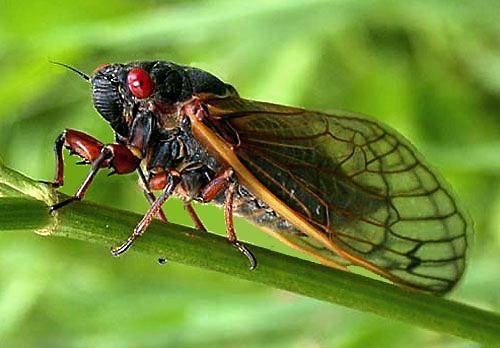
While the North American species of cicadas are appropriately nicknamed the dog day cicada, for it’s emergence in late July and August, the name cicada has a Latin derivation meaning tree cricket, of which there are over 2,500 species of throughout the world. The cicada enjoys hot weather and will do its most outrageous singing during the hottest part of a day.
This commonly 1-2 inch, large-eyed and winged insect can dwell in moderate to tropical climates and present in some variety in every continent other than Antarctica. The cicada is often confused with or called the locust, although a true locust is actually a type of grasshopper.
Cicadas are a generally friendly insect. They do not intentionally bite or sting humans but, if one allows the insect to rest on their arm it could mistake it for a tree branch and attempt to feed through its long proboscis to extract sap. Cicadas have been known, though, to damage crops, shrubs, and trees because females lay their eggs deep in the branches. Their favorites include oak, cypress, willow, ash and maple trees. It is much more enjoyable to simply watch a cicada in its habitat.
There are several interesting videos on YouTube that show cicadas in their habitat and even making their loud call.
The sound of the cicada is not made like crickets or other sound making insects, who rubs parts together making a striation. The cicada makes different types of songs at different pitches for mating, distress and courtship using tymbals, which are located one the sides of the abdomen. By contracting or rapidly vibrating the membranes of the internal tymbal muscles, the cicada produces a clicking sound which then resonates in the practically hollow abdomen.
Some online videos showing cicadas producing sound make it easy to see where the noise derives from. Some cicadas have been measured making sounds up to 120 decibels, which in the appropriate setting, could actually cause damage to the human ear.
A few years ago, while residing on Centre Hall Mountain, I witnessed, over a period of time, the process of the 17-year cicada. Depending on the particular species, these insects live underground as nymphs for many years until they make tunnels to the surface as a large group.
The cycle that I witnessed included the cicadas progressively emerging from hundreds of holes in my lawn, hatching from eggs laid all over the trunks and branches of the trees then molting their skins, leaving an adult cicada and the abandoned exoskeletons clinging to the trees, on the ground, and all over my back patio.
In China, the casings of cicadas are employed in traditional medicines. After the process of emergence, my neighbors and I had the pleasure of listening to their summer song for the next few weeks. It was quite the process to witness, although the “infestation” did feel like a strange episode of “Alfred Hitchcock Presents,” at times. Cicadas don’t bother some people though.
Actually, cicadas have been eaten on skewers, deep fried, dipped in chocolate or stir fried, as a delicacy in many countries including China, Malaysia, Burma, Latin America, the Congo and even in the United States.
In these last few weeks of true summertime, turn off the television and music, put down your book and listen carefully for the song of the cicada. This insect is a truly unique specimen of which we can inadvertently use to mark the close of summer, the beginning of school, and the coming of cooler weather.
More Centre County Gazette
View all Centre County Gazette
ShelterFest Returns to Support Out of the Cold’s Mission
Out of the Cold is inviting the community to ShelterFest 2026, a four-day celebration of live music, local food and community support that helps ensure some of Centre County's most vulnerable residents have a safe place to sleep.

Centre County Jail Population Falls to Lowest Level Since 2005
The inmate population at the Centre County Correctional Facility has fallen to its lowest level since the current jail opened in 2005, a trend officials attribute to expanded diversion programs, re-entry efforts and changes in probation laws.

A Promise Kept: The Hope Fund Celebrates 5th Annual ‘A Toast to T.J.’ Event
What began as a community rallying around a young husband and father battling a rare form of cancer has grown into The Hope Fund, a volunteer nonprofit that has quietly helped more than 300 Penns Valley families facing medical emergencies…


