

In these most unprecedented and difficult of times, Centre Countians from first responders and medical professionals to folks with a needle, thread, and a spirit of generosity are stepping up to meet the challenge posed by the COVID-19 pandemic. Here are just a few of their stories.
This is the third and final part of a special report in Town&Gown’s May issue. Part 1 | Part 2
Paying It Forward, In 3D
During what is certainly a scary time of uncertainty for many small businesses, Victor DeDonato feels blessed. He’s fortunate, he says, because his store, The UPS Store at Colonnade Way in State College, is considered an essential business, which means it remained open during Pennsylvania’s COVID-19 restrictions, allowing him to keep people gainfully employed.
When it comes to good fortune, DeDonato and The UPS Store have always looked for ways to pay it forward, he says, so when a friend, Bridget Flickinger, an emergency room physician at Mount Nittany Medical Center, approached him with a need, he quickly figured out how his business could help.
Flickinger had seen an article about State College native Jeremy Filko, who had come up with a design for a plastic shield to protect N95 face masks that could be created using a 3D printer. The shields are made of hard, colored plastic and fit over an N95 mask to cover the wearer’s nose and mouth.
“The N95 respirator masks are supposed to be disposable. But with the shortage, they have been having to reuse them,” DeDonato says. “So Bridget asked me if we could do these shields, and at the time I had no idea about them. … I looked into it, and found out I could download and print a file from [Filko’s] website” collectiveshield.org.
So DeDonato and his crew got to work, printing out about 20 shields for the Mount Nittany ER department. Meanwhile, he received another request, this time from the Chamber of Business and Industry of Centre County. The CBICC was reaching out on behalf of the Mount Nittany Health Foundation, which was looking for local companies that could manufacture N95 respirators and other protective equipment for Mount Nittany Health employees beyond the ER department. DeDonato signed on to provide 50 more mask shields.
The process of 3D printing the shields takes several days, DeDonato says, and the materials required are expensive.
“We can build about 25 at a time,” he explains. “It takes over a day to print, and then we have to wash them, and then process them, break them apart, and get all of the support material off of them.”
All in all, DeDonato says, The UPS Store is donating $2,000 worth of product to the hospital.
“We’re just trying to help out. We’ve done that for as long as we’ve been in business – helping with nonprofits, doing charity runs and book drives and that kind of thing. We’re just trying to do the right thing.”
Of course, supplying 3D printed protective medical equipment is just one aspect of what defines The UPS Store as a “life-sustaining” business, according to Pennsylvania’s guidelines during the COVID-19 crisis. The business has continued to offer essential services such as shipping, printing, and notary services.
The store has been practicing stringent safety precautions, DeDonato says, including providing gloves and masks for employees; creating a buffer between customers and staff by placing boxes in front of the counters and tape on the floors; displaying signage asking employees to follow CDC social distancing guidelines – remaining 6 feet apart and not allowing more than 10 customers on-site at a time; and disinfecting touch points frequently throughout the day.
– Karen Walker
An Increase in Need – and Donations
In times as uncertain as these, with confusion and sorrow at the forefront of many people’s minds, one thing has remained constant: the helping hands that extend from this tight-knit community. Places that have always been known for their collective support, like the State College Food Bank, have continued to offer a great deal of help to those who have been affected by such an unprecedented experience.
“We have seen an increase in need,” says Allayn Beck, executive director of the State College Food Bank. “We are receiving more referrals from our referring agencies, and we are having more people walk in to receive service who have never been here before.”
As more people find themselves in need of the food bank’s services, donations in State College have actually been increasing, Beck notes.
“It’s wonderful to see the support our community shares with us. We are very fortunate,” she says.
The State College Food Bank, while utilizing donations, also relies on the help of volunteers to operate successfully. Given the current situation surrounding the outbreak of COVID-19, the food bank has “decreased the number of volunteers we need to operate,” Beck says. “Thankfully, we haven’t needed to recruit new people. Our current volunteer base is covering our needs.”
While some aspects of operation have remained similar to times in the past, with donations and volunteers at the forefront, the process of how the public is getting food has inevitably changed.
As social distancing has become the new norm within society, the State College Food Bank has new methods of food distribution. Before the pandemic, people would go to the food bank on South Atherton Street and “shop for food – much like a grocery store,” Beck says.
To ensure the safety of everyone involved, the food is now pre-packaged and brought to clients while they stay in their vehicles, Beck says.
“We are also working to support our partner agencies at this time as best we can,” Beck says in reference to distributing food to those in need.
Times like these can cause everyone to feel alone, but togetherness does not have to seem out of reach. With communal support being offered at places like the State College Food Bank, it’s right around the corner for anyone who needs it.
Located at 1321 S. Atherton St., the food bank operates on Mondays, Wednesdays, and Fridays. Client distribution hours are from 1-4:30 p.m. on Mondays, and 1-3:30 p.m. on Wednesdays and Fridays. The public can drop off donations from 9 a.m. to 12:30 p.m. on those days, or by appointment. More information can be found at scfoodbank.org.
– Jordan Holsopple
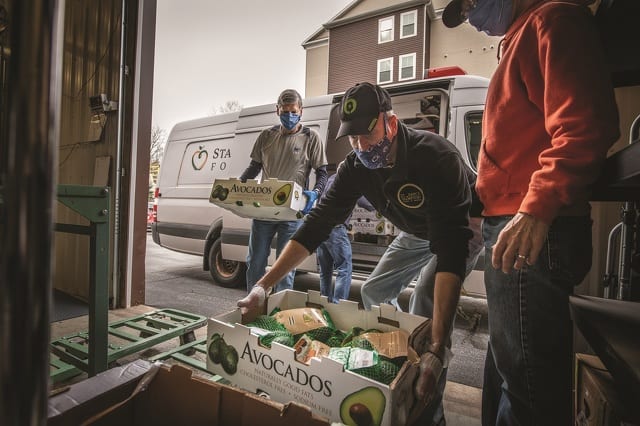
(Photo by Darren Andrew Weimert) Donations to the State College Food Bank have been increasing during this time of greater need.
Mindful Resilience
The COVID-19 pandemic has created a stressful situation for just about everyone, but perhaps none are more affected than those on the front lines – the health-care workers and first responders who are putting themselves in harm’s way and risking exposure as they work to save the lives of those afflicted with the deadly, contagious virus. Under pressure and facing intense life-and-death situations, these workers may be experiencing symptoms of trauma similar to what military veterans encounter in combat situations.
Wellness in Motion yoga studio has been offering “mindful resilience” classes at no charge to veterans for the past six months, and now the studio is expanding that free access to include first responders and health-care workers.
“The whole program is basically built on building resilience in a trauma-informed way,” explains instructor Jessica Minelli. “We’re giving people tools to be able to use outside of the yoga situation.”
Those tools come in the form of the five pillars of the mindful resilience program: gratitude, mindful movement, meditation, breath work, and guided rest. All five tools are incorporated into each one-hour class, which Minelli says is taught at a beginner yoga level to make it accessible to anyone.
“We teach people how to use all of these tools, so they can use them later on in their life, or later on in the day, or anytime they find themselves in a stressful situation,” she explains.
“The way we thought it was so relatable to the world right now is that we are all kind of in this uncharted territory and we’re carrying around stress from all of that. … Stress causes us to be in that ‘flight or fight’ kind of mode, to the point where sometimes we are not in connection with our own breath or even with our own feelings and our own thoughts,” she says. “[The practice] allows us to turn our attention inward, and to focus on what we can control.”
For example, she explains, “Meditation helps calm the mind, which helps calm the central nervous system. … So, I can learn to deepen my breath, and I can sit there with that for a little bit and allow that to bring a sense of calm into my body. And then maybe I can take a step forward from there.”
While traditionally the program is taught in the State College studio at 2541 East College Avenue, the classes have gone online via the Zoom app due to COVID-19 restrictions. The shift to virtual classes has been challenging in some respects, she says, but the technology has also allowed the program to reach participants from outside of the State College area, including a nurse from Hawaii and a police officer from New York City. The Zoom app also allows for an important social connection.
“We’re all missing that contact with the outside world and with our friends, classmates, students. So when we do this virtually, there is the ability for other people to see each other on the screen and sometimes there is some time before or after class for people to at least say hello. It’s giving us the opportunity to connect, even though it might be different.”
Minelli invites people to see demonstrations of mindful resilience practices by visiting the Veterans Yoga Project website, veteransyogaproject.org. Minelli’s classes are offered every Wednesday at noon and one Sunday evening per month. Interested participants can sign up at wellnessinmotion.com. First responders can use the code “1FIRSTRESPONDERS” when checking out to avoid paying the regular fee for the class.
– Karen Walker
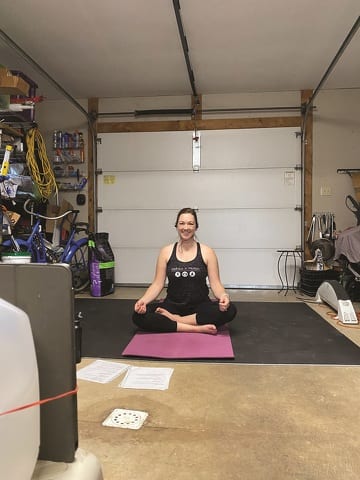
“The whole program is basically built on building resilience in a trauma-informed way,” explains instructor Jessica Minelli.
Mask-Makers Unite
Rachael Huxford was feeling helpless as the impact from the coronavirus was changing the world all around her. But she remembered to “look for the helpers,” and she stumbled upon several groups across the country making face masks for not just themselves and their loved ones, but also for hospitals and nursing homes. She, however, didn’t find one in Centre County.
“That’s when I knew I had found my way to become a helper,” says Huxford. Inspired, Huxford got to work on social media and at her sewing machine, and after connecting with a few other local crafters, she created a Facebook page called State College Mask Makers, with a goal to connect people who needed masks to those who can make them.
The site grew to more than 225 members by mid-April, with more than 1,500 requests for masks. The group is focused and organized, with sewers and even non-sewers who make runs twice a week to deliver materials, pick up masks, and exchange other supplies between households.
“This means anyone who wants to participate can get materials delivered right to their doorstep,” says Huxford. “We are also partnered with a few members who have been 3D printing face shields for donation, and even patterns for our cutters to use! We’re also looking into knitting and crocheting options for people to make ‘ear-savers,’ which nurses can attach the elastic of their mask to in order to reduce the stress on their ears.”
The group has received help from the community, which has donated supplies, food, and many messages of support. All that support helps keep those hands moving.
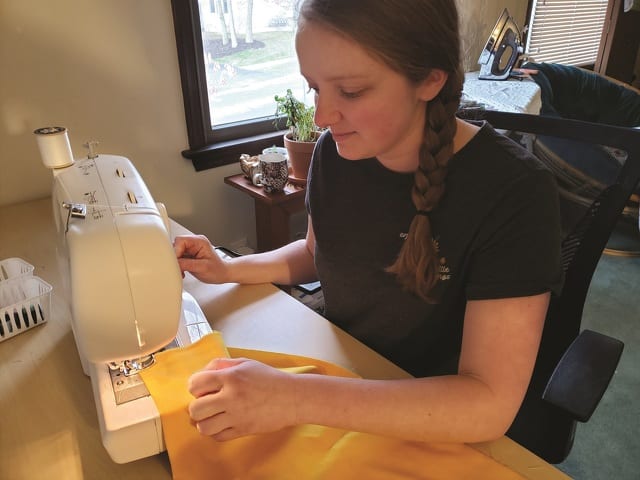
When Rachael Huxford saw a need for masks, she got to work on social media – and at her sewing machine.
In mid-April, another Facebook group called Happy Valley Moms Making Masks, which got started in late March, merged with the State College Mask Makers team to combine efforts.
“It means so much for me to be able to do this. To find a tangible way to help is definitely a saving grace for my mental health during this crisis, when it is so easy to feel helpless and lost,” says Huxford. “It has not only given my idle hands purpose, but also given me a way to feel connected to our community during quarantine. The outpouring of support I’ve received from so many to help build and continue to run this group has never made me prouder to live here.”
Similarly, Amy Frank, owner of The Makery in State College, realized that her business was well set up to help make masks for people who need them.
“We realized we can be of service, because we can help people understand how to make a mask … that is what we do, we teach people to sew,” says Frank. “The trick was people were having a hard time finding supplies because everywhere is closed.”
Well, The Makery had supplies, so Frank and her family got to work. They, too, started a Facebook group and in late March as the world was changing, they started making kits with a pattern and enough material to make 10 face masks each.
The next day Frank drove around the county, dropping off kits on porches to people who wanted to put their sewing skill to work.
“The neat part of the story was that a lot of the people who wanted to help were kids who we taught to sew,” says Frank. “Ten-, 11-, and 12-year-old kids who had taken our classes. … So it was a really neat opportunity for these children to take the skill they learned to do good in the community.”
The Facebook group grew and so did the requests for masks, mostly from health-care workers, such as at nursing homes and pharmacies.
“Slowly over the next week, the research came out that fabric masks are very helpful even to extend the life of N95 or level-one surgical masks,” Frank says, “and our membership started to grow.”
By mid-April, the Facebook Makery Mask Makers included almost 500 people sewing for the group; they have sent more than 1,400 masks to health-care professionals, with a waitlist more than 2,000 masks deep keeping those sewers busy.
The Facebook page is filled with fun stories of people making masks, and grateful messages from people who received them.
“The group has sewers who are in their 80s and sewers who are 8, it is so neat … the Facebook group has a lot of camaraderie; we have community members posting who are thankful for the masks, we have people posting funny stories about their back hurting from sewing, and people who are making masks [while] watching Tiger King,” says Frank. “It is interesting because many of them have commented that we don’t know each other in real life, but man has it become this pretty tight-knit, galvanized group of volunteers.”
Frank says that when this is all over, she hopes to get the group together at The Makery to meet each other. But she feels that the real kudos should be given to the people who need the masks and are working to keep this community safe.
“We are so happy just to have an opportunity to help in some small way,” says Frank. “The heroes of this story are the health-care professionals in Centre County. We are just happy to sew a little bit to help them as they help our community.”
– Vincent Corso

“We are so happy just to have an opportunity to help in some small way,” Amy Frank says of The Makery’s efforts to make masks.
‘A Game-Changer’
As many downtown businesses try to stay afloat, D.P Dough has made its most drastic changes in the 30 years since it opened in State College. From staffing to delivery mode, the calzone hotspot has been rolling with the punches.
D.P. Dough offers four different modes of delivery: DoorDash, GrubHub, Uber Eats, and through its own website, dpdough.com. Like all other restaurants across Pennsylvania, D.P. Dough has stacked its chairs and eliminated dine-in options amidst COVID-19.
All employees are wearing gloves, disinfecting surfaces, and meeting other health-related requirements to stay open.
“We typically call and drop at your door [for delivery], so there is no contact, and if you pick up we will bring it to your car,” says owner and manager Peter Gardella.
The drop-off process is the same for delivery-service drivers who come to pick up food for customers through an app; the food is brought out to drivers in order to minimize traffic in the restaurant.
D.P Dough, like a lot of other local businesses, has taken a hit to sales since the closure of in-person classes at Penn State in mid-March, as well as the state’s elimination of dine-in and its stay-at-home order. In March, the business took nearly a 50 percent cut to sales; that was estimated to rise to 70 percent by the end of April, which is usually one of the three best-performing months for the eatery.
Gardella’s main priorities moving forward are to keep his crew of 15 local employees working and busy, as well as covering basic food and overhead costs.
Because the primary business of D.P Dough relies on the influx of 50,000 Penn State students, August can’t come soon enough, he says.
“We are riding a wave; instead of summer starting May 15, it started March 15. … Even if all restrictions lift on May 1, the orders will still be at the same volume, because students still won’t be here,” explains Gardella.
D.P Dough is in the same boat as many college-town businesses across America. Nearly 50 percent of D.P. Dough’s revenue relies on a shoulder-to-shoulder packed dining room that usually consists of college students.
Gardella, in the meantime, is trying to reach out to other local businesses to garner orders, including handing out fliers to garages and warehouses that are still open and conducting business.
“When you take 50,000 out of your doorstep, it’s a game-changer,” explains Gardella, who says he remains optimistic about the future.
– Elizabeth Molek
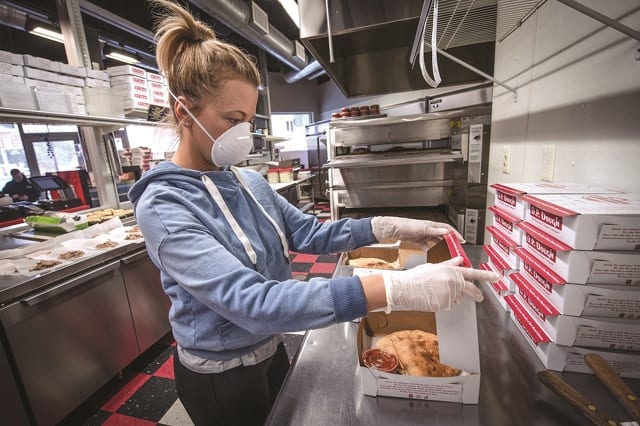
(Photo by Darren Andrew Weimert) Stephanie Gardella boxes an order at D.P. Dough.
More Community & Entertainment
View all Community & Entertainment
January Is a Call to Action to Respond to Stalking
This column by Centre Safe Executive Director Jennifer Pencek originally appeared in The Centre County Gazette. When we talk about acts of interpersonal violence, oftentimes people will focus on sexual […]

Busy Weekend of Fall Festivals and More on Tap Around Centre County
The weekend of Sept. 29-Oct. 1 is packed with activities around Centre County, including fall festivals, Oktoberfests, fairs, concerts and more. Check out some of the weekend highlights below. For […]
Downtown State College Cheesesteak Shop Sets Opening Date
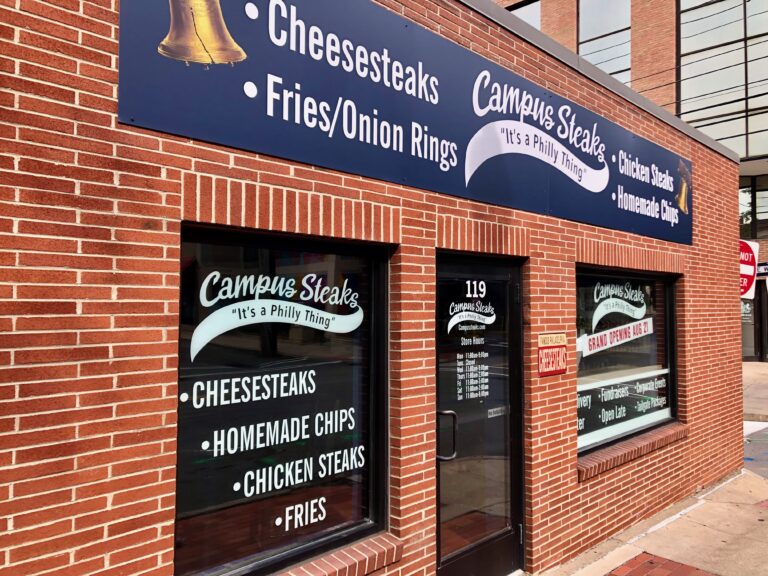
A new cheesesteak shop that promises a taste of Philly in downtown State College has set an opening date. Campus Steaks plans to hold a grand opening on Aug. 28 […]


