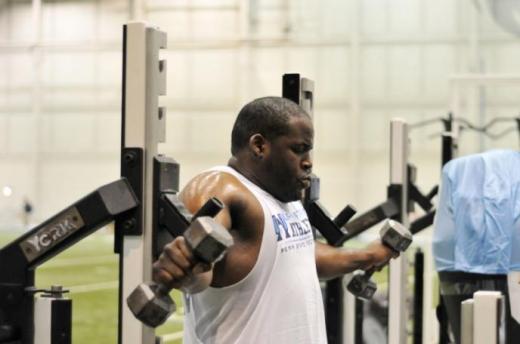
By now you’ve heard my contrarian views in the global warming debate. But over the years I have been involved in another debate, and it has to do with weight training.
Given that weight training now has a much larger impact on athletics than it used to, all sorts of different ideas have popped up as to what is the right way to train. Just like the global warming debate, fiefdoms have been established and are threatened by any answer other than their own.
Every time something goes wrong with a team people follow around here, the coaches get blamed. Already, the grumbling about the football team has started.
Like it or not, weight training and nutrition has evened out the playing field and upped the level of competition. When I first came to Penn State—a university that attracted top-level athletes, of which there were fewer overall—it almost always had a team that would physically beat up the opposition. Now, though, it’s a different story. Everyone has big, strong people.
Which brings up the great strength training debate: Free weights or machines? High-intensity or explosion?
It’s kind of funny, because in this debate, most of the debaters are big, strong specimens who may argue their point, but do so in a well-mannered way. The global warming debate is much more vicious, with people being threatened, etc. Perhaps some of the people in that debate should have played sports at a high level; maybe they would calm down a bit.
In any case, over the years, in spite of having trained both ways, and in spite of still training explosively, I have come to see the value of the high-intensity method and have grown more sympathetic to the plight of the coaches in this matter. I think a good coach’s goal is to make himself obsolete. By the time any player is a junior or a senior, he should know what to do to get the best out of that athlete.
Doing so takes an understanding of some basic rules:
Rule No. 1: In most cases, the more gifted the athlete, the more it takes to convince the athlete he or she needs to do more.
And for good reason. After all, if you have been successful doing something the way nature allowed you to, why should you change? Some guys even wear their lack of training as a badge of honor: I never had to lift weights, for example. But what they don’t know is, if they had—and had done so with the same kind of mindset that they play with—they would have performed even better. So a need has to be created for the athlete to train hard.
That brings us to rule No. 2: the better the athlete, the bigger the pay-off from training.
This argument is almost political in nature. How so? Take the income gap, which is used by proponents of higher taxes and more regulation as evidence that we should tax people at higher levels. The argument: Every time we cut taxes and deregulate, the income gaps widen. Despite the fighting and finger pointing, the reason should be obvious: Give someone with money more chances to make money, and guess what happens? He makes a lot of money.
And then there is the problem of why someone has it and someone doesn’t in the first place. Unlike the genetic roulette, the very reason someone may have money is because when he did not have it, he figured out how to make it, and, if given the opportunity, he would do so again.
However, I have observed that in weight training, many times the hardest workers are the have-nots. But an interesting thing happens. The hard worker learns two things: That is the card I was dealt, and I have to work with it; and the guy with the talent can be caught because he may not be used to ramping it up.
Every now and then, though, you get the gifted athlete who figures out what to do to get better. And then look out. He is the guy who made a lot of money and then is given the chance to make more.
So what can a coach do? And does it really come down to one way actually working better than the other? Or is it simply finding what works best for the athlete, which means the athlete has to do the work to search for the right way to train and eat, and be willing to pay the price?
A coach cannot be so dogmatic that it’s ‘my way or the highway.” But the coach should be a guide to helping players get the most out of themselves. Let’s take head wrestling coach Cael Sanderson as an example. Cael does not go in and lift every day. He trains hard, but in the way that he knows is best for him. He certainly has had coaches before, but as someone who has learned to be responsible with the talent he was given, he has searched and found the best way to develop in his sport. The result: 159-0 in college and the gold medal in the Olympics.
And take Tara Cunningham, who is married to assistant wrestling coach Casey Cunningham. In 2000, at just 105 pounds, she became the first USA woman to win an Olympic gold medal in weightlifting. She found out what foods worked for her, and simply ate them all the time, never changing her diet as she peaked.
But she says it was the personal challenge of getting the best out of herself that drove her farther. She had coaches, but in the end had to be smart enough and tough enough as an athlete to respond to her own personal quest. (Amazingly, she did not know right away that she had won the gold medal, just that she had broken her own personal record. She missed the gold medal ceremony because she was watching her teammate. Talk about humility.)
What do these two have in common? Nothing was handed to them, but they both had suspected they had the talent to reach the top of their respective sports. As athletes, they had to strive to find what worked best for them. A need was placed there by a personal challenge. Sure, they had coaches. And a good coach will poke, probe, and suggest. But a coach can do no more than throw matches on the wood. The athlete has to build the fire.
Now for all of you grumbling about the football team, let me offer you a bit of hope. Possibly, a need is being created for each of these young men to find a way to get the best out of themselves.
Whether it’s high intensity or explosive weights, what could be forming here through adversity may turn out to be the team’s advantage. The team is young and bruised, but showed a lot against Alabama and Iowa in the way it fought back. On the other hand, the Illinois game was a physical beating.
Sports like football and wrestling attack your weakest point, but that creates a need to respond. These kids are young and no matter what the coach tells them, they couldn’t understand that until they lived it. The key will be the willingness to search for the best way to train and the freedom to excel.
So, which training regimen is better? For one athlete, it might be machines; for another it might be free weights, or a combination of both. But the common denominator of each is the need to get better and the willingness to do what it takes to succeed. That means focusing on your strengths instead of your weaknesses.
What does this come down to? Character. What is done in the dark shows most in the light!
Imagine that: life lessons straight from the weight room.