

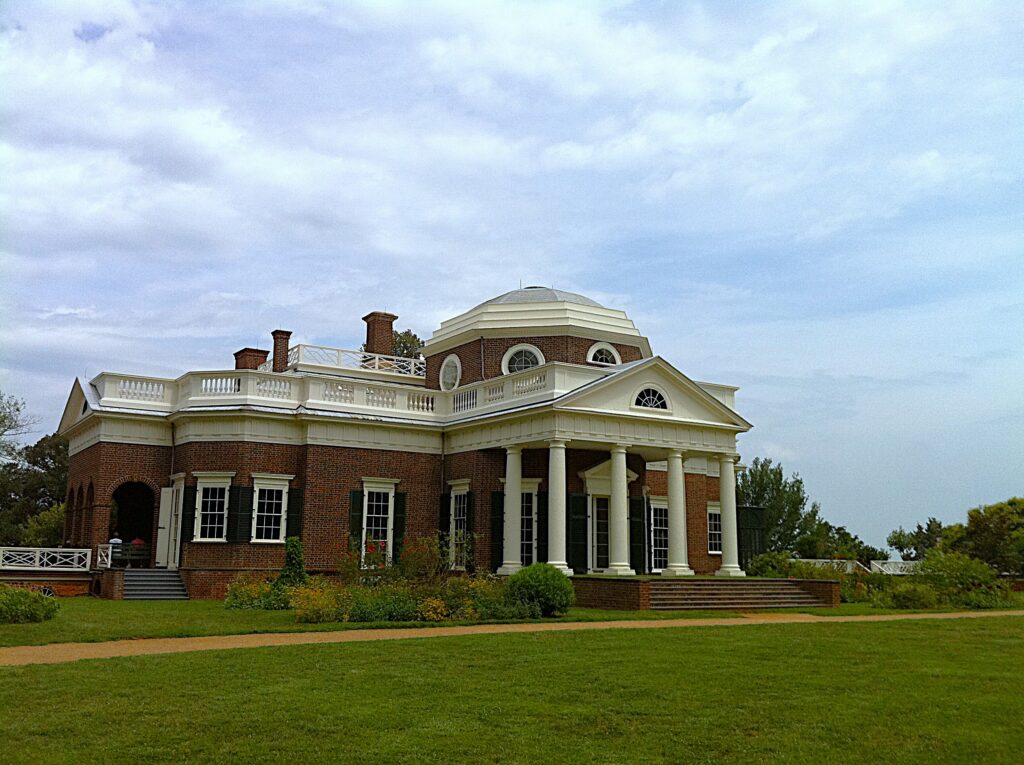
If there was ever a place where one could truly understand American exceptionalism it is at Monticello, Thomas Jefferson’s home just outside Charlottesville, Virginia.
Jefferson often spent evenings in the small, square one-room brick and glass garden pavilion to contemplate the day and read. Gazing over the ridges and mountains, he reflected on his life, the words he’d written and the legacy he’d built. He reflected on political triumphs and setbacks, including friends and foes.
Over time, John Adams was a political friend, then foe, then friend. The two men were partnered on the Declaration of Independence, and diplomatic missions abroad. Politics temporarily ruptured that friendship. But eventually they made amends and both respected the other’s honest opinions as foils to their own.
This weekend marks the 200th anniversary of their deaths; they both died on the 50th anniversary of the Declaration of Independence.
How do they represent American exceptionalism?
Despite what many believe in our current era, understanding and acknowledging our faults is a big part of what has always made this nation exceptional. The cosplay patriots believe American exceptionalism requires a belief in some no-fault historical American perfectionism. Their brand of perfectionism requires complete adherence to authority, as long as their guy is in control of the levers of power.
But that mythical greater/perfect historical era has not yet existed. Indeed, the very words of our Constitution state “In order to form a more perfect union.” The founders knew they hadn’t attained perfection.
They were cognizant of their own failures, aware of the compromises made to form the words of the documents that bound us to one another.
But back to Monticello.
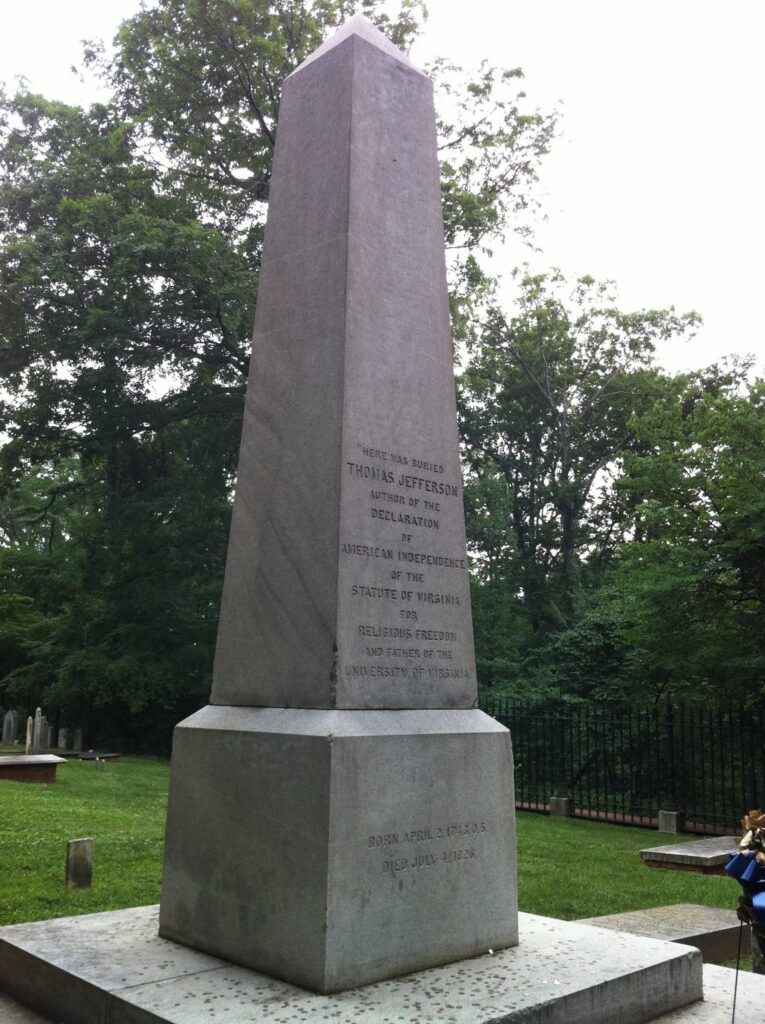
Jefferson is buried on that hilltop. On his grave are carved three life accomplishments that he requested to be memorialized. He believed these were his great legacy. They represented personal liberty, religious freedom and a commitment to the education of the American people.
He listed his authorship of the Declaration of Independence, the Virginia Statute for Religious Freedom and his founding of the University of Virginia.
The words Jefferson wrote in the Declaration of Independence in Philadelphia in 1776 are among the most enduring and inspiring ever penned by any man or woman. They have inspired people yearning for liberty and self-governance across centuries in every part of the world.
“We hold these truths to be self-evident, that all men are created equal, that they are endowed by their Creator with certain unalienable Rights, that among these are Life, Liberty and the pursuit of Happiness.–That to secure these rights, Governments are instituted among Men, deriving their just powers from the consent of the governed.”
And yet as he wrote those revolutionary words, he was keenly aware of his hypocrisy and the hypocrisy of the nation he was helping to found. At home in Monticello, he was the owner of men and women, people that were not treated with equality, and by their very enslavement were not given their unalienable rights of life, liberty and the pursuit of happiness.
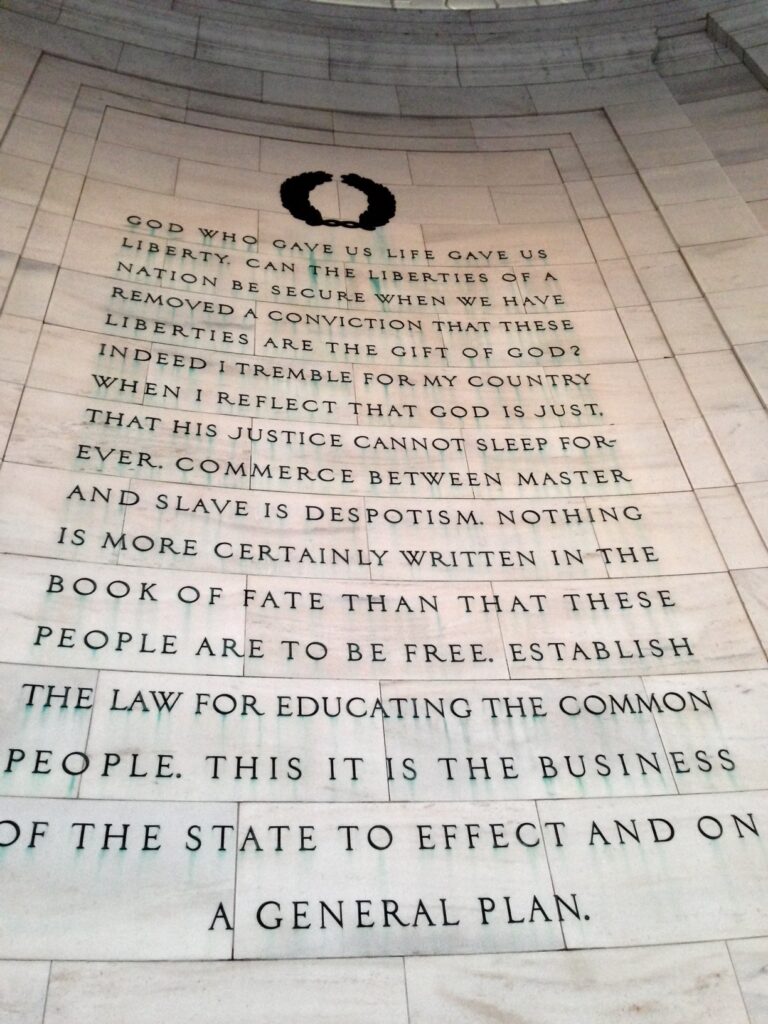
We know this because he wrote of these contradictions. We know this because he understood that slavery would be the original sin of this nation’s founding imperfection. The founders of this country, himself included, could not bring themselves to address the one issue that would, as predicted by Jefferson, result in warfare and brutal bloodshed.
“Indeed, I tremble for my country when I reflect that God is just, that his justice cannot sleep forever. Commerce between master and slave is despotism. Nothing is more certainly written in the book of fate than these people are to be free.”
God’s justice did indeed awake from its slumber with a fury of terrible Civil War and bloodshed. Four-score and seven years later, the high-water mark of the Confederacy’s aggression was turned back in Gettysburg (July 3, 1863) and with the fall of Vicksburg, Mississippi (July 4, 1863).
Lincoln spoke of this in his 2nd Inaugural Address in March 1865 as the war raged toward its conclusion.
“Yet, if God wills that it continue until all the wealth piled by the bondsman’s two hundred and fifty years of unrequited toil shall be sunk and until every drop of blood drawn with the lash shall be paid by another drawn with the sword as was said three thousand years ago so still it must be said ‘the judgments of the Lord are true and righteous altogether.”
Lincoln would be assassinated just weeks later.
Jefferson’s second legacy noted on his grave was the Virginia Statute for Religious Freedom. Jefferson wrote the statute in 1777. It was later championed by James Madison and enacted in 1786 in response to a proposed bill to provide taxes and financial assistance for certain Christian denominations.
Around the time that Jefferson was writing the statute, he was reading John Locke and made the following note: “neither Pagan nor Mahometan (Muslim) nor Jew ought to be excluded from the civil rights of the Commonwealth.”
Jefferson studied many religions, including Islam. And he understood the dangers of religious tyranny, spelling it out in the statute.
“That the impious presumption of legislators and rulers, civil as well as ecclesiastical, who, being themselves but fallible and uninspired men have assumed dominion over the faith of others, setting up their own opinions and modes of thinking as the only true and infallible, and as such endeavoring to impose them on others, hath established and maintained false religions over the greatest part of the world and through all time.”
That statute was enacted before the U.S. Constitution and its Bill of Rights. But the founders believed religious freedom was so important that it was part of the First Amendment. And yet, across our history, the claims that one religion is the foundation of our nation or should be preferred over all others persist.
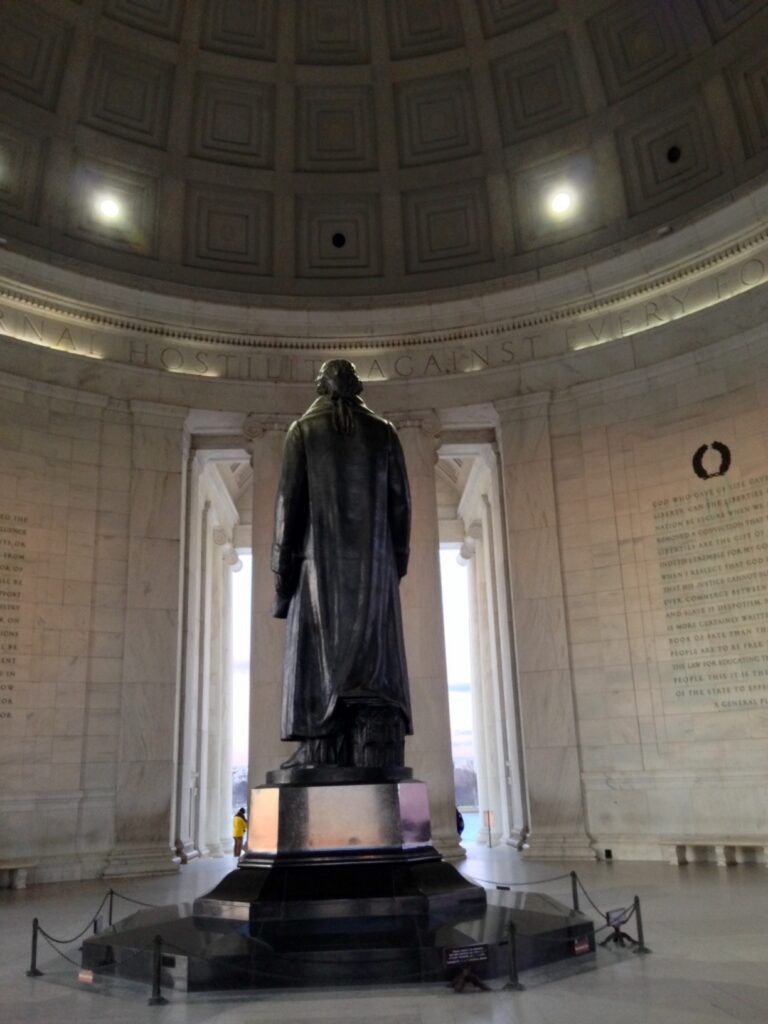
The third legacy of Jefferson that he wanted noted was the establishment of The University of Virginia. He believed that education of the people of this country would be critically important to its future and to its good governance.
Watching from his mountaintop, he could see the University’s Academical Village being built in the distance by enslaved people. The University of Virginia, to their credit, has acknowledged that history and has even built an insightful and moving memorial to those workers.
That university’s unflinching acknowledgment of its complex history and faults led to an attempt to correct them as best as they can is a positive step—even with the passage of time.
It speaks to what Jefferson wrote to British historian William Roscoe describing the goal of his newly founded university.
“For here we are not afraid to follow truth wherever it may lead, nor to tolerate any error so long as reason is left free to combat it.”
Jefferson saw education, and truth, as critical to America’s journey of self-governance. He believed it was perhaps the most important element of enduring freedom in America.
“If a nation expects to be ignorant and free, in a state of civilization, it expects what never was and never will be. The functionaries of every government have propensities to command at will the liberty and property of their constituents. There is no safe deposit for these but with the people themselves; nor can they be safe with them without information. Where the press is free and every man able to read, all is safe.”
In 2026, as we mark the 250th anniversary of our nation’s birth, these words take on a greater meaning than at perhaps any other time since the Civil War. Control of information, while in some ways as diffused as ever, is in the most important ways more controlled under the levers manipulated by a select few.
In his Cooper Union Address in 1860, Lincoln warned of that: “No man has the right to mislead others, who have less access to history, and less leisure to study it. . . . Thus substituting falsehood and deception for truthful evidence and fair argument.”
Both Jefferson’s and Lincoln’s words about history and education and the free press ring true, even all these years later.
Jefferson was part of the fires of a political crucible in the earliest days of our new Constitution. It would create a schism in his friendship with John Adams.
The Alien and Sedition Acts of 1798 included limits on criticism of the President. It was an attempt to stifle dissent in the press, and it was signed into law by President Adams. It would become a critical issue in the election of 1800, which led to Jefferson’s assent to the presidency.
That act was an example of how power has always wanted to be protected from the implementation of our truest brand of exceptionalism: understanding our faults both current and past.
Our brand of exceptionalism should be our journey toward a more perfect union on the road of understanding and working to correct our faults.
In his “I Have a Dream” speech, Martin Luther King, Jr stood in the shadow of Lincoln looking at a monument to Washington and called for our nation to honor our founding promise: “We refuse to believe that the bank of justice is bankrupt. We refuse to believe that there are insufficient funds in the great vaults of opportunity of this nation. And so, we’ve come to cash this check, a check that will give us upon demand the riches of freedom and the security of justice.”
There is a passage in the Bible that invokes an idea that has been lost in America in 2026. In an era where American leadership is increasingly defined as never admitting a fault or error, American exceptionalism is dying, not thriving.
Exceptionalism is rooted in understanding the truth of our nation’s actions, both good and bad. It is rooted in speaking up, protected by the First Amendment and without those hearing truth in differing opinions always drawing permanent battle lines.
In Galatians 4:16, Saint Paul writes: “Am I therefore become your enemy, because I tell you the truth?”

An early and vitally important lesson for America was made by John Adams. Despite his political misstep he learned from his mistake and laid the most significant cornerstone of American exceptionalism.
After losing the contentious 1800 election, when it came time for the transition, Adams accepted the results and established the precedent of the peaceful transfer of power. It was a precedent that lasted for 220 years.
Looking forward, true exceptionalism’s path must be a climb into the rare air of honest dissent and compromise in an educated nation with a truly informed electorate. That will be the foundation for the next 250 years.
More Opinion
View all Opinion
Hook: How PA Stacks Up Nationally in High School Sports
The National Federation of State High School Associations (NFHS) is the organization in our country that writes the playing rules for most high school sports. It consists of 51 state […]

Paterno: Keep the Faith and Stand Your Ground, Penn State Fans
One of the great leadership lessons from Lincoln was the lesson of the letter. When he was angry, he would write a letter to the person who’d angered him. He’d […]

Subu Vedam: It’s Now One Year in ICE Custody
What is there to say about the case of Subramanyam Vedam at this point? Only this: Subu was released because, after 43 years in prison, a Centre County judge agreed […]


