
Penn State has always been and likely will always be a sports school, first and foremost.
With 85 team national championships, 335 conference championships (regular season plus tournament), a historic wrestling dynasty, blue blood women’s volleyball program, ascending hockey programs and one of the biggest football brands in the country, the men’s basketball program remains the school’s greatest athletic outlier — a persistent paradox of potential versus performance.
For all of Penn State’s athletic success, achievements on the hardwood have been few and far between, and the gap between hoops and other Nittany Lion sports — which are generally all competitive, if not dominant, within their respective conferences — only seems to be widening.
That’s the Penn State Men’s Basketball Paradox™.
This discrepancy can be closely compared to the “chicken or the egg” dilemma. But it doesn’t matter which came first — it just matters that one always leads to the other, creating a continuous loop.
For the Nittany Lions, the question becomes: “Which comes first, fan support or on-court performance?”
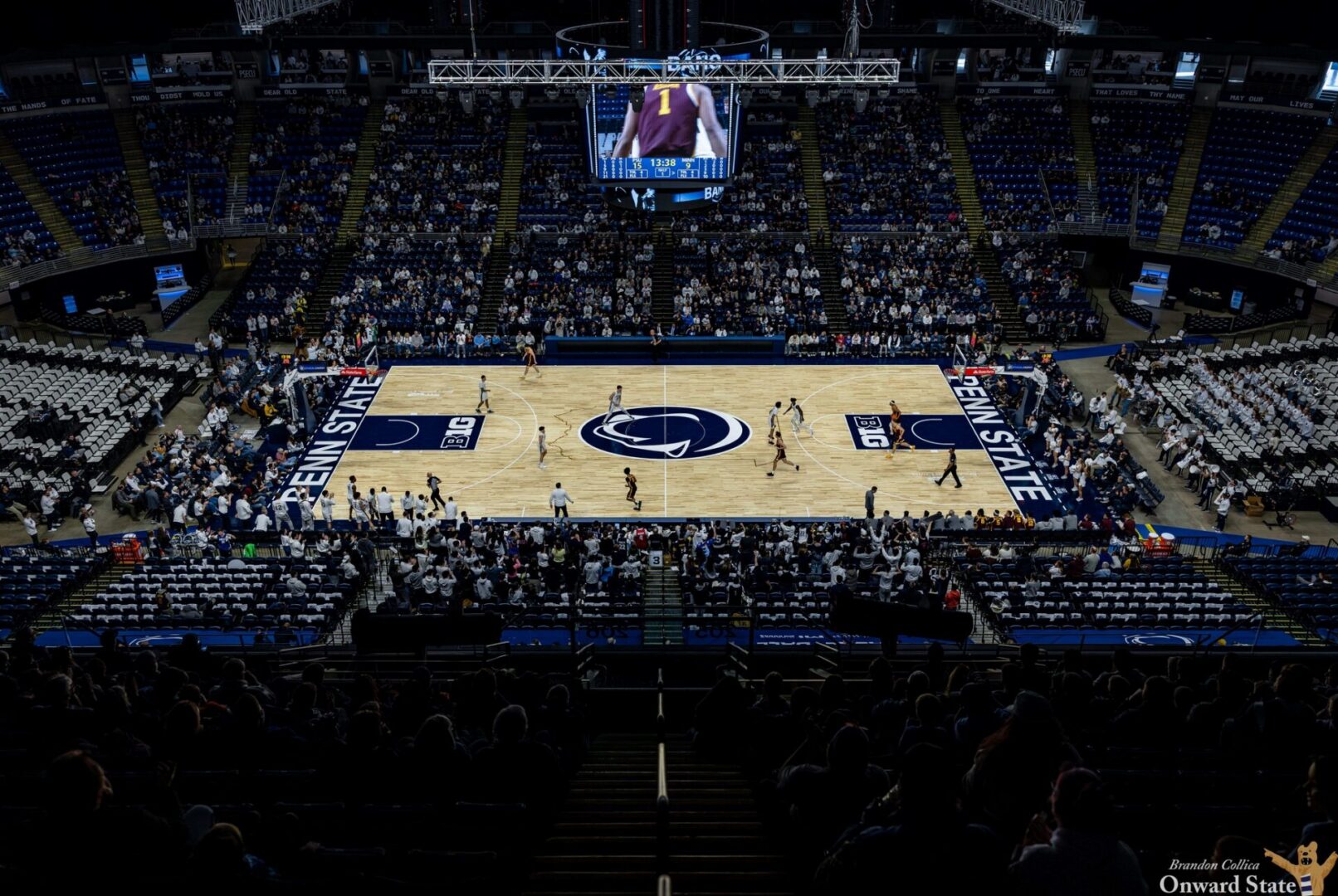
The team currently grapples with a multi-front battle: low game attendance, a lackluster online presence, stagnant merchandise sales and insufficient NIL support — described by head coach Mike Rhoades last week as “at the bottom” of the Big Ten. And the on-court product has largely matched the apathy shown by the fanbase.
While it’s undeniably true that consistent on-court success would naturally bolster these metrics, the modern college landscape dictates that these very resources — specifically robust financial backing and a fervent fan culture — are the prerequisites for achieving that success in the first place.
This cycle has persisted for decades without a consistent break, leaving the program in a state of perpetual outlier status compared to the championship standards of its Happy Valley peers.
This is a challenging cycle to break because, at Penn State, fandom is deeply rooted in tradition and proven excellence.
The “White Out” creates an environment arguably unmatched in college football. The wrestling program is a juggernaut that fills the seats with a fervor bordering on religious devotion. Even the hockey program, a relative newcomer compared to the historic depth of the university’s other sports, has rapidly cultivated an identity as a raucous environment. In these arenas, the fan support isn’t just consistent; it’s expected.
The basketball program, however, exists in a vacuum adjacent to this success. It’s a paradox of geography as much as culture. Penn State sits in the heart of the Northeast corridor, a region teeming with legendary basketball hubs.
Philadelphia and New York City serve as two of the sport’s biggest strongholds. Just a few hours’ drive away, programs like Villanova and Syracuse have demonstrated that consistent, high-level basketball is possible in the region, including with homegrown players.
This brings us back to the chicken-or-egg dilemma that defines the Nittany Lions’ struggle. In the modern era of college athletics, success is rarely organic; it is purchased through investment, NIL collectives, and intense, year-round engagement.
The prevailing logic is that if the team wins, the fans will come, the merchandise will fly off the shelves, and the NIL coffers will swell. But the reality is far more cyclical: without those robust, pre-existing resources — the fervent student sections, the massive merchandise sales, and the aggressive financial backing — a program struggles to attract the caliber of talent necessary to build a competitor in the Big Ten.
It’s a functional deadlock. The program needs proper support to compete for top-tier coaches and recruits. Without that, it’s left to build a foundation of hope rather than the concrete advantages peers enjoy.
When the team does occasionally show flashes of brilliance, there is an underlying sense of “what could be,” but those sparks never catch fire. Instead, the program remains a perennial outlier, trapped in a historical feedback loop where the absence of support prevents the success that would inevitably create that very support.
As the university enters a new era of college athletics driven by NIL and the transfer portal, the question remains: can Penn State men’s basketball generate enough gravity to break its own cycle, or will it forever be the outlier looking in at the higher standards of its peers?
More Penn State Basketball
View all Penn State Basketball
Big Ten Announces Dates for Full Men’s Basketball Conference Schedule
The final dates on Penn State men’s basketball’s schedule have been revealed. The Big Ten on Wednesday evening released the dates for all conference games during the 2026-27 season. Previously, […]
Penn State Men’s Basketball Reveals Return to Rec Game Info
Penn State men’s basketball is taking a different approach to its annual Return to Rec game. The Nittany Lions on Thursday announced they’ll be facing Lafayette in Rec Hall on […]
Penn State Men’s Basketball Announces Full Nonconference Schedule
More pieces of Penn State men’s basketball’s schedule have fallen into place. The Nittany Lions on Thursday morning announced their complete 12-game nonconference schedule for the 2026-27 season, including eight […]


