
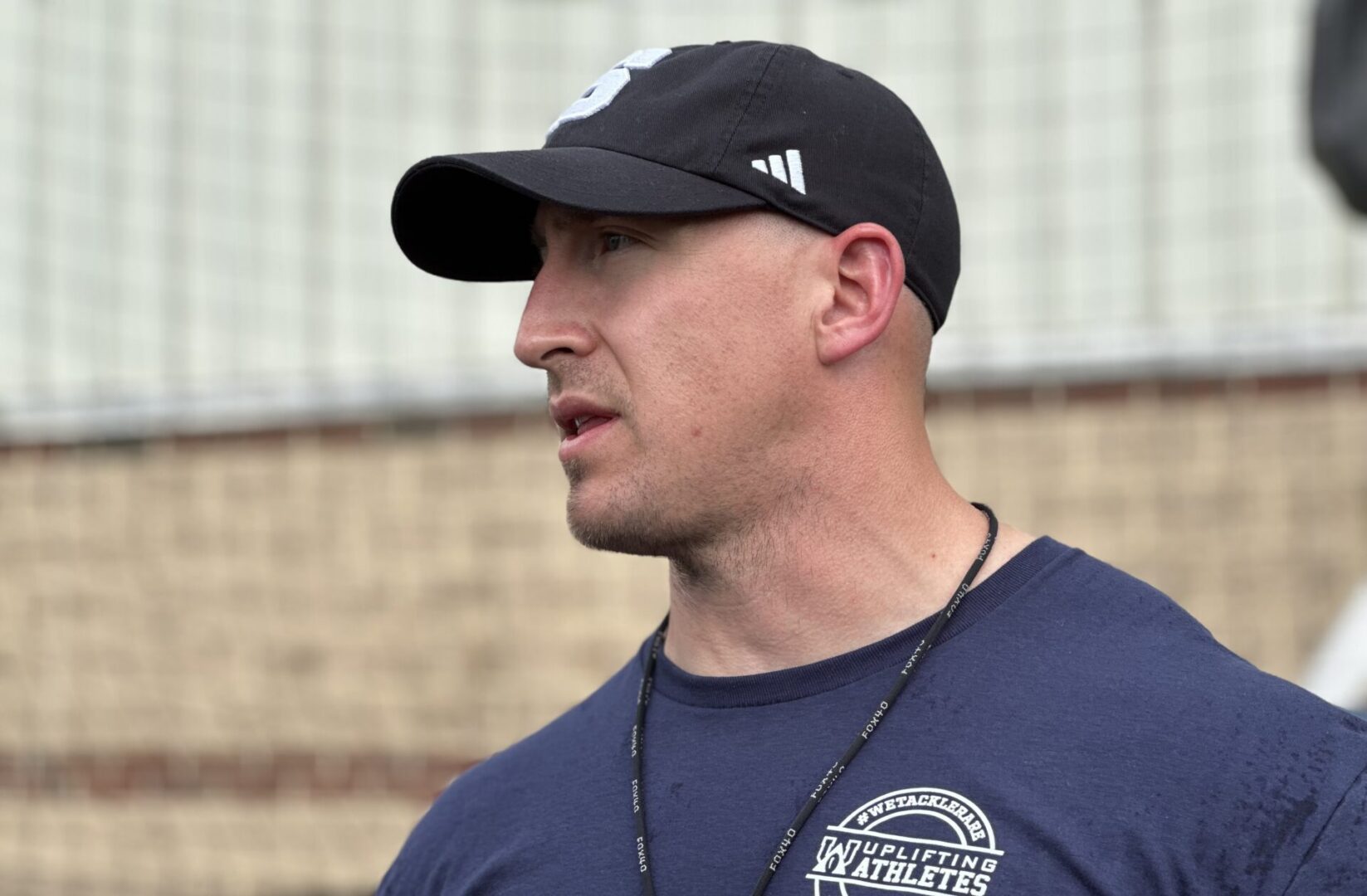
Among the many staff changes Penn State football underwent this year was at the helm of the strength and conditioning program.
Reid Kagy has stepped in as the Nittany Lions’ new director of strength and conditioning — arriving from Iowa State where he worked under head coach Matt Campbell — to help establish a physical reset in State College.
The Bloomville, Ohio, native spent the last three seasons serving as the director of football strength and conditioning for the Cyclones, where his programs were credited with notable player development. He also had prior stints as an assistant strength coach with Cincinnati, Oregon and Boise State.
“What an awesome event for me to be a part of for the first time,” Kagy said during his media debut at Wednesday’s annual Lift for Life event. “We were able to put our little twist on it and make it competitive. We go out throughout the season, and we have leadership teams, and they’re competing in everything we do, because we’re going to compete in the fall. And sometimes some of that stuff is absent throughout the offseason. The competition piece of it, there’s not a win and loss. We’re trying to create a win and a loss every day.”
Kagy replaces longtime predecessor Chuck Losey, who followed former head coach James Franklin to Virginia Tech. The transition represents a shift in both regime and training philosophy.
The emphasis on daily competition aligns with the broader cultural identity the new coaching staff aims to install, with a stated objective of building the “most violent team in the nation.” Because strength staff members spend the most hands-on time with players during winter workouts and summer conditioning, Kagy is positioned as the primary architect for that culture.
The roster features a mixture of established veterans who chose to stay through the coaching transition alongside transfer additions — from Iowa State or elsewhere — and incoming freshmen. Kagy noted that the shared work in the weight room has served as the baseline for the roster to mesh.
“There’s a whole bunch of trust involved in winning football games and training and all those things,” Kagy said. “We needed that time. It was critical, and I couldn’t be more proud of what this team has done, coming and meshing together, not knowing each other off the jump, really spending the time to get together.”
The summer has been a time for hard-earned rest and recovery with player-led practices and workouts sprinkled in. Heading into the fall, the focus remains on how Kagy’s conditioning approach will translate to on-field identity.
While testing numbers and individual physical benchmarks remain a part of the evaluation, the performance staff is prioritizing collective mental and physical resilience. Daily charting, competitive drills, and structural accountability are being utilized to ensure the Nittany Lions possess the requisite stamina to dictate games late into the fourth quarter.
“We want to make sure we’re working as hard as we can to build up armor, to build up resiliency… to keep them on the football field,” Kagy said.
More Penn State Football
View all Penn State Football
Matt Campbell Defends Penn State QB Rocco Becht, Gives Koby Howard Update Amid Bye Week
During the only media availability of Penn State’s bye week, head coach Matt Campbell met with reporters on Tuesday to discuss the current state of the program as it looks […]
Kickoff Time, TV Network Announced for Penn State vs. Purdue
Penn State is slated for another unconventional kickoff time. The Nittany Lions will welcome Purdue for a 4:15 p.m. kickoff on Saturday, Oct. 31, the Big Ten announced on Monday […]
Penn State After Michigan: A Top 20 Bye (Week) and Sell
ANN ARBOR, Mich. — Penn State left the Big House here on Saturday night as the not-so-proud owner of a four-game losing streak. With an upcoming bye week, Matt Campbell’s […]


