
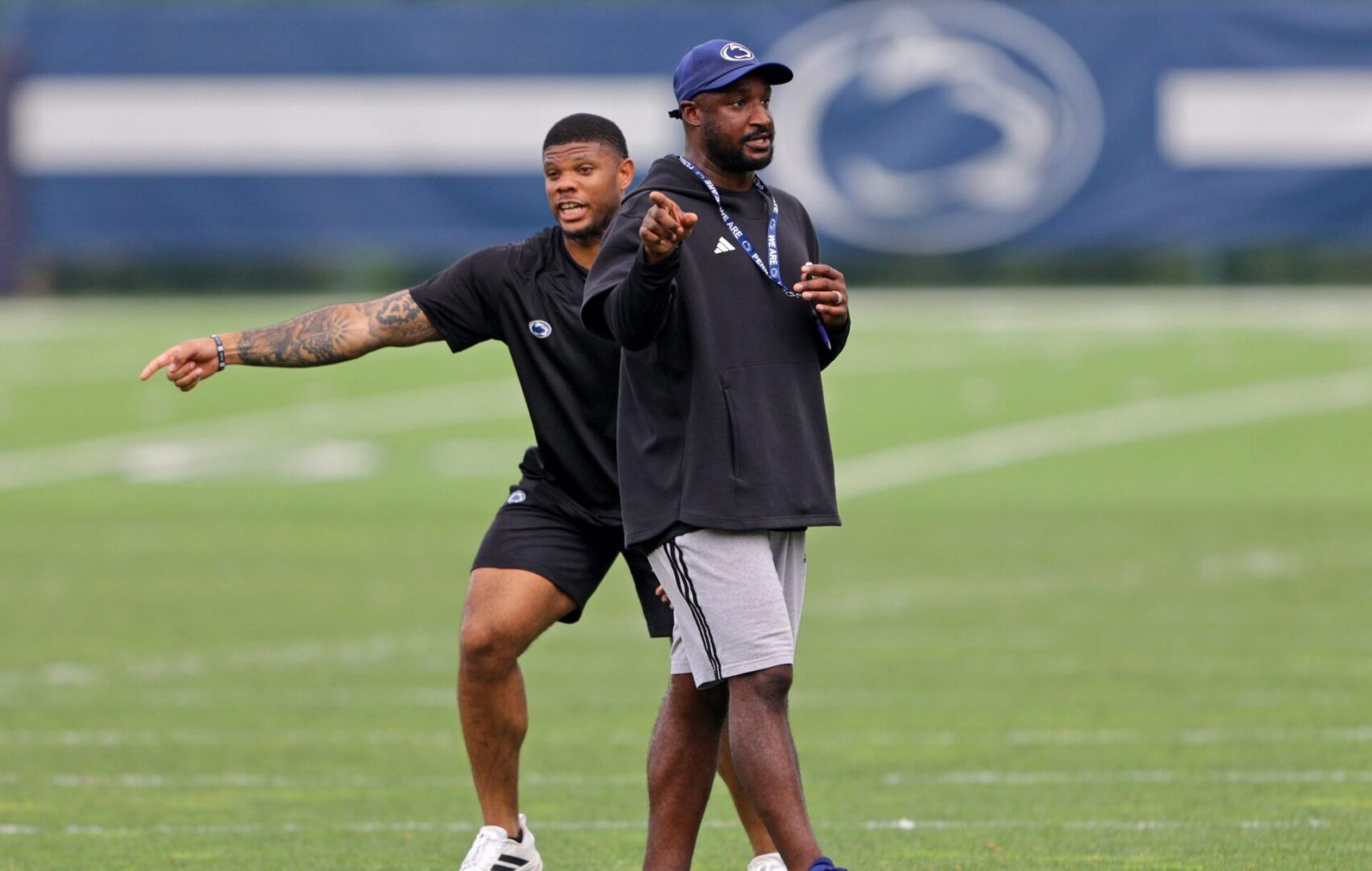
For the last four years, Penn State relied heavily on a predictable tandem of Kaytron Allen and Nick Singleton to anchor its offense. As training camp nears its conclusion, new running backs coach Savon Huggins is preparing a drastically different approach.
Rather than feature a pair of primary ball carriers, the Nittany Lions plan to unleash a four-man rotation built around Carson Hansen, James Peoples, Quinton Martin Jr. and Cam Wallace.
Managing four talented backs across a long season requires clear structural distribution. Huggins noted that each runner brings distinct, complementary traits suited for specific demands.
“Cam, Carson, Q, and James have all been major contributors to this offense,” Huggins said. “You got to have them all available, you know? Like, it’s a long season, and we expect to be in it for the long haul. So just got to keep them all ready.”
Huggins views situational versatility as essential to the rotation. In late-game, four-minute scenarios designed to drain the clock, Peoples and Martin are trusted options to earn tough yards.
During up-tempo, two-minute situations, Wallace steps into the fold as a home-run threat. When the offense faces critical fourth-and-1 opportunities, Hansen remains the proven option, though Huggins continues to evaluate how the other three backs handle high-leverage short-yardage reps during scrimmages.
Passing-game usage further expands the room’s flexibility. While Hansen and Wallace operate effectively out of the backfield on screens and swing passes, Martin and Peoples possess the athletic ability to stretch defenses out wide.
“That’s what the expectation was going into fall camp: to really try to utilize those guys in the pass game and on the perimeter because they got some juice,” Huggins said.
But Huggins emphasized that playing time will hinge on two non-negotiable fundamentals: ball security and pass protection. He made it clear that he doesn’t decide the depth charter — the players do with their practice performance.
Peoples has made substantial strides in that area throughout camp. The Ohio State transfer has embraced physical blocking assignments while taking reps with both the first- and second-team units, demonstrating growth on interior run concepts like power and counter.
“James has evolved as a really good pass protector,” Huggins said. “He is willing in pass pro. He fits up there and gets in the A-gap and also out on the edge.”
Wallace brings resilience to the group, battling back from a season-ending injury in 2024 to reach peak physical condition while providing a spark during practice. Meanwhile, Martin offers pure explosive playmaking potential as the fastest in the room. Playing at a steady 215 to 217 pounds, the redshirt sophomore has clocked 22 miles per hour on Catapult tracking data while improving his pad level between the tackles and expanding his film study routine.
Hansen sets the standard as the room’s unselfish veteran. Despite moving away from a high-volume workload (1,704 yards across the last two seasons), the veteran back provides leadership by helping younger teammates process defensive fronts and protection schemes.
“Carson is such a team guy,” Huggins said. “If it requires him to carry the ball 30 times, he’ll do it. If it was for 15 times or 12 times, he’ll do it. He really has zero ego.”
With four reliable options capable of executing all three downs, Penn State enters the season ready to rotate its talent and keep defenses off balance. Despite losing two of the best backs to ever suit up in blue and white, depth is no issue.
More Penn State Football
View all Penn State Football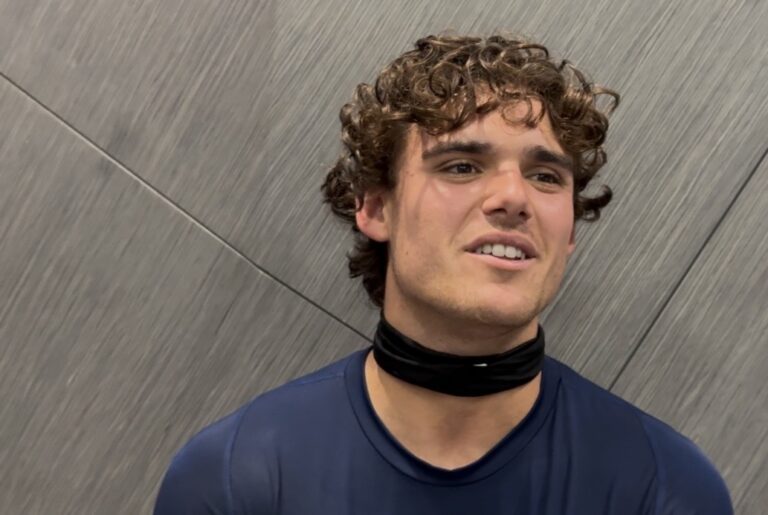
Penn State Quarterback Rocco Becht on Local Fame, His Fall Class and His Dad Hanging Out With the Team
Penn State quarterback Rocco Becht is the most prominent transfer from Iowa State this past offseason. Other than head coach Matt Campbell, of course. In three seasons at Iowa State, […]
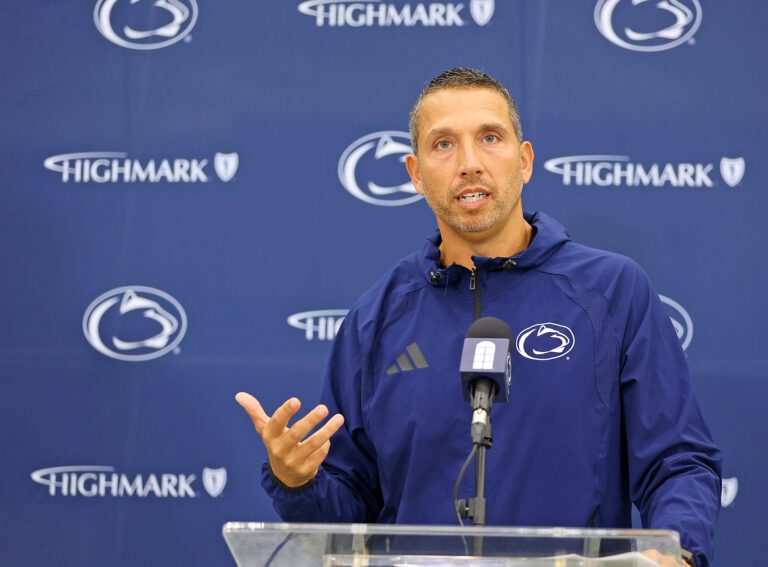
Matt Campbell Praises Rocco Becht’s ‘Almost Flawless’ Fall Camp, Shares Other Updates
With fall camp nearing its end, head coach Matt Campbell met with the media inside Penn State’s team meeting room to provide updates entering his debut season in Happy Valley. […]

18 Days Until Penn State’s ‘Amazing’ No. 18 Hits the Field. Will Ben Brahmer Be the Nittany Lions’ Next Star Tight End?
It’s 18 days until No.18 Penn State opens its 139th season of college football under its 17th head coach, Matt Campbell. After quarterback Rocco Becht, one of the Nittany Lions’ […]


