
Spotlight PA is an independent, nonpartisan and nonprofit newsroom producing investigative and public-service journalism that holds power to account and drives positive change in Pennsylvania. Sign up for our free newsletters.
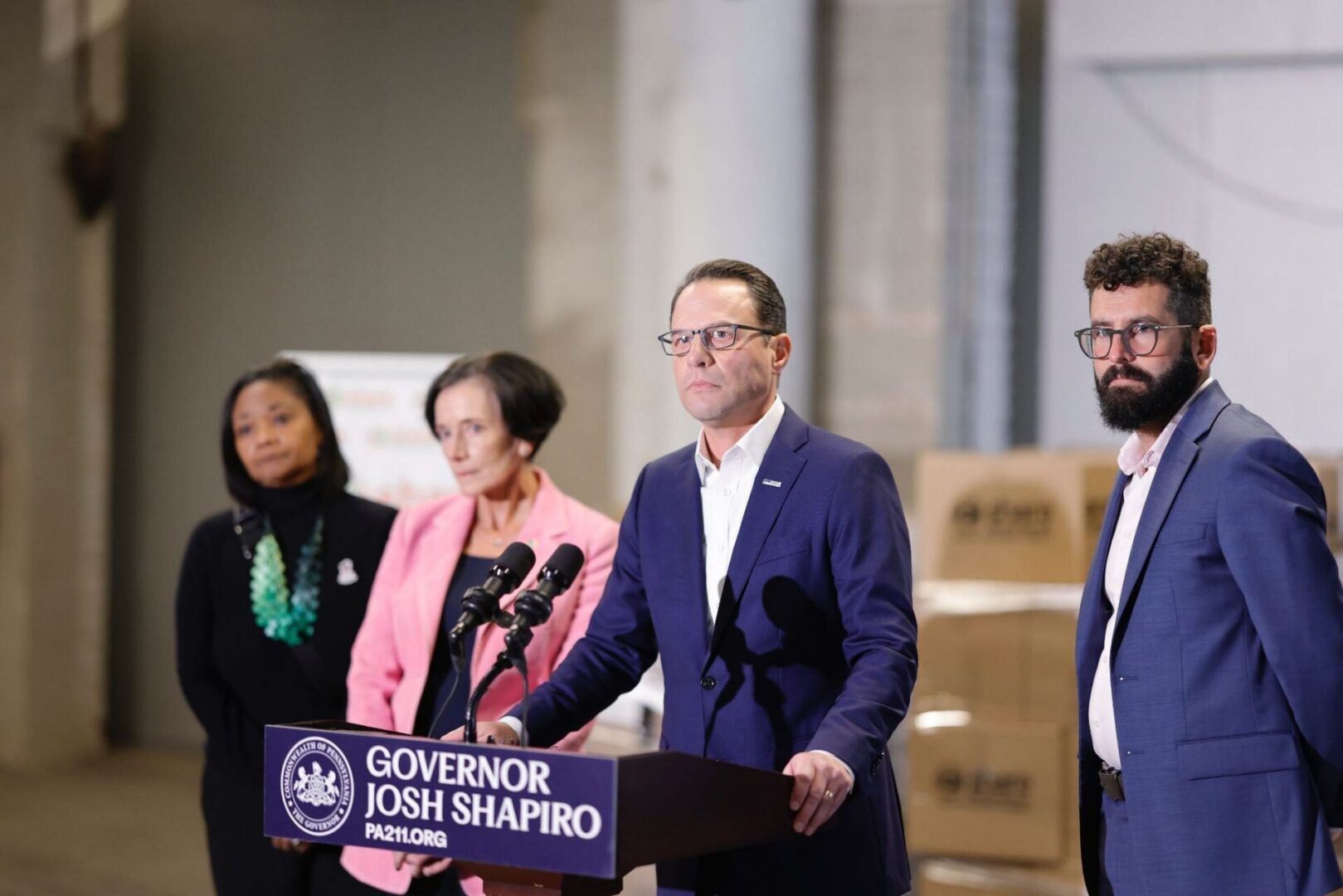
HARRISBURG — Over the past year and a half, Democratic Gov. Josh Shapiro has sued the Trump administration more than two dozen times to challenge the loss of federal funding, rollbacks of environmental protections and more.
Shapiro has signed Pennsylvania onto most of these cases in his formal capacity as governor, using the commonwealth’s Office of General Counsel as legal representation.
Republican Attorney General Dave Sunday, charged with defending Pennsylvania in court, has not entered the commonwealth into any lawsuit against the Trump administration. Sunday told a panel of state House lawmakers earlier this year that the Office of General Counsel might be better suited to handle the federal lawsuits — at least in terms of managing both offices’ caseloads. He also noted state law gives the governor discretion to join these cases.
(Democrats, meanwhile, have accused Sunday of putting loyalty to President Donald Trump first.)
But Sunday stepping back has given Shapiro a spotlight: The governor is among the few people named in these high-profile cases, which typically list states rather than their elected officials. The suits have become a key part of Shapiro’s reelection campaign, and may serve as a launchpad for his potential 2028 Democratic presidential bid.
Spotlight PA has the details about the lawsuits, where they are in the process and more:
Skip to section
Federal funding freeze
Shapiro’s office filed its first lawsuit against the Trump administration in February 2025 to overturn the White House’s executive order that paused $2.1 billion from being distributed to Pennsylvania departments and programs.
Most of the disputed money supported environmental protection, according to the lawsuit, like abandoned well plugging, water quality improvement and reducing greenhouse gas pollution. Another program funding improvements to low-income households was also cited in the lawsuit.
Months after the funds were released to Pennsylvania agencies, the commonwealth agreed to dismiss the case.
COVID-19 health grants
In March 2025, U.S. Health Secretary Robert F. Kennedy Jr. canceled billions of dollars in nationwide COVID-19-era public health grants meant to aid states in combating infectious diseases, and provide long-term care for older adults and immunizations for children. Caught in the cancellation was nearly $500 million for the Pennsylvania departments of human services, health and drug and alcohol programs.
Shapiro joined a slate of Democratic officials and states in suing the federal office, urging a judge in Rhode Island’s federal court to demand the funds be issued as promised. The judge agreed to temporarily stall the federal government’s cancellation of the funds — effectively allowing the dollars to flow to the states as the case runs its course.
But the litigation is ongoing.
On July 20, the presiding judge ordered both sides to submit written arguments on whether the plaintiffs should be allowed an extended record discovery period. That process has deadlines throughout August.
COVID-19 education grants
The Shapiro administration says about $185 million in federal funding had already been allocated for mental health counseling, repairs to school infrastructure and HVAC systems and programs for unhoused youth when the U.S. Department of Education revoked those dollars in March 2025. Those funds were part of a post-pandemic effort to improve schools.
In April, Shapiro signed onto a multistate lawsuit challenging that rescission — a case in which the states were successful. In November last year, the states agreed to dismiss the case after a federal judge in New York ordered the U.S. Department of Education to disburse the funds.
AmeriCorps programming
PennSERVE is a commission that disburses funding from AmeriCorps, a federal agency that aids local nonprofits, schools and agencies with volunteering. In April 2025 — after the Trump administration sought to drastically reduce staff at the federal program and cut already allocated funds — Pennsylvania joined a lawsuit to obtain the $6 million the Shapiro administration claims the state was owed.
In June last year, a federal judge in Maryland ordered the restoration of the cuts. The court case continues, as the states expanded their argument to challenge the Office of Management and Budget for withholding funds from AmeriCorps. The judge set deadlines for each side to make their arguments between July and October.
Local food buying
In June 2025, the Shapiro administration sued the U.S. Department of Agriculture over its decision to cancel $13 million in federal funding for a program supporting farmers that sell to food banks. The lawsuit came after Pennsylvania Agriculture Secretary Russell Redding repeatedly contacted the USDA to attempt to restore the funding.
In a major blow to the Shapiro administration, a federal judge in Pennsylvania sided with the USDA and dismissed the case. In the decision, the judge argued that the complaint belonged in a separate court and plaintiffs failed to “state a claim upon which relief can be granted.”
The Shapiro administration is looking to appeal the case to the U.S. Court of Appeals for the Third Circuit, as of a January court filing. No decision has been released.
Labor grants canceled
The U.S. Department of Labor canceled a series of grants in May 2025 that the Shapiro administration claimed in a multistate lawsuit the following month were intended to update the state’s unemployment insurance systems. Shapiro said in a statement that the Trump administration claimed the grants “no longer effectuate agency priorities.”
Earlier this month, a Massachusetts judge ordered that federal statutes “do not allow terminations of awards based on new program goals or agency priorities that an agency identifies after granting the award.” The Trump administration had not filed an appeal as of July 30.
$230 million for education
On the day before schools typically gain access to a slate of federal education funds, the Shapiro administration claims the U.S. Department of Education froze roughly $230 million from being disbursed. That money was allocated to support a host of school initiatives, including before- and after-school programs, teacher trainings, adult literacy programs and improving technology access.
Shapiro subsequently joined a multistate lawsuit last year aimed at retrieving those funds. The participating states claimed credit for the Trump administration later deciding to release the money.
Natural disasters
In July 2025, Shapiro joined a multistate lawsuit over $130 million for disaster mitigation that his administration said was unlawfully canceled by the Federal Emergency Management Agency.
Shapiro said on social media that those funds were meant for 47 projects across Pennsylvania meant to “save lives, protect local businesses, support our hospitals, schools and fire departments, and save taxpayer dollars.”
In December, a judge voided FEMA’s termination of the funds and ordered it to distribute the dollars to the states. As of the latest court filings from March, FEMA claims to still be distributing the funds — a process it said could take six to 12 months.
Affordable Care Act changes
Shapiro joined 20 other states suing the Centers for Medicare and Medicaid Services and some officials over a July 2025 attempt to overhaul qualifications for the Affordable Care Act, including a shortened enrollment period, increased verification requirements for special enrollment, a $5 monthly fee for patients and coverage restrictions for “sex-trait modification procedures.”
In October, a judge denied the states’ request for the changes to be put on pause. The case is ongoing.
Planned Parenthood
After Congress passed Trump’s tax and spending megabill last year, Shapiro joined a multistate lawsuit challenging a provision that would have blocked Medicaid funds from reaching Planned Parenthood, the largest provider of abortions and reproductive care in the country.
“This unconstitutional decision threatens to close vital health care centers and deny Pennsylvanians essential, lifesaving care such as cancer screening and prevention, family planning services, and prenatal and postpartum care,” Shapiro said on social media after he signed onto the case.
A Massachusetts federal judge initially stalled the defunding, though a federal appeals court overturned that decision in December and allowed the provision to go into effect while the appeal continued. In March, the states voluntarily withdrew their case.
Gender-affirming care
More than a dozen states and elected officials, including Shapiro, are challenging Trump’s executive order and two subsequent orders from the U.S. Department of Justice banning gender-affirming care for transgender people under the age of 19. They argue there is no federal law that bans medical care for minors.
After the Trump administration’s directives, three major Pennsylvania hospital systems — Penn State Health, UPMC and Penn Medicine — announced they would not perform gender-affirming surgeries on patients younger than 19. Penn State Health and UPMC also stopped offering hormone therapy to those patients.
In June, a Massachusetts federal judge denied the Trump administration’s attempt to dismiss the state-led case. After the states amended their complaints in July, the Trump administration last week filed documents again seeking to dismiss the case.
Electric vehicle funding
The Trump administration last year tried to pause roughly $5 billion in federal funding to build out electric vehicle charging stations nationwide — sparking a host of Democratic officials and states led by them to file a lawsuit to obtain that money. Though he was not attached to the initial case, Shapiro later joined the lawsuit in an amended complaint.
The Shapiro administration claimed in the lawsuit that $58 million in National Electric Vehicle Infrastructure funds were being withheld by the feds. That’s more than one-third of the roughly $134.9 million it argued Pennsylvania had already allocated to PennDOT.
In January, a federal judge in the Western District of Washington ruled that the U.S. Department of Transportation must provide the funding to states and not interfere with the implementation of the program. The Trump administration did not appeal the decision.
Renewable energy caps
The federal Department of Energy adopted a policy last year barring more than 10% of a State Energy Project initiative’s budget from “indirect” and “fringe” costs — like salaries, health insurance, and pensions for employees working on federally funded energy projects promoting sustainability and efficiency.
A host of states and officials, including Shapiro, then sued the federal department to overturn the rule. In November, a federal judge in the District of Oregon sided with the states, and the Department of Energy subsequently walked back its policy.
SNAP data
The USDA threatened to withhold $460 million from Pennsylvania if the Shapiro administration did not hand over the personal data of 2 million residents enrolled in the Supplemental Nutrition Assistance Program. The USDA conducted a similar push nationwide against other Democratic-led states, claiming the effort would reduce fraud and waste.
Shapiro joined an existing lawsuit in September last year, which — at least temporarily — has staved off that order as the case continues in the Northern District of California court.
In June, the DOJ filed its own lawsuit against four states, including Pennsylvania, for not turning over SNAP recipient data. Now, the states have a hearing to request a judge block the DOJ’s lawsuit as the states’ earlier suit plays out. The hearing is scheduled for Aug. 14.
Two ‘Solar for All’ cases
In two separate cases, the Shapiro administration joined other states to challenge the EPA’s decision to end the “Solar for All” program, after Congress passed Trump’s tax and spending reduction bill in 2025.
The Shapiro administration argues the federal legislation did not rescind already allocated funds, though it did repeal the program’s underlying authority. Pennsylvania is at risk of losing some $156 million, according to the lawsuits.
Unlike the other cases, Shapiro is not the listed plaintiff in these cases — instead, Department of Environmental Protection Secretary Jessica Shirley is named in the Washington state case, while the Pennsylvania Energy Development Authority is named in the Court of Federal Claims case.
In the Washington case, the court sided with the Trump administration in June and the states have not appealed. The Court of Federal Claims case has oral arguments scheduled for July 31.
Security funding
Last year, Shapiro joined an existing lawsuit disputing the Department of Homeland Security’s repeal of roughly $18 million in grants toward Philadelphia’s efforts to prepare and respond to acts of terrorism, natural disasters and other emergencies. It also challenged the Trump administration’s efforts to withhold funding from states until they provide new population assessments to FEMA that exclude people who have been deported.
A federal judge ordered the Trump administration to release the funds, writing that the “Defendants’ wanton abuse of their role in federal grant administration is particularly troublesome given the fact that they have been entrusted with a most solemn duty: safeguarding our Nation and its citizens.”
The Trump administration’s appeal was voluntarily dismissed in May.
SNAP funding
When Congress failed to approve a federal budget for months past its deadline last year, payments were stalled for tens of millions of SNAP recipients, including two million Pennsylvanians. In October 2025, Shapiro joined a host of Democratic-led states to force the Trump administration to use contingency funds to temporarily continue SNAP funding.
A judge ordered the state’s request be met on Nov. 12, and later that day Trump signed a stopgap funding bill to end the government shutdown.
In May, the case was dismissed, with the Trump administration agreeing not to retaliate against the states that filed the lawsuit.
Housing efforts
The U.S. Department of Housing and Urban Development sought to overhaul its Continuum of Care program, which is the federal government’s primary avenue to support people experiencing homelessness.
It tied funding to a bevy of conditions, like barring organizations from receiving funding if they serve transgender people. The federal department also intended to reduce the amount of funding available for upgrading permanent housing projects and favor local governments with policies that align with the Trump administration’s preferences.
A lawsuit filed by several Democratic-led states and elected officials, including Shapiro, claimed those changes would “threaten to cancel thousands of existing projects, require providers to fundamentally reshape their programs on an impossible timeline, and essentially guarantee that tens of thousands of formerly homeless individuals and families will be evicted back into homelessness.”
In June, Rhode Island’s federal court sided with the states. It determined the new federal guidance violated federal law that oversees administrative procedures, and ordered HUD to distribute the funding. However, the judge fell short of barring the Trump administration from attempting to adopt the policy changes in a future fiscal year.
Electric vehicle chargers and other fuels
When Trump first entered office for his second term, he signed an executive order that directed his administration to freeze the disbursement of funds for programs under the Bipartisan Infrastructure Law.
That executive order included the Charging and Fueling Infrastructure Grant Program, which funds the build-out of EV chargers as well as other kinds of refueling stations, such as for hydrogen, propane and natural gas.
In December, Pennsylvania and 15 other states sued Trump to release the funds.
While a similar suit for the National Electric Vehicle Infrastructure program was settled early this year, this case is currently sitting in the Western District Court of Washington.
Vaccination schedule
Typically, the Advisory Committee on Immunization Practices, a small body under the CDC, recommends which vaccines should be required each year.
However, this January, Trump officials circumvented ACIP and recommended that seven vaccines be removed from the CDC’s list of universally recommended childhood shots, including for respiratory syncytial virus (RSV), the flu and COVID-19.
Then-acting CDC Director Jim O’Neill signed off on this recommendation, making it the agency’s official position.
In February, Pennsylvania and 14 other states sued the Department of Health and Human Services to reverse that recommendation. The case currently sits in the Northern District of California court.
Global tariffs
Pennsylvania, alongside over 20 other states, sued the Trump administration in the U.S Court of International Trade last March, following another round of tariffs.
The Trump administration’s previous tariffs had just been struck down as unconstitutional by the U.S. Supreme Court. That same day, the administration issued new tariffs based on a different legal basis.
In May, the Court of International Trade ruled in favor of the states, saying that tariffs were unlawful, as Trump did not have the authority to issue them.
The Trump administration appealed the ruling to the U.S. Court of Appeals the next day, where it currently resides.
Air pollution protection
In February, the EPA rolled back a finding that is a cornerstone of U.S climate policy: that greenhouse gases, such as carbon dioxide and methane, pollute the atmosphere and create public health issues.
The finding, enshrined into law in 2009, established greenhouse gases as pollutants, and allowed the EPA to regulate them under the Clean Air Act.
The following month, Pennsylvania and 23 other states appealed the EPA’s decision to roll back the finding to the U.S. Court of Appeals in Washington, D.C, where the case is currently sitting.
Mail voting and voter lists
In late March, Trump signed an executive order to create a federal voter roll and direct the United States Postal Service to refuse to deliver mail ballots to voters who are not on a pre-cleared list of verified voters. Election officials who allow such “ineligible voters” to use their mail ballots would be subject to criminal prosecution.
In response, Pennsylvania and 21 other states sued the Trump administration over that executive order in the U.S. District Court of Massachusetts. They argued that it was unconstitutional and exceeded the power of the executive order.
In June, a federal judge ruled in their favor and halted Trump’s order from being implemented in the states that sued him for the fall election.
The Trump administration and a dozen states that filed to intervene in the case in favor of Trump appealed the judge’s ruling. The ruling was later upheld by the 1st U.S. Circuit Court of Appeals in late July.
The Trump administration appealed the ruling to the U.S. Supreme Court, urging it to take up the case before the midterms this fall. The court has yet to respond.
Student loan limits
Federal lawmakers established limits for how much graduate and professional students could borrow in federal student loans as a part of the “One Big Beautiful Bill.”
Subsequently, the federal Department of Education further limited the definition of who qualifies as a “professional” student.
In May, Pennsylvania and 24 other states, with Washington, D.C., sued the U.S. Department of Education over the definition, saying that it limited what qualified as a professional degree to just a handful of training courses.
A district court judge ruled in favor of the states the following month, and expanded the definition of what qualified as a professional degree. The Department of Education said it would review the ruling and take appropriate action, but has yet to appeal the decision.
Medicaid work requirements
Under the One Big Beautiful Bill, federal lawmakers added work requirements to qualify for Medicaid but carved out exceptions, including for people with certain health conditions.
Pennsylvania and two dozen other states, as well as Washington, D.C., sued the Centers for Medicaid and Medicare Services for limiting the scope of who qualified for the exemption, as the agency adopted a rule that dictated such individuals must be found to be “significantly impaired.”
The states asked for the court to strike that definition, arguing that the rule departs from what was intended under the new law.
Most recently, a preliminary hearing for the case was held in late July before a Massachusetts district court judge. States have been struggling with how to implement the exemption with its new definition as the court case continues.
Homeland security grants
The Trump administration wanted to restrict access to grants from the Department of Homeland Security and FEMA by changing requirements for states to obtain them. Per the Shapiro administration, Pennsylvania stands to lose $6 million in funding.
In July, Shapiro, alongside 23 other states and Washington, D.C., sued the agency to claim the grant funds without having to meet the new standards, saying that DHS did not have the authority to impose such regulations.
The grants are dedicated to supporting state and local preparedness in emergencies. According to the lawsuit, the state had previously used part of the funds to train law enforcement and other public safety personnel and to prepare first responders to support large public events across Pennsylvania.
States were directed to meet new immigration and election requirements. These included giving federal authorities access to detainees in state and local correctional facilities, conducting a post-election audit and using voter rolls to verify citizenship.
The case is playing out in the U.S. District Court of Rhode Island. The application for the grant closed the day after the lawsuit was filed.
Did we overlook a case or an important filing? Reach out to reporters Jaxon White and Kate Huangpu at jwhite@spotlightpa.org and khuangpu@spotlightpa.org.
BEFORE YOU GO… If you learned something from this article, pay it forward and contribute to Spotlight PA at spotlightpa.org/donate. This story was funded in part thanks to the support of the Lancaster County Local Journalism Fund. Learn more about how we are supported here.
More Political News
View all Political News
Shapiro Admin Rules for Medicaid Recipients Spark Lawsuit From People With Disabilities
Four Pennsylvanians with intellectual and developmental disabilities filed a class action lawsuit challenging the new relative caregiver and travel rules.
Centre County League of Women Voters to Host 2026 Candidates’ Night
Candidates in four state and federal races will have an opportunity to answer questions from Central Pennsylvania voters during the League of Women Voters of Centre County’s 2026 General Election […]
Pa. Election 2026: Your Complete Guide to the Candidates for Governor
Incumbent Democratic Gov. Josh Shapiro will face Republican Stacy Garrity on the Nov. 3 ballot. Learn more about them with this guide.


