
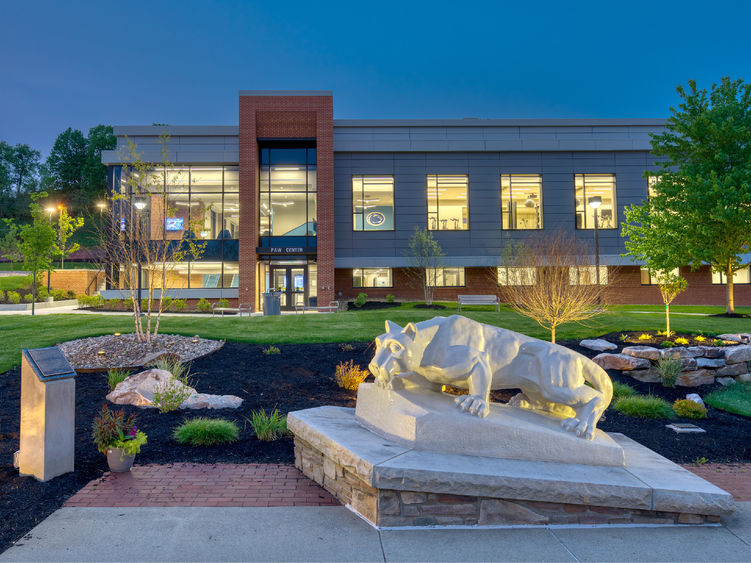
Penn State’s Board of Trustees has scheduled a public meeting to decide on a proposal to close seven of the university’s Commonwealth Campuses.
The board will meet at 5 p.m. on Thursday, May 22. The meeting will be livestreamed, with the link and agenda information to be posted at trustees.psu.edu/thursday-may-22-2025/.
Trustees met in executive session on Thursday morning to discuss the recommendation from university administrators to close the DuBois, Fayette, Mont Alto, New Kensington, Shenango, Wilkes-Barre and York campuses. The board had tentatively scheduled a public meeting to follow, but after convening behind closed doors last week to discuss the issue, trustees decided they needed more time to ask questions in private before bringing the measure to a vote, a Penn State spokesperson said earlier this week.
Penn State publicly released its report on the recommendations for the future of the Commonwealth Campus system on Tuesday night after a series of leaks to the media. The Philadelphia Inquirer identified the seven campuses on Monday, citing sources close to the board, and on Tuesday afternoon Spotlight PA’s State College Bureau reported on the entire document analyzing each of 12 campuses with recommendations for their future that was first shared with the board by President Neeli Bendapudi in late April.
“I am truly sorry that our community is learning of the recommendation through media coverage, rather than hearing about it with additional context directly from me or the board,” Bendapudi said in a statement. “I understand the concern this will cause on our campuses until the decision is finalized — during an already distressing time for those who may be affected.”
The seven campuses recommended for closure were among 12 that Bendapudi said in February were under consideration. The other five — Beaver, Greater Allegheny, Hazleton, Schuylkill and Scranton — are “recommended to remain open and receive focused investment to support their long-term success,” according to the 143-page document prepared by a workgroup tasked with analyzing the campuses and preparing the recommendation report.
Penn State’s seven largest campuses and the graduate studies focused Great Valley campus were not under consideration for closure.
The campuses proposed for closure “face overlapping challenges, including enrollment and financial decline, low housing occupancy and significant maintenance backlog,” according to the report.
“The projected low enrollments pose challenges for creating the kind of robust on-campus student experience that is consistent with the Penn State brand,” the workgroup wrote. “Keeping them open would require an estimated $19 million in annual financial support, $21 million in annual overhead expense, and more than $200 million in future facilities investment—resources that could be redirected to enhance and strengthen the campuses that remain.”
Penn State administrators say the university allocated $327 million to the 12 campuses over a 10-year period and for nearly three years “has explored many ways to stabilize and strengthen the Commonwealth Campus ecosystem, but despite these efforts, it has become evident that the University cannot sustain a viable Commonwealth Campus ecosystem without closing some campuses.”
Campus closures would not occur until after the conclusion of the 2026-27 academic year. Penn State will admit new and transfer students to those campuses for the fall 2025 semester, but not beyond and “every student who begins a degree at a closing campus will have the opportunity to complete their degree at Penn State,” according to a university news release. Students at those campuses will “receive personalized guidance and advising” to ensure they understand their options.
The university also says it will will honor tenure and non-tenure-line contracts. Tenure-line faculty will be offered “need-driven reassignments to remaining campuses,” and non-tenure-line and staff employees will be given “priority hiring consideration” if they apply for open roles across the university.
“The Board of Trustees charged President Bendapudi and her team two years ago with conducting an analysis of the Commonwealth Campus ecosystem and the evolving needs of the commonwealth,” said Board of Trustees Chair David Kleppinger. “The result is a robust, data-informed review of the Commonwealth Campus ecosystem, enrollment trends, demographic projections, financial performance, and other factors.”
U.S. Rep. Glenn Thompson, R-Howard Township, on Wednesday called on the university to spare the one campus proposed for closure in his 15th congressional district: Penn State DuBois in Clearfield County.
“The ivory tower of academia in State College has grown so high that Penn State has lost sight of its mission: to educate all residents of the commonwealth,” Thompson said in a statement. “For nearly 100 years, Penn State DuBois has been an anchor in our community.”
Located 52 miles from University Park, DuBois is the closest to Penn State’s flagship campus among any of the locations proposed for closure. Seven other educational institutions, including Penn State Altoona, are within 50 miles of the DuBois campus.
It enrolls 385 students, having experienced an enrollment decline of 32% in the last five years and 37% in the last 10, and operated at a $4 million deficit last year. The recommendation cited the campus’ “sustained and substantial enrollment decline” as chief among its “persistent and compounding structural challenges.”
DuBois, the report says, has aligned programming and partnerships with regional workforce needs, but its academic portfolio remains “narrow” and in most cases difficult to scale. It is also a small campus with no residential housing, “struggles to maintain the breadth of services and experiences expected of a Penn State education,” and would require “disproportionate
central support” to continue operating.
Thompson, though, urged the university to seek out ways to continue the campus.
“Penn State should work with local employers to identify affordable programming that will lead to workforce opportunities for Pennsylvania’s residents, rather than chasing out-of-state and overseas tuition dollars,” he said. “I urge the Board of Trustees to reevaluate this proposal and understand the devastating economic and social consequences that closing Penn State DuBois could have on the region and the Commonwealth’s greater workforce needs.”
More Latest Penn State News
View all Latest Penn State News
Penn State Liberal Arts Building Reopens Following Damage From ‘Structural Issue’
A Penn State building has reopened after being closed for seven months because of what the university termed a “localized structural issue.” The Susan Welch Liberal Arts Building, 137 Fischer […]

Centre Region COG Approves Growth Boundary Expansion for Penn State ARL Campus at Innovation Park
The Centre Region Council of Government General Forum on Monday approved a measure that will allow Penn State to pursue long-term plans for a unified campus for its Applied Research […]
State Games of America to Bring Thousands of Athletes to Centre County
Centre County will welcome more than 8,000 athletes from across the country starting this week for an Olympics-style multi-sport festival. The State Games of America will be held Friday, July […]


