
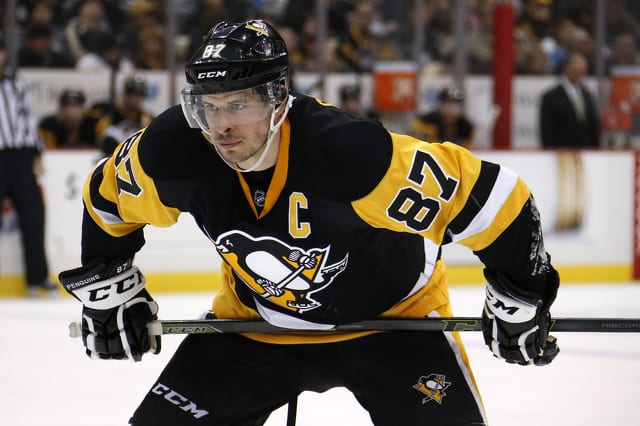
PITTSBURGH — When the clock ran down on April 23, as the Pittsburgh Penguins made quick work of the New York Rangers in five games, an energy was felt around the team that hadn’t been there for a number of years. Another weight was off of the veterans’ collective backs as they won a playoff series for the first time in two years, and they beat their nemesis in Henrik Lundqvist and the Rangers.
So much has changed in just a year’s time. Mike Sullivan came into the mix part way through this season. Every single line that took the ice against the Rangers has some new wrinkle to it that differs from the previous year.
Conor Sheary, an undrafted rookie, has found a home alongside Sidney Crosby. Eric Fehr, a free agent signing in the offseason, is playing alongside Evgeni Malkin. The Penguins third line consists of Carl Hagelin, Phil Kessel and Nick Bonino, while a fourth line sees Bryan Rust, Matt Cullen and Tom Kuhnhackl: All six of those players were new to the team for this postseason.
Give credit where it is due. Jim Rutherford recognized his team needed a change — a big change. He started with trading for Phil Kessel in the offseason, and he hasn’t looked back since. In total, 11 of the team’s 19 players that saw ice time on April 23 were not in Pittsburgh last April.
Hagelin was on the Rangers team that eliminated the Penguins last year, and he scored the game-winning goal for his club. He is now bringing that same tenacity and speed for the Pittsburgh Penguins.
Kessel has come up huge for this team in the playoffs.
Trevor Daley, acquired in a trade for Rob Scuderi midseason, has been a big contributor on the back end for the Penguins. He led the team in shots in the April 23 match up, and set up Rust’s first goal on a beautiful fake shot-pass from the slot. That ability to get pucks to the net was missing last year.
A lot of credit should be given to various people for the Penguins turnaround. It became abundantly clear this series, however, that a big reason the Penguins are advancing to the second round to play the Washington Capitals is the infusion of youth from the Wilkes-Barre club.
No one could have expected Sheary, Rust, Kuhnhackl and Matt Murray to be playing the way they are. Sheary has found a place in the top six. He was able to contribute two goals and an assist in his first bit of playoff action. He is also able to disrupt a team’s breakout with his speed and forecheck in the offensive zone.
Rust and Kuhnhackl flank Cullen to make up one of the best fourth lines in hockey.
Rust was the first star of the game, as he chipped in two goals and an assist. He, like Sheary, is able to create chances with his speed and ability to pressure a team’s defense.
Kuhnhackl contributed a goal and two assists during the series. His goal was a shorthanded goal in game 1, and he has also logged valuable minutes on the team’s penalty kill that went 89.47 percent for the series.
Murray has been nothing short of fantastic this postseason. After missing the first two games due to injury, he has gone on to win his first three starts of his postseason career. Over those three games, he has put up some good numbers. His goals against average is a miniscule 1.33, and his save percentage is .955. It is good enough to put him at fourth in both categories when compared to his peers this postseason.
Maybe more importantly, he has shown the ability to bounce back quickly and display a mental toughness rarely seen in rookie goaltenders. After giving up the first goal a little over a minute into the first period on April 23, he went on to stop 38 of 41 shots and gave his team a chance to comeback.
It is hard to really pinpoint one reason these youngsters are having so much success, but Sheary thinks speed and a familiarity with Sullivan have certainly helped. “(Speed) is a big part of my game in any series or any game,” Sheary said. “I think I try to use it as much as I can to get on their defense and get behind their defense.”
He later went on to talk about how the young guys have benefited from playing under Sullivan in Wilkes-Barre before he was promoted. “It is a big part of it. The coach has trust in you and you kind of know the coach’s system. It’s easier to play it.”
Sullivan echoed Sheary’s sentiments and also spoke about the advantage he had as a coach of knowing these players and knowing how to utilize them so they could be successful in the NHL. Unsurprisingly, he loves where his team is at heading into round two.
“We have established a chemistry amongst the group between a veteran group of guys that have established themselves as NHL players, and then these young guys that have come up and fit into this team.” Sullivan went on to say that “right now, we really like the chemistry that we have.”
For the first time in a long time, the Pittsburgh Penguins are getting healthy and getting hot at the right time of year. A season that started with such uncertainty and mediocrity is lending itself to one of the most promising and exciting postseasons in recent memory.
The Penguins’ next test will be the President Trophy winners from the regular season, the Washington Capitals. They will need all the firepower and quality goaltending that were on display this series to defeat the league’s best regular season team. Expect youth and speed to be a factor once again.
More Sports
View all Sports
Paterno: A New Season, 60 Years Later
In just over a week, Penn State will take the football field with a new head football coach when Matt Campbell starts his first season on the Nittany Lion sideline. […]
Big Ten, SEC Add Long-Missing Support to College Sports Bill and Revive Its Chances in the Senate
The Big Ten and Southeastern Conferences agreed Friday night to support a Senate bill that seeks to regulate college sports, ending a breakneck week of negotiations and pulling the bipartisan […]
Big Ten: No League Championship Game if College Football Moves to a 24-Team Playoff
The Big Ten Conference would do away with its championship game if college football adopts a 24-team playoff.


