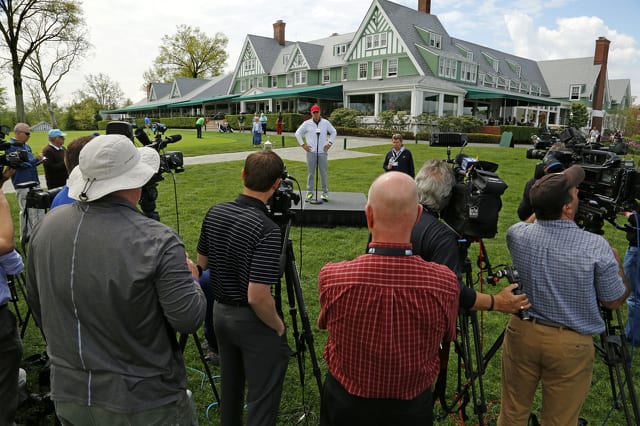
OAKMONT — Prior to the start of the 116th U. S. Open Tournament, the returning champion holds a press conference at the site of the current year’s event. Making the trip from Texas to southwest Pennsylvania’s Oakmont Country Club recently was 2015 winner Jordan Spieth. The 22-year-old champ provided those who cover golf with a question-and-answer media event.
In preparation for the tournament, Spieth also managed to play 27 holes on the fabled course for the first time.
The 116th U. S. Open will be held Monday, June 13, through Sunday, June 19. A limited number of tickets are still available.
Media: After playing 27 holes on the Oakmont course, what are your thoughts and impressions?
Spieth: Yeah, it’s lived up to and passed the hype it already receives from everybody. What a great test of golf and a very tough but fair test of golf. You can already tell. We had a great experience, played 27 holes. We played the back nine yesterday evening and 18 holes this morning. So, had a lot of fun with it and it’s going to be a great U.S. Open this year, I think.
Media: Unable to use your normal caddie and friend, Michael Greller, you relied on the wisdom of Oakmont caddie Danny Pursehouse. What did you learn from his input?
Spieth: Yeah, I had Danny, who caddies out here and has for a little while, and was very helpful. Same with Jim (Biehl, Oakmont club member), who hosted us. They were both very helpful in pointing out, you know, different slopes on the greens, different — kind of keep your eye out for short sided shots and how a lot of these greens, quite a few of them, pitch front to back, which is unusual, I would say, for golf courses now, and it forces you to really put the ball in the fairway.
I learned a lot. I learned a lot off of just playing a round and a half here. I have different impressions from what I already knew. These bunkers here may as well be bunkers in the U.K. They may as well be pot bunkers. You just kind of have to hit sideways out of them for the most part. So, they are very much hazards and you really don’t need a lot of drivers. I don’t think either of those points were of importance until playing it.
Media: Last year at Chambers Bay in Washington, there were a lot of risk-reward par 4s and this year you had 17, a par-4 313 yards. You played it twice; it could be the ultimate in risk/reward. What’s your early impression of No. 17, especially as it would play as the 71st hole of the championship?
Spieth: I think what makes it is the way the green is sloped. You’ve got part of the green that pitches left to right on the front, you’ve got part of it that pitches right to left on the back. And, the reason that makes a difference is with the speed and the firmness of the greens during the U.S. Open, if you’re on the wrong side of that, it turns — and you go for it, you may miss it by 10 feet, but all of a sudden you’re really struggling to try and make par.
I think that if you hit the right shot, you hit a 3-wood or driver off the tee and you hit it on the right line and you pull off the shot, you’re going to have a good look at birdie. It’s one of the great par 4s, one of the great short par 4s in the world. It’s tough for me to tell, so it seems like it will play that way.
It was a great par 4 when we played it (during the practice round). It was soft and the rough wasn’t up as high as it will be on the left side. But you could tell, it’s going to be dicey trying to make decisions there, depending on where you are and where you stand.
Media: Oakmont Country Club is noted for its bunkers, especially on No. 3 — the fabled church pews — as well as No. 5 and No. 15. So, what stood out to you that were so different than maybe any idea you had?
Spieth: The bunkers are hazards out here; not just the church pews, all of them. The church pews actually potentially could play as easier ones compared to some of the others depending on where you go on them. But it’s mainly just a chunked sand wedge out, and play the hole in with a stroke penalty.
Media: Other than the respect for the numerous bunkers on the Oakmont C.C. course, the lack of trees since the open was last held in 2007 is also a topic of discussion.
Spieth: I think they talk about how many trees have been taken out since, what, 1970, within the last, I think, 20 years; it’s been something like 5,000 taken out, or more. It throws off your depth.
It’s very difficult to understand, you get to a couple tee boxes, and you think you can hit driver. All of the sudden, your ball has landed. You think it’s on the right side of the fairway, but it’s flown either 25 yards farther or 25 yards shorter than you thought. That’s something that is nice having now played the golf course and understanding, not only going off the yardage book, but also visually gaining knowledge. It’s like playing in the U. K.
It will be interesting to see the firmness of the fairways. I think that if the fairways firm up a little but not too much and the greens are really firm, it will be a fantastic U.S. Open. If the fairways get too firm, it could potentially be scary and could be almost too challenging to hold them in certain cases. But the USGA does a great job of walking that line between, you know, finding even to a couple under without not being rewarded for hitting good shots. And certainly at Oakmont, they know what they are doing here.
Media: Do you have any recollection of the last U. S. Open here at Oakmont? And what would it mean to join the list of great champions here that includes Ben Hogan and Jack Nicklaus, among others?
Spieth: I remember watching Angel (Cabrera) just put on a clinic ball striking. He can do that. I’ve played with Angel, actually in a U. S. Open. I played with him at The Olympic Club for three rounds. I remember a little of it. I don’t remember a whole lot, honestly. But yeah, the history here, when you walk in and see the front half of the U. S. Open trophies in there and who has won it, Hogan and Nicklaus, and Gene Sarazen going back. Angel obviously won a Masters, as well.
This is a golf course that I was telling Danny (Pursehouse) as we were walking in, he asked my impressions of it. I said the best player would come out on top this week. You will have no crazy circumstance or bounces or this or that. You have to golf your ball around this place, and the person who is in full control of their entire game will win this U.S. Open.
Media: Please reiterate how you got over the Masters experience to get ready for another major tournament.
Spieth: It was 80 percent, 75 percent, you have to do it yourself; and then 25 percent relying on my team, family and friends. And then mentors, messages I get from mentors, pretty much saying, hey, you’ve been in contention six out of the last eight majors, won a couple of them. Something like that; the wrong miss at the wrong time is bound to happen at some point, whether you still win that major or not.
I had the same exact miss at the U.S. Open last year. On 17 I made double bogey and kind of squeaked it out at the end, but that was potentially the same kind of experience as the Masters. You’re going to be on the good end and bad end.
If you’re in it enough, you’re going to be on the good end and bad end of those situations, so keep putting ourselves in contention, and when we’re on the good end again, I’ll be able to enjoy it even more having experienced the other side of it.