
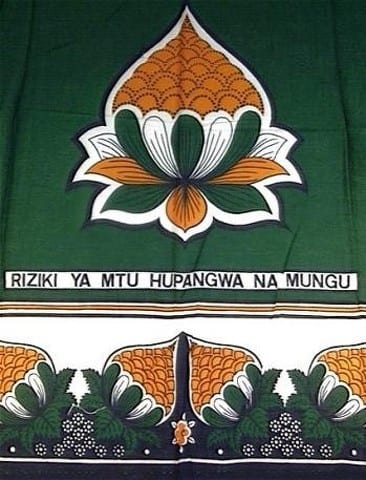
BELLEFONTE — ‘Kanga’ is the name used to refer to a colorful garment worn by women, and in rare instances by men, in the countries of East Africa. Beginning Friday, March 2, an exhibit featuring these garments will be on display at the Bellefonte Art Museum, 133 N. Allegheny St., Bellefonte.
Kangas are a pair of matching rectangular cloths about 1 meter long created in bold designs and bright colors with a matching border around the edges. One piece is used as a sarong covering from the waist to below the knee and the other is used for a matching blouse, wrap or head scarf. They are worn for both ordinary and ceremonial dress, with messages printed on the fabric. These messages may be proverbs, sayings, wishes, announcements, commemorations or religious verses. The messages concern country, culture, politics, agriculture, science, family, religion and special celebrations.
Kangas are worn by women along the whole of the East African coast, especially in Tanzania, Kenya and Zanzibar. Where and when they originated is debated, but early records show women in Tanzania and Zanzibar started wearing these fabrics as wraps in the mid-19th century. It seems the development of the kanga style was a reaction to the clothing worn by missionaries, which seemed cumbersome and inappropriate for tropical climates.
Kanga cloths are culturally significant and often given as a gift for birthdays or special occasions and often are handed down to younger members of the family. Since the words and messages printed on kangas have cultural significance, they may be passed on to reinforce popular or sacred beliefs. People connect by wearing kangas with the same or similar messages. This contributes to social unity and may constitute a group supporting a person or a cause.
‘Kanga’ comes from the Swahili name for guinea fowl, because the early patterns used for the fabrics resembled the bird’s plumage. Today, the motifs have evolved to provide an endless variety of designs in many colors, but the name continues to be used to refer to the wearable cloths.
The museum’s show includes a private collection of kangas. Intrigued by the colorful designs and messages, Pat House collected these garments in Tanzania, Kenya and Zanzibar over a period of 30 years.
“I was attracted to the beautiful patterns and colors and I was impressed with the idea of delivering a serious message through apparel,” said House. “Although this is not unusual today, these ladies demonstrated a desire to share and publicize their beliefs before it was popular on the other continents. The kanga was one way to give East African women a voice.”
This exhibition is supported in part by the Pennsylvania Council on the Arts, a state agency funded by the Commonwealth of Pennsylvania, and the National Endowment for the Arts, a federal agency.
More Arts & Entertainment
View all Arts & Entertainment
‘Rock the ’80s’ Benefit Concert Set to Return to State Theatre
2023's "Rock the '80s" concert will mark the annual fundraiser's first in-person event since 2019.

Your Vote Could Help Bring a Free Outdoor Concert Series to State College
You can vote by visiting levitt.org/vote or by texting 866-267-2023 and using the keyword "STATECOLLEGE".

Happy Valley Cornhole tourney returns
STATE COLLEGE — The second Happy Valley Cornhole Tournament will take place on Sunday, April 5 at the American Legion’s Post 245 location at 1950 Pine Hall Road in […]


