
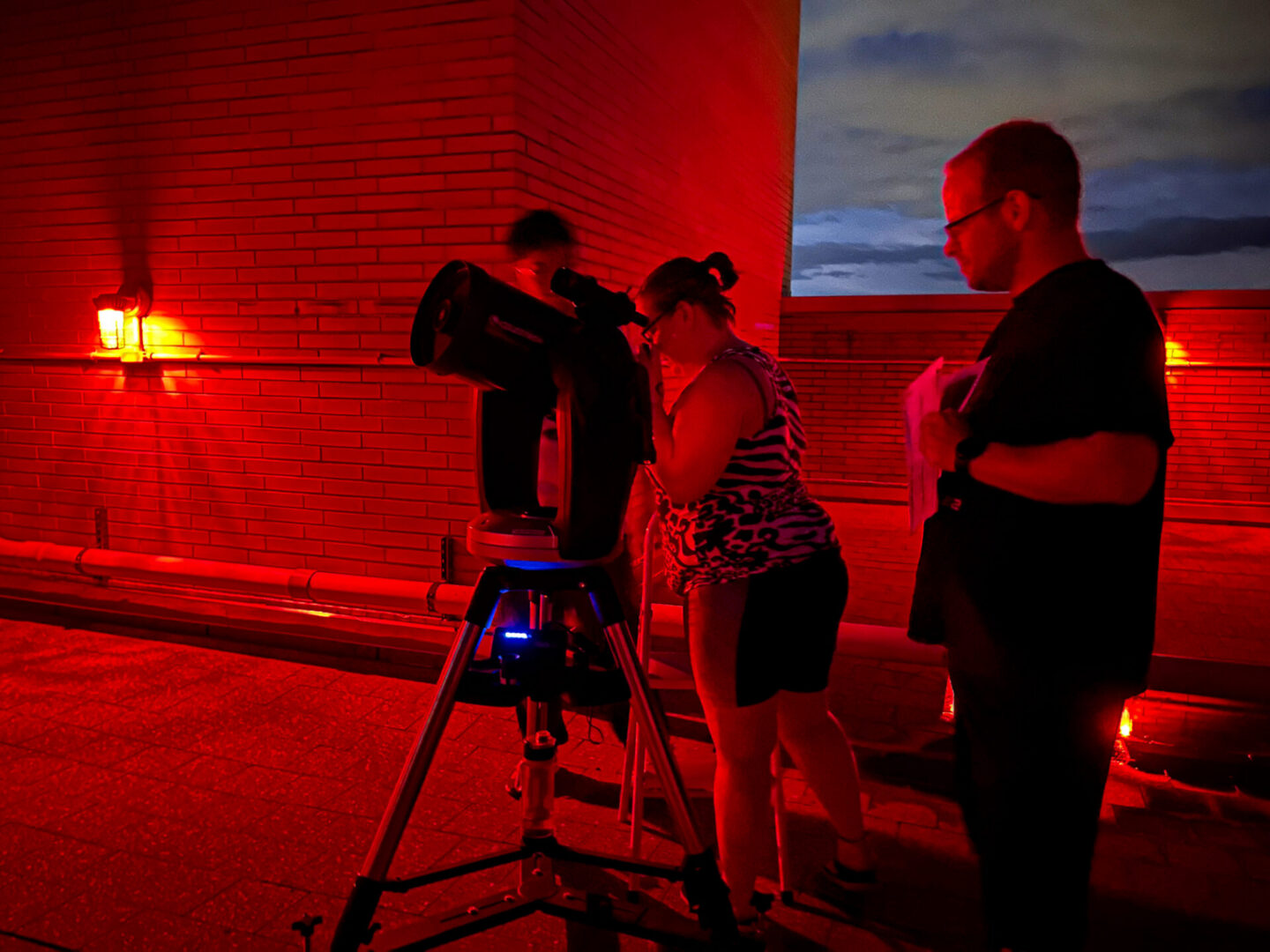
The Penn State Eberly College of Science’s popular AstroFest returns for four nights of free astronomy activities and stargazing this week during the Central Pennsylvania Festival of the Arts.
The college’s Department of Astronomy and Astrophysics will welcome visitors to Davey Laboratory on Pollock Road from 8:30 to 11:30 p.m. each night from Wednesday, July 8, through Saturday, July 11, for fun, educational activities.
Events at the 27th annual AstroFest will be held rain or shine in classrooms and in the planetarium on the fifth floor of Davey Lab, where on clear nights visitors will be able to use rooftop observatory telescopes to get a closer look at the stars. On the way in, visitors can pick up an AstroFest program, which can be stamped at activities and returned for science-themed prizes.
Activities for kids will be offered during the first half of the night, and the program will bring back fan favorites, such as the Oobleck kiddie pool, water rockets and space arts and crafts, as well as introduce new, timely activities and information about ongoing research.
“AstroFest is for all ages and interest levels, and one of the things we enjoy each year is sharing both entry-level activities to spark an interest in space as well as timely space research with our community,” Chris Palma, teaching professor of astronomy and astrophysics, said in a release. “We’re helping to address fundamental questions about the universe while also leading some of today’s key advancements in space-related innovation and instrumentation, and AstroFest gives us the opportunity to share this exciting work with our neighbors and friends.”
Among recent advancements, NASA’s Swiftly mission launched July 3 with mission operations run out of the Eberly College of Science. The college is a key partner in NASA’s first mission of its kind to boost its “rapid-response” space telescope back into orbit so the Neil Gehrels Swift Observatory can continue to collect valuable data.
Eberly researchers helped build the observatory 22 years ago and have run mission operations from State College since then, as Swift has detected more than 1,760 gamma-ray bursts in its history along with many other phenomena.
Penn State astronomers also provide scientific and leadership support for the NSF–DOE Vera C. Rubin Observatory in Chile, which in June launched the Legacy Survey of Space and Time. The 10-year international collaboration will create the most comprehensive, cinematic record of the universe in history through an ultra-wide, ultra-high-definition time lapse using a 3,200-megapixel camera — the largest digital camera in the world — that is now capturing a new, detailed image approximately every 40 seconds.
Some of the newest research will be among a wide range of presentations and programs will be offered by experts from the university, which in June was ranked No. 13 in the nation for space science research by U.S. News & World Report for the second year in a row.
Wednesday, July 8
Room 538
- 8:30–9:00 p.m. “The Story of Stars Through Cosmic Time” S. Jean Feeser
- 9:00–9:30 p.m. “Planets, Planets, Everywhere!” Eric Feigelson
- 9:30–10:00 p.m. “Up, Up, Up To Low Orbit: How and Why NASA Is Swiftly Boosting Swift” Michael Siegel
- 10:00–10:30 p.m. “Star-eating black holes: The monsters lurking at the center of galaxies (about tidal disruption events and how they are found by surveys like Rubin)” Charlotte Ward
- 10:30–11:00 p.m. “Outrageous Theories of Astronomy.” Tristan Weaver
- 11:00–11:30 p.m. “Hoth in Star Wars and Snowball Earth” Darren William
Room 541
- 9:00–9:30 p.m. “Star-eating black holes: The monsters lurking at the center of galaxies (about tidal disruption events and how they are found by surveys like Rubin)”
- 9:30–10:00 p.m. “The Long-Awaited 2029 Apophis Encounter with Earth” Darren Williams
- 10:00–10:30 p.m. “Time Travel: As Good as it Gets?” Derek Fox
- 10:30–11:00 p.m. “Up, Up, Up To Low Orbit: How and Why NASA Is Swiftly Boosting Swift” Michael Siegel
- 11:00–11:30 p.m. “Time Travel: As Good as it Gets?” Derek Fox
Thursday, July 9
Room 538
- 8:30–9:00 p.m. “Where Anthropology meets Astronomy” Annette Mercedes
- 9:00–9:30 p.m. “Peering Deep with the James Webb Space Telescope” Kevin Luhman
- 9:30–10:00 p.m. “Hoth in Star Wars and Snowball Earth” Darren William
- 10:00–10:30 p.m. “Peering Deep with the James Webb Space Telescope” Kevin Luhman
- 10:30–11:00 p.m. “Star-eating black holes: The monsters lurking at the center of galaxies (about tidal disruption events and how they are found by surveys like Rubin)”
- 11:00–11:30 p.m. “A Traveler’s Guide to Black Holes” Mary Ogborn
Room 541
- 9:00–9:30 p.m. “A Traveler’s Guide to Black Holes” Mary Ogborn
- 9:30–10:00 p.m. “Star-eating black holes: The monsters lurking at the center of galaxies (about tidal disruption events and how they are found by surveys like Rubin)”
- 10:00–10:30 p.m. “Astronomy and Art” Nahks Tr’Ehnl
- 10:30–11:00 p.m. “The Long-Awaited 2029 Apophis Encounter with Earth” Darren Williams
- 11:00–11:30 p.m. “Astronomy and Art” Nahks Tr’Ehnl
Friday, July 10
Room 538
- 8:30–9:00 p.m. “Planets, Planets, Everywhere!” Eric Feigelson
- 9:00–9:30 p.m. “The Story of Stars Through Cosmic Time” S. Jean Feeser
- 9:30–10:00 p.m. “Peering Deep with the James Webb Space Telescope” Kevin Luhman
- 10:00–10:30 p.m. “Up, Up, Up To Low Orbit: How and Why NASA Is Swiftly Boosting Swift” Michael Siegel
- 10:30–11:00 p.m. “Peering Deep with the James Webb Space Telescope” Kevin Luhman
- 11:00–11:30 p.m. “Artemis” Nate Hamme
Room 541
- 9:00–9:30 p.m. “Up, Up, Up To Low Orbit: How and Why NASA Is Swiftly Boosting Swift” Michael Siegel
- 9:30–10:00 p.m. “Galactic Trainwrecks” Michael Eracleous
- 10:00–10:30 p.m. “Planets, Planets, Everywhere!” Eric Feigelson
- 10:30–11:00 p.m. “Galactic Trainwrecks” Michael Eracleous
- 11:00–11:30 p.m. “The Story of Stars Through Cosmic Time” S. Jean Feeser
Saturday, July 11
Room 538
- 8:30–9:00 p.m.”The Long-Awaited 2029 Apophis Encounter with Earth” Darren Williams
- 9:00–9:30 p.m. “Galactic Trainwrecks” Michael Eracleous
- 9:30–10:00 p.m. “Artemis” Nate Hamme
- 10:00–10:30 p.m. “Outrageous Theories of Astronomy” Tristan Weaver
- 10:30–11:00 p.m. “Where Anthropology meets Astronomy” Annette Mercedes
- 11:00–11:30 p.m. “A Traveler’s Guide to Black Holes” Mary Ogborn
Room 541
- 9:00–9:30 p.m. “A Traveler’s Guide to Black Holes” Mary Ogborn
- 9:30–10:00 p.m. “Astronomy and Art” Nahks Tr’Ehnl
- 10:00–10:30 p.m. “Galactic Trainwrecks” Michael Eracleous
- 10:30–11:00 p.m. “Artemis” Nate Hamme
- 11:00–11:30 p.m. “Outrageous Theories of Astronomy” Tristan Weaver
More Local News
View all Local News
Centre County Issues Disaster Emergency Declaration After Severe Storms Cause Flooding, Damage
Centre County’s Board of Commissioners on Thursday issued a declaration of disaster emergency after severe storms overnight caused significant flooding and damage to property. Torrential rain that started Wednesday night […]
Heading to Penn State Football’s Season Opener? What to Know About Road Work, Traffic
Penn State football will kick off the Matt Campbell era at 3:30 p.m. on Saturday, and fans traveling to the game from outside of State College are likely to encounter […]
Sandusky Files to Cancel Evidentiary Hearing, Plans to Pursue Federal Appeal
Jerry Sandusky has filed to cancel an upcoming hearing where one of his accusers was expected to recant his allegations of sexual abuse and instead reportedly will pursue his appeal […]


